My Cart
Your Cart 0

    Your cart is empty.

  • Total (Amount) ₹0.00
NCERT Exemplar · Class 12 · Maths

Chapter 11: Three Dimensional Geometry

Practice each question, then open the answer or worked solution.

Questions

24 questions
Q11Written answer

Find the equations of the two lines through the origin which intersect the line
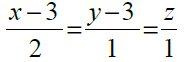
NCERT Exemplar Solutions Class 12 Mathematics Chapter 11 - 15at angles of π/3 each.

Show solutionHide solution
Worked solution

Any point in the given line is

x – 3/ 2 = y – 3/1 = z/1 = λ

x = 2λ + 3, y = λ + 3 and z = λ

Let it be the coordinates of P

So, the direction ratios of OP are (2λ + 3 – 0), (λ + 3 – 0) and (λ – 0) ⇒ 2λ + 3, λ + 3, λ

But the direction ratios of the line PQ are 2, 1, 1

Now, we know that
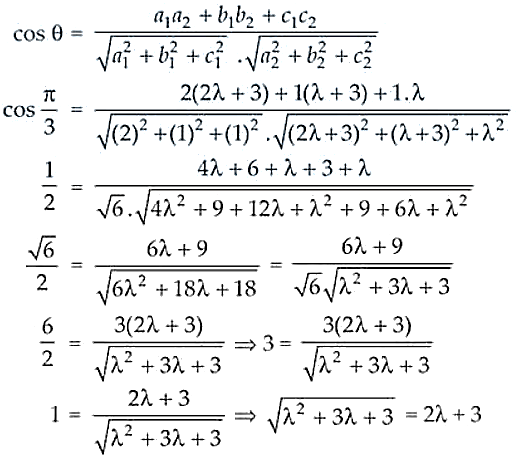
NCERT Exemplar Solutions Class 12 Mathematics Chapter 11 - 16

λ2 + 3λ + 3 = 4λ2 + 9 + 12λ (On squaring on both sides)

3λ2 + 9λ + 6 = 0

λ2 + 3λ + 2 = 0

(λ + 1)( λ + 2) = 0

λ = -1, -2

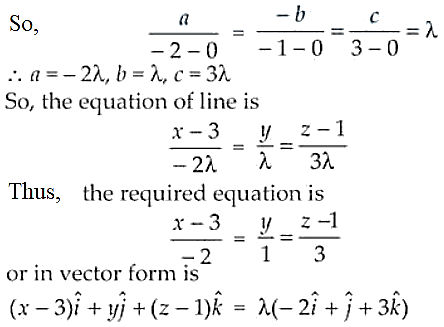
So, the direction are:

Thus, the required equation of planes are

x/1 = y/2 = z/-1 and x/-1 = y/1 = z/-2
Q12Written answer

Find the angle between the lines whose direction cosines are given by the equations l + m + n = 0, l2 + m2 – n2 = 0.

Show solutionHide solution
Worked solution

Given equations are,

l + m + n = 0 ….. (i)

l2 + m2 – n2 = 0 …. (ii)

From equation (i), we have n = – (l + m)

Putting the value of n is equation (ii), we get

l2 + m2 + [-(l + m)]2 = 0

l2 + m2 – l2 – m2 – 2lm = 0

-2lm = 0

lm = 0 ⇒ (- m – n)m = 0 [Since, l = – m – n]

(m + n)m = 0 ⇒ m = 0 or m = -n

⇒ l = 0 or l = -n

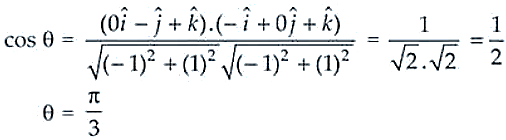
Now, the direction cosines of the two lines are

0, -n, n and -n, 0, n ⇒ 0, -1, 1 and -1, 0, 1

NCERT Exemplar Solutions Class 12 Mathematics Chapter 11 - 17

Thus, the required angle π/3.

Q13Written answer

If a variable line in two adjacent positions has direction cosines l, m, n and l + dl, m + dm, n + dn, show that the small angle dq between the two positions is given by

dq2 = dl2 + dm2 + dn2

Show solutionHide solution
Worked solution

Given that l, m, n and l + dl, m + dm, n + dn are the direction cosines of a variable line in two positions

l2 + m2 + n2 = 1 ….. (i) and

(l + dl)2 + (m + dm)2 + (n + dn)2 = 1 …. (ii)

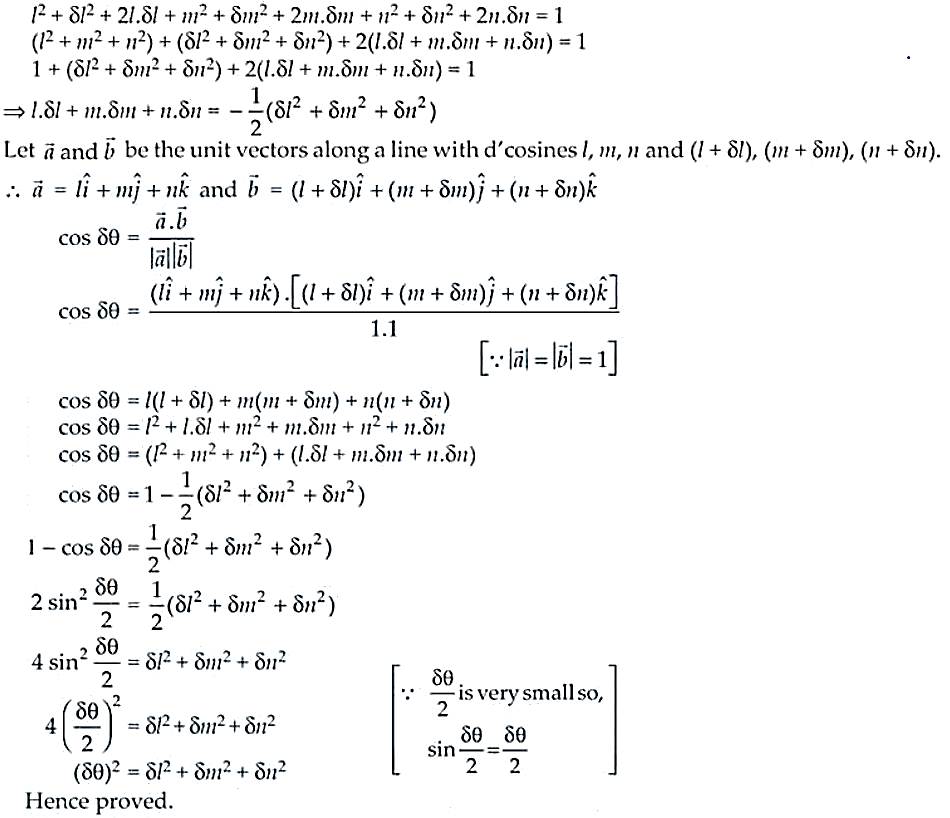
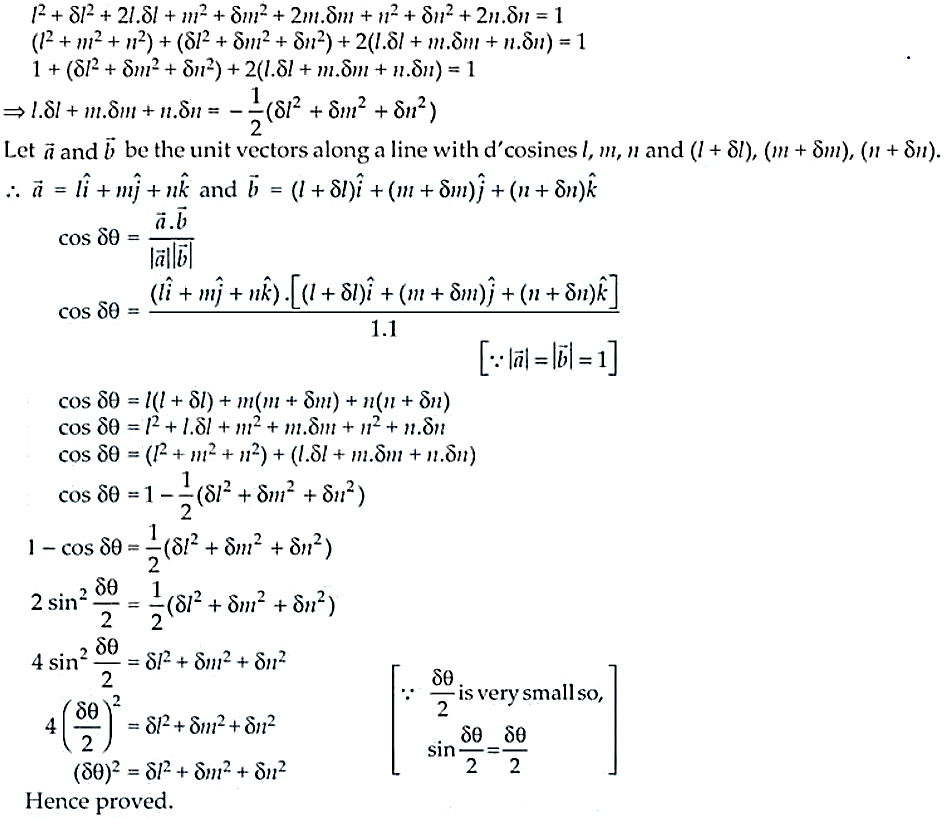
NCERT Exemplar Solutions Class 12 Mathematics Chapter 11 - 18

NCERT Exemplar Solutions Class 12 Mathematics Chapter 11 - 19

Q14Written answer

O is the origin and A is (a, b, c). Find the direction cosines of the line OA and the equation of plane through A at right angle to OA.

Show solutionHide solution
Worked solution

Given, O (0, 0, 0) and A(a, b, c)

So, the direction ratios of OA = a – 0, b – 0, c – 0 = a, b, c

And, the direction cosines of line OA

NCERT Exemplar Solutions Class 12 Mathematics Chapter 11 - 20

Now, the direction ratios of the normal to the plane are (a, b, c).

We know that, the equation of the plan passing through the point A(a, b, c) is

a(x – a) + b(y – b) + c(z – c) = 0

ax – a2 + by – b2 + cz – c2 = 0

ax + by + cz = a2 + b2 + c2

Thus, the required equation of the plane is ax + by + cz = a2 + b2 + c2

Q15Written answer

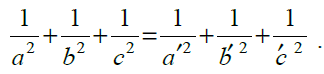
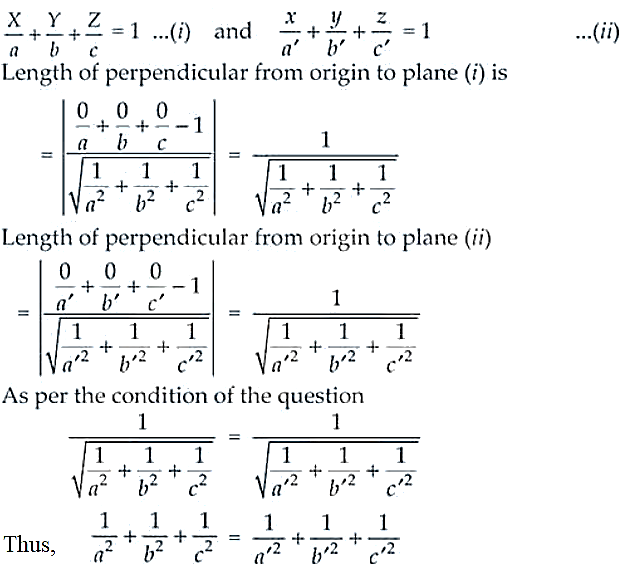
Two systems of rectangular axis have the same origin. If a plane cuts them at distances a, b, c and a¢, b¢, c¢, respectively, from the origin, prove that

NCERT Exemplar Solutions Class 12 Mathematics Chapter 11 - 21

Show solutionHide solution
Worked solution

Let’s take OX, OY, OZ and ox, oy, oz to be two rectangular systems.

And, the equations of two planes are

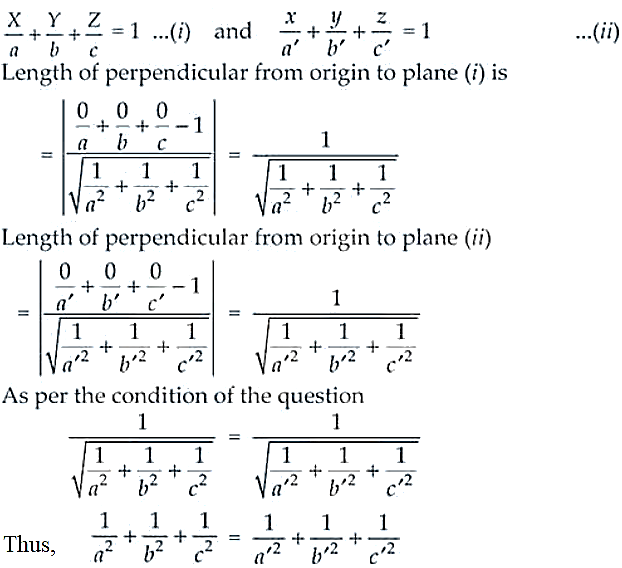
NCERT Exemplar Solutions Class 12 Mathematics Chapter 11 - 22

NCERT Exemplar Solutions Class 12 Mathematics Chapter 11 - 23

Long Answer (L.A.)

Q16Written answer

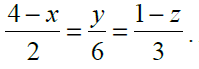
Find the foot of perpendicular from the point (2, 3, –8) to the line NCERT Exemplar Solutions Class 12 Mathematics Chapter 11 - 24
Also, find the perpendicular distance from the given point to the line.

Show solutionHide solution
Worked solution

Given,

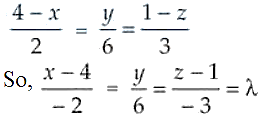
NCERT Exemplar Solutions Class 12 Mathematics Chapter 11 - 25is the equation of the line.

Now, the coordinates of any point Q on the line are

x = -2λ + 4, y = 6λ and z = -3λ + 1 and the given point is P(2, 3, -8)

The direction ratios of PQ are -2λ + 4 – 2, 6λ – 3, -3λ + 1 + 8 i.e. -2λ + 2, 6λ – 3, -3λ + 9

And the direction ratios of the given line are -2, 6, -3.

If PQ ⊥ line, then

-2(-2λ + 2) + 6(6λ – 3) – 3(-3λ + 9) = 0

4λ – 4 + 36λ – 18 + 9λ – 27 = 0

49λ – 49 = 0

λ = 1

Now, the foot of the perpendicular is -2(1) + 4, 6(1), -3(1) + 1 i.e. 2, 6, -2

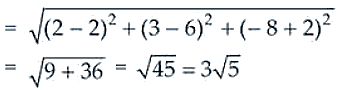
Hence, the distance PQ is

NCERT Exemplar Solutions Class 12 Mathematics Chapter 11 - 26

Thus, the required coordinates of the foot of perpendicular are 2, 6, -2 and the required distance is 3√5 units.

Q17Written answer

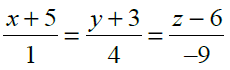
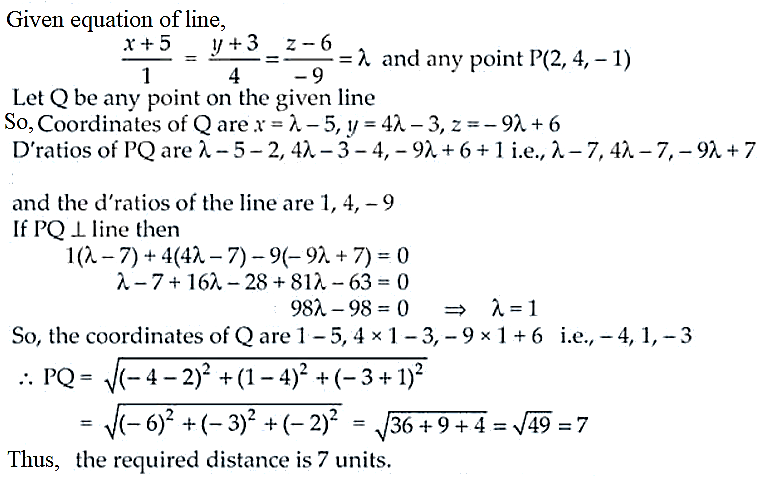
Find the distance of a point (2, 4, –1) from the line

NCERT Exemplar Solutions Class 12 Mathematics Chapter 11 - 27

Show solutionHide solution
Worked solution

NCERT Exemplar Solutions Class 12 Mathematics Chapter 11 - 28

Q18Written answer

Find the length and the foot of perpendicular from the point (1, 3/2, 2) to the plane 2x – 2y + 4z + 5 = 0.

Show solutionHide solution
Worked solution

Given plane is 2x – 2y + 4z + 5 = 0 and point (1, 3/2, 2)

The direction ratios of the normal to the plane are 2, -2, 4

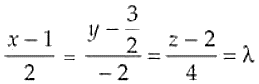
So, the equation of the line passing through (1, 3/2, 2) and direction ratios are equal to the direction ratios of the normal to the plane i.e. 2, -2, 4 is

NCERT Exemplar Solutions Class 12 Mathematics Chapter 11 - 29

Now, any point in the plane is 2λ + 1, -2λ + 3/2, 4λ + 2

Since, the point lies in the plane, then

2(2λ + 1) – 2(-2λ + 3/2) + 4(4λ + 2) + 5 = 0

4λ + 2 + 4λ – 3 + 16λ + 8 + 5 = 0

24λ + 12 = 0 λ = ½

So, the coordinates of the point in the plane are

2(-1/2) + 1, -2(-1/2) + 3/2, 4(-1/2) + 2 = 0, 5/2, 0

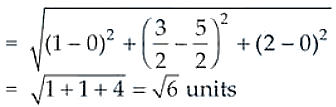
Thus, the foot of the perpendicular is (0, 5/2, 0) and the required length

NCERT Exemplar Solutions Class 12 Mathematics Chapter 11 - 30

Q19Written answer

Find the equations of the line passing through the point (3,0,1) and parallel to the planes x + 2y = 0 and 3y – z = 0.

Show solutionHide solution
Worked solution

Given point is (3, 0, 1) and the equation of planes are

x + 2y = 0 …. (i) and 3y – z = 0 …. (ii)

Equation of any line l passing through (3, 0, 1) is

l: (x – 3)/a = (y – 0)/b = (z – 1)/c

Now, the direction ratios of the normal to plane (i) and plane (ii) are (1, 2, 0) and (0, 3, 1).

As the line is parallel to both the planes, we have

1.a + 2.b + 0.c = 0 ⇒ a + 2b + 0c = 0 and

0.a + 3.b – 1.c = 0 ⇒ 0a + 3b – c = 0

NCERT Exemplar Solutions Class 12 Mathematics Chapter 11 - 31

Q20Written answer

Find the equation of the plane through the points (2, 1, –1) and (–1, 3, 4) and perpendicular to the plane x – 2y + 4z = 10.

Show solutionHide solution
Worked solution

We know that, equation of the plane passing through two points (x1, y1, z1) and (x2, y2, z2) with its normal’s direction ratios is

a(x – x1) + b(y – y1) + c(z – z1) = 0 …. (i)

Now, if the plane is passing through two points (2, 1, -1) and (-1, 3, 4) then

a(x2 -x1) + b(y2 – y1) + c(z2 – z1) = 0

a(-1 – 2) + b(3 – 1) + c(4 + 1) = 0

-3a + 2b + 5c = 0 …. (ii)

As the required plane is perpendicular to the given plane x – 2y + 4z = 10, then

1.a – 2.b + 4.c = 10 …. (iii)

On solving (ii) and (iii) we get,

NCERT Exemplar Solutions Class 12 Mathematics Chapter 11 - 32

So, a = 18λ, b = 17λ and c = 4λ

Thus, the required plane is

18λ (x – 2) + 17λ (y – 1) + 4λ (z + 1) = 0

18x – 36 + 17y – 17 + 4z + 4 = 0

⇒ 18x + 17y + 4z – 49 = 0