My Cart
Your Cart 0

    Your cart is empty.

  • Total (Amount) ₹0.00
NCERT Exemplar · Class 12 · Biology

Chapter 2: Sexual Reproduction in Flowering Plants

Practice each question, then open the answer or worked solution.

Long Answer Questions

5 questions
Q1Written answer

Starting with the zygote, draw the diagrams of the different stages of embryo development in a dicot.

Show solutionHide solution
Worked solution

Ans: In a dicot, an embryo goes through the following stages during its course of development:

1. Transverse division in the zygote cell leading to the formation of a large sized basal cell and a smaller sized apical or terminal cell.

2. The larger basal cell grows further by transverse division to form a suspensor which is a group of cells 6-10 in number. 

3. The first cell of the suspensor which lies at the micropylar end is called haustorium while the last cell of the suspensor lies at the chalazal end and is called hypophysis. This hypophysis later forms the radicle after some development.

4. In the smaller apical cell formed after the first transverse division of the zygote undergoes a vertical division to form two cells. These two cells further undergo transverse division to form four embryonal cells and lead to a quadrant stage in the embryo.

5. After some time, these four embryonal cells of quadrant stage vertically split and then a proembryo is formed which makes it an octet stage of the embryo.

6. Four cells towards the apex continue to form a plumule whereas the four cells at the base form the hypocotyl.

seo images


Q2Written answer

What are the possible types of pollinations in chasmogamous flowers? Give reasons.

Show solutionHide solution
Worked solution

Ans: Chasmogamous flowers are those flowers that open up at the time of maturation to allow exposure of pollen and stigma for facilitating cross-pollination. These are also known as open flowers and are brightly colored flowers with significant nectar and scent, usually bisexual, to attract pollinating agents like insects, birds, etc. for initiating pollination.

The types of pollinations which could be possible in such flowers are:

1. Autogamy; a specific type of self-pollination is the process of fertilization of the egg by a pollen from the anther of the same flower i.e., the pollen falls from the anther onto the stigma in the same flower and continue to produce an embryo. For this process to efficiently occur, the maturation of stigma and anther has to occur at the same time as the pollen release and reception of stigma has to be synchronized.

2. Geitonogamy; another kind of self-pollination involves fertilization of an egg from the pollen of the flower of the same plant i.e., the pollen after its release falls from the anther of its flower to the stigma of another flower but of the same plant. In this process, difference in maturation of the stigma and anther does not interfere with the process of fertilization as long as the pollen and pistil are compatible. 

3. Xenogamy; a cross-pollination technique in which the pollen grains after their release go to the stigmas of a flower of a different plant from its own i.e., the flower and plant bearing the pollen and stigma, both are different. This leads to fertilization in genetically different plants and hence is termed cross-pollination.


Q3Written answer

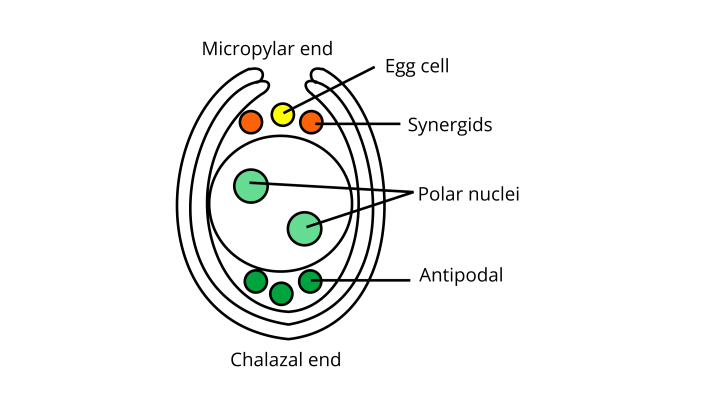
With a neat, labelled diagram, describe the parts of a mature angiosperm embryo sac. Mention the role of synergids.

Show solutionHide solution
Worked solution

Ans: An angiosperm’s mature embryo sac is a 8-nucleated and 7 celled structure constituting 3 antipodal cells, 1 central cell with two polar nuclei, 2 synergids and 1 egg nucleus. 

i. Antipodals are a group of three cells lying at the chalazal end of the female gametophyte. These three cells are haploid in nature.

ii. Polar Nuclei situated in the central portion of the embryo sac constitute a central cell. During maturation, both these cells fuse to form a binucleate or a single diploid cell. This occurs before fertilization and the cell so formed is called the secondary or definitive nucleus.

iii. Egg Apparatus, formed by three cells, is situated at the micropylar end of an embryo  sac. The egg in the central portion is called the egg nucleus which fuses with a male gamete from pollen to form zygote later on. The egg cell has a prominent nucleus and also contains a vacuole. The other two cells at its periphery are synergids and are haploid in nature. These two synergids have some cytoplasmic thickenings towards the micropylar end which is named the filiform apparatus


seo images


Importance of the synergid cells:

i. Synergids are needed for the reproduction to occur in angiosperm plants.

ii. Synergids help in the formation of pollen tubes in the pistil when pollen is compatible.

iii. Synergids nourish the embryo sac. They do so by absorbing and transporting nutrients or food from its nucleus through the filiform apparatus at the micropylar end.

iv. The filiform apparatus is a thickening of cytoplasm, a structure formed by the cell walls of synergids situated at the micropylar end. It helps in directing the entry of the pollen through a pollen tube and then release of the male gamete. 


Q4Written answer

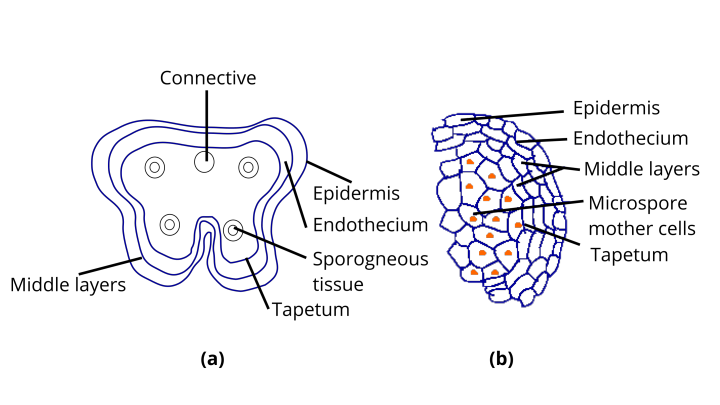
Draw the diagram of a microsporangium and label its wall layers. Write briefly on the role of the endothecium.

Show solutionHide solution
Worked solution

Ans:  A microsporangium or the anther is usually made up of four layers which are:

1. Epidermis; the outermost layer in the microsporangium is one cell layer thick and is a protective covering.

2. Endothecium; the second layer in a microsporangium, lies inner to the epidermis.

3. Middle layers; three to four layers of cells with very thin cell walls and are located just beneath the endothecium. 

4. Tapetum; the innermost layer contributing to the main nourishment of the pollen grain during its development. Tapetum cells constitute thick cytoplasm and is mutli-nuceleate i.e., the number of nuclei is more than one.

Epidermis, endothecium, and middle layers protect layers of the anther and these protect the pollen during its development. When pollen reaches maturity, the three layers (including the endothecium) rupture, thus the dehiscence of the pollen. 


seo images


Figure: (a) Transverse section of a young anther; (b) Enlarged view of one microsporangium showing wall layers

Importance of endothecium layer of a microsporangium or another: 

i. It is an important layer in regards to the anther dehiscence for pollen shedding. 

ii. Endothecium being a fibrous layer lies beneath the epidermis of the anther wall and serves as a barrier.

iii. As the cells of this layer undergo phases of maturation, the water is lost and the cells contract. This is what leads to dehiscence of the pollen sac. 


Q5Written answer

Embryo sacs of some apomictic species appear normal, but contain diploid cells. Suggest a suitable explanation for the condition.

Show solutionHide solution
Worked solution

Ans: Apomixis is a form of asexual reproduction occurring in many plants instead of sexual reproduction, which is the norm. Genetically, the offspring obtained through the process of apomixis are completely identical to the parents. 

In some plants where diploid cells are present, the cells divide to form embryos even before meiosis has occurred i.e., at the stage of megaspore mother cells(2n). These megaspore mother cells in sexual reproduction undergo reduction division to form haploid megaspores which in further divisions lead to formation of the egg cell. But in apomictic plants, this megaspore mother cell, instead of undergoing meiosis, starts dividing to form cells of the embryo sac as a diploid cell only. Therefore, the cells formed in the embryo sac and the embryo itself in these cases becomes diploid. 


Sexual Reproduction in Flowering Plants - Free PDF

Exemplars are a great way for the students to practice their knowledge about various subjects and their Chapters. With the help of NCERT Exemplar for Class 12 Biology Chapter 2 - Sexual Reproduction in Flowering Plants, a student gives themselves a choice to be good at the topic. This is one of the best ways to prepare not just for the student’s main Exams but also various competitive Exams. 


The problems or questions that the students get to solve in the NCERT Exemplar for Class 12 Biology Chapter 2 - Sexual Reproduction in Flowering Plants are the ones which are great for their practice. It is in the quality of the questions in the NCERT Exemplar that the student gets a good grasp on the subject and can even better themselves. 


In case a student does not know the solutions to all the questions that are being asked, they can simply go for solutions. Yes, the book solutions can be found online very easily at Vedantu, where there are PDFs available online for the students to take cues from. These can help them in the future to form answers to similar questions in a better way so as to gain good marks in any Exam they appear in relating to this Chapter.