My Cart
Your Cart 0

    Your cart is empty.

  • Total (Amount) ₹0.00
NCERT Exemplar · Class 12 · Biology

Chapter 2: Sexual Reproduction in Flowering Plants

Practice each question, then open the answer or worked solution.

Short Answer Questions

10 questions
Q1Written answer

List three strategies that a bisexual chasmogamous flower can evolve to prevent self-pollination (autogamy). 

Show solutionHide solution
Worked solution

Ans: The various strategies adopted for preventing autogamy are:

1. Dichogamy, i.e., maturation of stigma and anther at different times prevents autogamy or self-pollination. With different maturation periods, when the pollen matures the stigma isn’t receptive enough to receive them or vice-versa and thus, fertilization is prevented in the same plant.

2. Heterostyly i.e., the stigma and anther are placed at such distance as to prevent the pollen from reaching the stigma. 

3. Mechanical hindrance can be present to avoid the pollen from reaching the stigma of the same flower.

4. Incompatibility of the pollen i.e., the pollen may be rendered incompatible for the same flower by a chemical reaction occurring at stigma. Such pollen is blocked from forming a path to the egg through pistil.

Q2Written answer

Given below are the events that are observed in an artificial hybridization program. Arrange them in the correct sequential order in which they are followed in the hybridization program.

(a) Re-bagging (b) Selection of parents (c) Bagging (d) Dusting the pollen on stigma (e) Emasculation (f) Collection of pollen from male parents. 

Show solutionHide solution
Worked solution

Ans: The following is the sequence in which the events occur in artificial hybridization:

1. Selection of parents (b): To make hybridization easier, selection of a bisexual flower which contains both male and female structures is vital.

2. Emasculation (e): Removal of anthers before the dehiscence occurs with the help of forceps to avoid pollination is called emasculation. 

3. Bagging (c): The flower stigma is bagged, generally with a butter paper, to avoid pollination by any other pollen.

4. Collection of pollen from male parent (f): Pollens are collected and stored till they are needed from the male structure.

5. Dusting the pollen on stigma (d): After maturation of pistil is complete, the collected pollen is then dusted upon the stigma to initiate the process of fertilization.

6. Re-bagging (a): The flowers after dusting of pollen are re-bagged to ensure fertilization by the same pollen. The flowers are bagged till the fruit develops.


Q3Written answer

Vivipary automatically limits the number of offspring in a litter. How? 

Show solutionHide solution
Worked solution

Ans:  Vivipary refers to development of offspring inside the mother's womb for some time and is seen in primates. The time taken for completing embryo’s development varies in different organisms. During this period, the parent cannot get pregnant again which ensures a certain number of individuals only from one parent. 


Q4Written answer

Does self-incompatibility impose any restrictions on autogamy? Give reasons and suggest the method of pollination in such plants. 

Show solutionHide solution
Worked solution

Ans: Self-incompatibility restricts autogamy or self-pollination in quite an efficient way as the pollen even after falling on a receptive stigma cannot fertilize the egg if rendered incompatible. In these cases, the method of pollination which can be used is mixed pollination or cross pollination. 


Q5Written answer

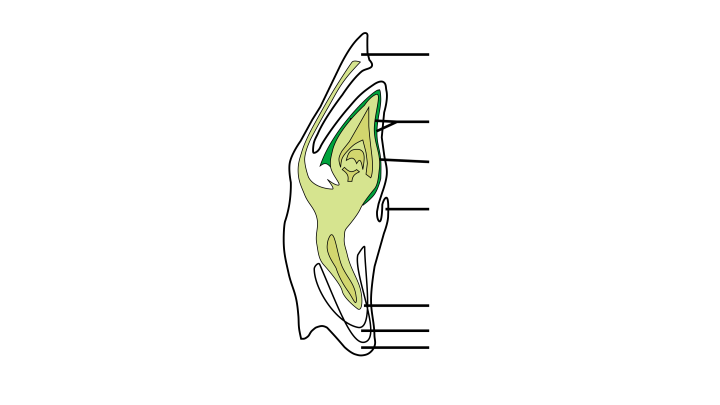
In the given diagram, write the names of parts shown with lines. 


seo images


Show solutionHide solution
Worked solution

Ans: According to alphabetical order in the given diagram;


seo images


A. Scutellum; also known as cotyledon, is the seed’s outer layer.

B. Coleoptile; protective covering enclosing the leaf primordia and apex of the shoot. 

C. Shoot apex; from where the new stems and leaves arise. 

D. Epiblast; outer sheath in an embryo which grows during the development of embryo. 

E. Radicle; from where the roots arise during germination of the plant.

F. Root cap; protective covering or cap of the root which lies at the tip of the root

G. Coleorhiza; the protective sheath enclosing the root apex for root germination. 


Q6Written answer

What is polyembryony and how can it be commercially exploited? 

Show solutionHide solution
Worked solution

Ans: Polyembryony is the process in which more than one embryo is formed in one fruit. The embryos formed arise from singly fertilized egg i.e., a single seed. A few of the nucellar cells are responsible for initiating the process of division and later, protrude in the embryo sac to form many more embryos. 

The commercial exploitation of this process is done:

1. In developing new species of fruits like mangoes and citrus.

2. In techniques like tissue culture and horticulture.

3. Producing virus-free plants with excellent strength.

4. Producing uniform seedlings which are otherwise obtained in vegetative propagation.


Q7Written answer

Are parthenocarpy and apomixis different phenomena? Discuss their benefits. Hint: Yes, they are different. Parthenocarpy leads to development of seedless fruits. Apomixis leads to embryo development. 

Show solutionHide solution
Worked solution

Ans: Parthenocarpy is the process of fruit development without making seeds i.e., fruit is formed directly without any fertilization or seed formation. Apomixis is a form of asexual reproduction, which involves production of embryo without any fertilization. The similarity in both these processes is the absence of fertilization. 

Parthenocarpy occurs in bananas, pineapple, etc. Apomictic plants are papaya, watermelon, etc.


Q8Written answer

Why does the zygote begin to divide only after the division of Primary endosperm cells (PEC)? 

Show solutionHide solution
Worked solution

Ans: The embryo sac progressively decreases the amount of nutrition provided to the growing zygote as it matures. To compensate for the depleting nutrition, the primary endosperm cells (PEC) divide. This results in the PEC dividing before the zygote grows and the PEC develops to become the endosperm and zygote becomes the embryo. 


Q9Written answer

The generative cell of a two-celled pollen divides in the pollen tube but not in a three-celled pollen. Give reasons.

Show solutionHide solution
Worked solution

Ans: Angiosperms have a peculiar trait. They shed pollen for pollination when pollen is in a two-celled stage of their life cycle. Either of these cells can be in the vegetative or generative stage. The generative cells divide into 2 male gametes inside the pollen tube 

In the rare instance when the pollen is in a three-celled stage, its because the generative cell has divided into 3 cells prior to pollination 


Q10Written answer

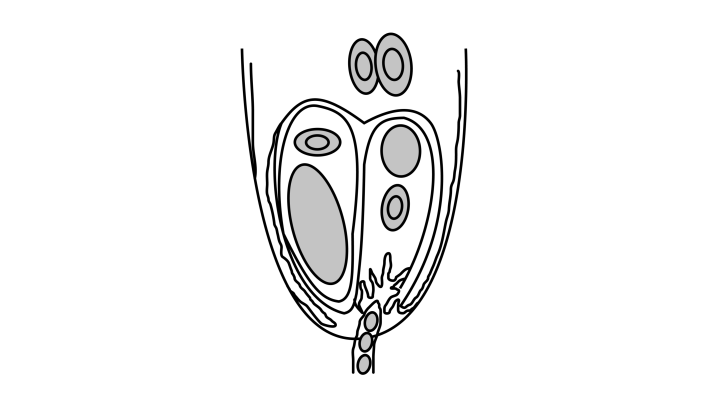
In the figure given below label the following parts: male gametes, egg cell, polar nuclei, synergid and pollen tube.


seo images


Show solutionHide solution
Worked solution

Ans: 


seo images


1. Polar nuclei are two haploid nuclei at the center of the embryo sac formed via mitosis of the megaspore.

2. The egg cell is present at the micropylar end situated between the two synergids. 

3. Synergids have special thickenings that protect the filiform apparatus that act as a guide for the pollen tube.

4. Male gametes are secreted by the pollen tube into the ovary of the female plant.  

5. Pollen tube is an extension of the pollen grain that adheres to the stigma and penetrates through the style to reach the ovules.