My Cart
Your Cart 0

    Your cart is empty.

  • Total (Amount) ₹0.00
NCERT Exemplar · Class 12 · Biology

Chapter 2: Sexual Reproduction in Flowering Plants

Practice each question, then open the answer or worked solution.

Very Short Answer Questions

18 questions
Q11Written answer

What is self-incompatibility?

Show solutionHide solution
Worked solution

Ans: Self-incompatibility is a term opposite of compatibility i.e., when the two gametes are not compatible and cannot hence, form a zygote. This mechanism is found in angiosperms to prevent in-breeding. It helps in prevention of fertilization of an egg cell by the pollen of the same flower or plant. The incompatibility is determined when the pollen falls on the stigma. It is decided via a chemical reaction occurring at the surface of stigma following which the pollen is blocked from going further inside the gynoecium. Self-incompatibility reduces inbreeding and promotes outbreeding. It is exhibited by some plants.
Q12Written answer

Name the type of pollination in self-incompatible plants.

Show solutionHide solution
Worked solution

Ans: In self-incompatible plants, the type of pollination that is seen is cross pollination. In this kind of pollination, pollen is transferred from the flower of one plant to a flower of the same or a different plant(xenogamy). Self-incompatibility ensures no fertilization in the same flower of a plant(geitonogamy). 


Q13Written answer

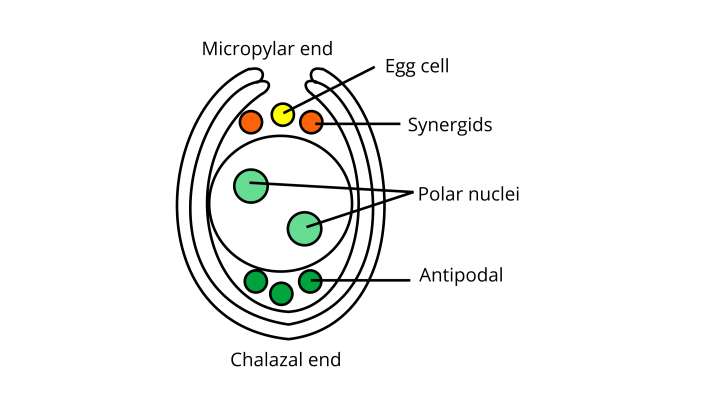
Draw the diagram of a mature embryo sac and show its 8-nucleate, 7-celled nature. Show the following parts: antipodal, synergids, egg, central cell, polar nuclei.

Show solutionHide solution
Worked solution

Ans:


seo images


A mature embryo sac contains synergids and egg at the micropylar end along with filiform apparatus formed by cytoplasm thickenings of synergids; two central polar nuclei; and three antipodal cells at the chalazal end of the embryo sac. This makes it an 8 nucleate, 7 celled apparatus.


Q14Written answer

Which is the triploid tissue in a fertilized ovule? How is the triploid condition achieved?

Show solutionHide solution
Worked solution

Ans: Primary Endosperm nucleus or PEN is the triploid tissue found in a fertilized ovule i.e., it has three sets of chromosomes. PEN is formed from the union of a male gamete (from pollen) with the two polar nuclei (present in the center of the embryo sac or female gametophyte). As these three haploid nuclei unite, a triploid endosperm is formed. 


Q15Written answer

Are pollination and fertilization necessary in apomixis? Give reasons.

Show solutionHide solution
Worked solution

Ans: Apomixis is a form of asexual reproduction which occurs without any fertilization before the development of an embryo. Hence, as there is no need for fertilization, pollination is also ruled out since the main purpose of pollination is fertilization. Therefore, no, fertilization and pollination are not necessary in formation of an embryo through apomixis.


Q16Written answer

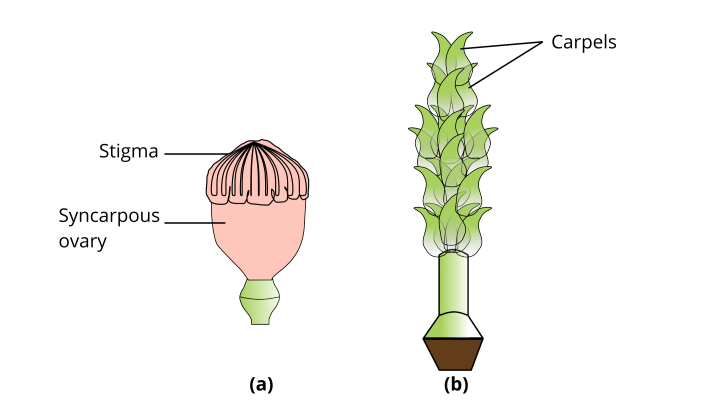
Identify the type of carpel with the help of diagrams given below. 


seo images


Show solutionHide solution
Worked solution

Ans: (a) Multicarpellary, Syncarpous condition is seen in plant Papaver. 

(b) Multicarpellary Apocarpous condition is seen in plant Michellia.

Multicarpellary gynoecium refers to the presence of multiple carpels in the female reproductive part of a flower. Syncarpous means that the carpels of a gynoecium in a Multicarpellary condition are joined or fused together. This is seen in a compound ovary. The apocarpous condition, on the other hand, means that the carpels of the ovary are free and not fused together.


Q17Written answer

How is pollination carried out in water plants?

Show solutionHide solution
Worked solution

Ans: In water plants, pollination can be carried out by water, wind, or insects. Any of these modes of pollination can be used by a plant depending on its characteristics. 

In plants like Vallisneria, the female plant reaches up to the surface of water and comes in contact with pollen grains released on the water surface which travel with the passive water currents. Not all the pollen reach stigma but the ones that do get fertilized and form an embryo.

In plants like sea grasses, the pollens are released inside the water and reach stigma deep under the water surface. In this kind, the pollen grains are long in size to facilitate easy and passive movement through the water.

The plants who have wind and water as pollinating agents usually do not have colorful or attractiveness because they do not need to attract pollinators. 


Q18Written answer

What is the function of the two male gametes produced by each pollen grain in angiosperms?

Show solutionHide solution
Worked solution

Ans: The two male gametes produced in male gamete are formed from one generative cell at maturation and lead to a three-celled stage of the pollen grain which is then shed. The other cell at this stage is vegetative cell. The significance of two male gametes is double fertilization which is a characteristic feature of angiosperms. Out of the two male gametes, one fuses with the egg nucleus to form zygote and the other one unites with polar nuclei to form a triploid endosperm. This event is called double fertilization.