My Cart
Your Cart 0

    Your cart is empty.

  • Total (Amount) ₹0.00
NCERT Exemplar · Class 11 · Maths

Chapter 5: Complex Numbers and Quadratic Equations

Practice each question, then open the answer or worked solution.

Short Answer Questions

50 questions
Q41Written answer

Which of the following is correct for any two complex numbers ${z_1}\text{ and }{z_2}$?

$(A)\left| {{z_1}{z_2}} \right| = \left| {{z_1}} \right|\left| {{z_2}} \right|$

$(B)\left| {{z_1} + {z_2}} \right| = \left| {{z_1}} \right| + \left| {{z_2}} \right|$

$(C)arg\left( {{z_1}{z_2}} \right) = arg\left( {{z_1}} \right).arg\left( {{z_2}} \right)$

Show solutionHide solution
Worked solution

Ans: Option A is correct answer

complex numbers ${z_1}{\text{ and }}{z_2}$.

Let ${z_1} = {r_1}\left( {\cos {\theta _1} + i\sin {\theta _1}} \right)$ and ${z_2} = {r_2}\left( {\cos {\theta _2} + i\sin {\theta _2}} \right)$ are two complex numbers.

  ${{\text{ Let }}} {{z_1} = {r_1}\left( {\cos {\theta _1} + i\sin {\theta _1}} \right)}$ 

 $\Rightarrow  {\left| {{z_1}} \right| = {r_1}.....\left( i \right)}$ 

and $ {z_2} = {r_2}\left( {\cos {\theta _2} + i\sin {\theta _2}} \right)$

$\Rightarrow  \left| {{z_2}} \right| = {r_2}.....\left( {ii} \right)$

Now, 

  ${z_1}{z_2} = {r_1}{r_2}\left[ {\cos {\theta _1}\cos {\theta _2} + i\sin {\theta _1}\cos {\theta _2} + i\cos {\theta _1}\sin {\theta _2} + {i^2}\sin {\theta _1}\sin {\theta _2}} \right]$

$= {r_1}{r_2}\left[ {\cos \left( {{\theta _1} + {\theta _2}} \right) + i\sin \left( {{\theta _1} + {\theta _2}} \right)} \right]$

 $\Rightarrow \left| {{z_1}{z_2}} \right| = {r_1}{r_2}$

$\therefore \left| {{z_1}{z_2}} \right| = \left| {{z_1}} \right|\left| {{z_2}} \right|\left[ {{\text{Using equation }}\left( i \right){\text{ and }}\left( {ii} \right)} \right]$ 

Q42Written answer

The point represented by the complex number $(2 - i)$ is rotated about

origin through an angle $\dfrac{\pi }{2}$ in the clockwise direction, the new position of point is

$(A)1 + 2i$

$(B) - 1 - 2i$

$(C)2 + i$

$(D) - 1 + 2i$

Show solutionHide solution
Worked solution

Ans: Option B is correct answer

complex number $(2 - i)$

Here, $z < i\alpha $ is a complex number, where modulus is $r$ and argument $(\theta  + \alpha )$ If $P(z)$ rotates in clockwise sense through an angle $\alpha $, then its new position will be $z(\theta  - i\alpha )$

Given that, $z = 2 - i$

It is rotated about origin through an angle $\dfrac{\pi }{2}$ in the clockwise direction.

$\therefore  {\text{ New position}} = z{e^{ - i\pi /2}}$

 $\Rightarrow (2 - i){e^{ - i\pi /2}} = (2 - i)\left[ {\cos \left( {\dfrac{{ - \pi }}{2}} \right) + i\sin \left( {\dfrac{{ - \pi }}{2}} \right)} \right]$

 $\Rightarrow (2 - i)[0 - i] =  - 2i - 1 =  - 1 - 2i$ 


Q43Written answer

If $x,y\in R$, then $x + iy$ is a non-real complex number, if

(A) $x = 0$

(B) $y = 0$

(C) $y =0$

(D) $y \ne 0$

Show solutionHide solution
Worked solution

Ans: Option D is correct answer

Given, $x,y \in R$

$x + iy$ is non-real complex number if and only if $y \ne 0$.

Given that,

$x,y \in R$

Then, $x + iy$ is non-real complex number if and only if $y \ne 0$.


Q44Written answer

If $a + ib = c + id$, if

(A) ${a^2} + {c^2} = 0$

(B) ${b^2} + {c^2} = 0$

(C) ${b^2} + {d^2} = 0$

(D) ${a^2} + {b^2} = {c^2} + {d^2}$

Show solutionHide solution
Worked solution

Ans: Option D is correct answer

$a + ib = c + id$

If two complex numbers ${z_1} = {x_1} + i{y_1}$ and ${z_2} = {x_2} + i{y_2}$ are equal, then

$\left| {{z_1}} \right| = \left| {{z_2}} \right|$

 $\Rightarrow \sqrt {x_1^2 + y_1^2}  = \sqrt {x_2^2 + y_2^2}$ 

Given that, $a + ib = c + id$

$\Rightarrow  |a + ib| = |c + id|$

$\Rightarrow  \sqrt {{a^2} + {b^2}}  = \sqrt {{c^2} + {d^2}}$

On squaring both sides, we get 

${a^2} + {b^2} = {c^2} + {d^2}$


Q45Written answer

The complex number $z$ which satisfies the condition $\left| {\dfrac{{i + z}}{{i - z}}} \right| = 1$ lies on

(A) circle ${x^2} + {y^2} = 1$

(B) the $x$- axis

(C) the $y$- axis

(D) the line $x + y = 1$

Show solutionHide solution
Worked solution

Ans: Option B is correct answer

$\left| {\dfrac{{i + z}}{{i - z}}} \right| = 1$

Let $z$ be a complex number and $z = x + iy$ then $\left| z \right| = \sqrt {{x^2} + {y^2}}$.

Given that, $\left| {\dfrac{{i + z}}{{i - z}}} \right| = 1$

Let $ z = x + iy$

$\therefore  \left| {\dfrac{{x + i(y + 1)}}{{ - x - i(y - 1)}}} \right| = 1$

 $\Rightarrow \dfrac{{{x^2} + {{(y + 1)}^2}}}{{{x^2} + {{(y - 1)}^2}}} = 1$ 

$\Rightarrow  {x^2} + {(y + 1)^2} = {x^2} + {(y - 1)^2}$

 $\Rightarrow  4y = 0$

 $\Rightarrow y = 0$ 

So, $z$ lies on $x$-axis (real axis).


Q46Written answer

If $z$ is a complex number, then

(A) $\left| {{z^2}} \right| > |z|$

(B) $\left| {{z^2}} \right| = |z{|^2}$

(C) $\left| {{z^2}} \right| < |z{|^2}$

(D) $\left| {{z^2}} \right| \geq  |z{|^2}$

Show solutionHide solution
Worked solution

Ans: Option B is correct answer

$z$ is a complex number.

If $z$ is a complex number, then $z = x + iy$ $|z| = |x + |y\mid$ and $|z{|^2} = |x + iy{|^2}$

If $z$ is a complex number, then $z = x + iy$ $|z| = |x + |y\mid$ and $|z{|^2} = |x + iy{|^2}$

$\Rightarrow  |z{|^2} = {x^2} + {y^2}.....\left( i \right)$

and $ {z^2} = {(x + iy)^2} = {x^2} + {i^2}{y^2} + i2xy$

${z^2} = {x^2} - {y^2} + i2xy$

$\Rightarrow \left| {{z^2}} \right| = \sqrt {{{\left( {{x^2} - {y^2}} \right)}^2} + {{(2xy)}^2}}$

$\Rightarrow  \left| {{z^2}} \right| = \sqrt {{x^4} + {y^4} - 2{x^2}{y^2} + 4{x^2}{y^2}}$

$\Rightarrow  \left| {{z^2}} \right| = \sqrt {{x^4} + {y^4} + 2{x^2}{y^2}}  = \sqrt {{{\left( {{x^2} + {y^2}} \right)}^2}}$

$\Rightarrow  \left| {{z^2}} \right| = {x^2} + {y^2}.....\left( {ii} \right)$

From Eqs. (i) and (ii), ${\left| {z} \right|^2} = \left| {{z^2}} \right|$


Q47Written answer

$\left| {{z_1} + {z_2}} \right| = \left| {{z_1}} \right| + \left| {{z_2}} \right|$ is possible, if

(A) ${z_2} = {\bar z_1}$

(B) ${z_2} = \dfrac{1}{{{z_1}}}$

(C) $arg\left( {{z_1}} \right) = arg\left( {{z_2}} \right)$

(D) $\left| {{z_1}} \right| = \left| {{z_2}} \right|$

Show solutionHide solution
Worked solution

Ans: Option C is correct answer

 $\left| {{z_1} + {z_2}} \right| = \left| {{z_1}} \right| + \left| {{z_2}} \right|$

Let $z$ be a complex number and $z = x + iy$ then $\left| z \right| = \sqrt {{x^2} + {y^2}}$.

Given that, $ \left| {{z_1} + {z_2}} \right| = \left| {{z_1}} \right| + \left| {{z_2}} \right|$

$\Rightarrow \left| {{r_1}\left( {\cos {\theta _1} + i\sin {\theta _1}} \right) + {r_2}\left( {\cos {\theta _2} + i\sin {\theta _2}} \right)} \right| = \left| {{r_1}\left( {\cos {\theta _1} + i\sin {\theta _1}} \right)} \right|$

$+ \left| {{r_2}\left( {\cos {\theta _2} + i\sin {\theta _2}} \right)} \right|$

$\Rightarrow \left| {\left( {{r_1}\cos {\theta _1} + {r_2}\cos \theta } \right) + i\left( {{r_1}\sin {\theta _1} + {r_2}\sin {\theta _2}} \right)} \right| = {r_1} + {r_2}$

$\Rightarrow  \sqrt {r_1^2{{\cos }^2}{\theta _1} + r_2^2{{\cos }^2}{\theta _2} + 2{r_1}{r_2}\cos {\theta _1}\cos {\theta _2} + r_1^2{{\sin }^2}{\theta _1} + r_2^2{{\sin }^2}{\theta _2}}$

$\sqrt { + 2{r_1}{r_2}\sin {\theta _1}\sin {\theta _2}}  = {r_1} + {r_2}$

$\Rightarrow \sqrt {r_1^2 + r_2^2 + 2{r_1}{r_2}\left[ {\cos \left( {{\theta _1} - {\theta _2}} \right)} \right]}  = {r_1} + {r_2}$

On squaring both sides, we get 

$r_1^2 + r_2^2 + 2{r_1}{r_2}\cos \left( {{\theta _1} - {\theta _2}} \right) = r_1^2 + r_2^2 + 2{r_1}{r_2}$

$\Rightarrow  2{r_1}{r_2}\left[ {1 - \cos \left( {{\theta _1} - {\theta _2}} \right)} \right] = 0$

$\Rightarrow1 - \cos \left( {{\theta _1} - {\theta _2}} \right) = 0$

$\Rightarrow\cos \left( {{\theta _1} - {\theta _2}} \right) = 1$

$\Rightarrow \cos \left( {{\theta _1} - {\theta _2}} \right) = \cos {0^\circ }$

$\Rightarrow  {\theta _1} - {\theta _2} = {0^\circ }$

$\Rightarrow{\theta _1} = {\theta _2}$

$\therefore$$\arg \left( {{z_1}} \right) = \arg \left( {{z_2}} \right)$


Q48Written answer

The real value of $\theta$ for which the expression $\dfrac{{1 + icos\theta }}{{1 - 2icos\theta }}$ is a real number is

(A) $n\pi  + \dfrac{\pi }{4}$

(B) $n\pi  + {( - 1)^n}\dfrac{\pi }{4}$

(C) $2n\pi  \pm \dfrac{\pi }{2}$

(D) None of these

Show solutionHide solution
Worked solution

Ans: Option C is correct answer

$\dfrac{{1 + i\cos \theta }}{{1 - 2i\cos \theta }}$

Simplify the given equation and use the formula $\cos \dfrac{\pi }{2} = 0$.

Given expression,

$= \dfrac{{1 + i\cos \theta }}{{1 - 2i\cos \theta }} = \dfrac{{(1 + i\cos \theta )(1 + 2i\cos \theta )}}{{(1 - 2i\cos \theta )(1 + 2i\cos \theta )}}$

 $\Rightarrow \dfrac{{1 + i\cos \theta  + 2i\cos \theta  + 2{i^2}{{\cos }^2}\theta }}{{1 - 4{i^2}{{\cos }^2}\theta }}$

 $\Rightarrow \dfrac{{1 + 3i\cos \theta  - 2{{\cos }^2}\theta }}{{1 + 4{{\cos }^2}\theta }}$ 

For real value of $\theta ,$

$\dfrac{{3\cos \theta }}{{1 + 4{{\cos }^2}\theta }} = 0$

 $\Rightarrow 3\cos \theta  = 0$

 $\Rightarrow \cos \theta  = \cos \dfrac{\pi }{2}$

 $\Rightarrow \theta  = 2n\pi  \pm \dfrac{\pi }{2}$ 


Q49Written answer

The value of arg $(x)$, when $x < 0$ is

(A) 0

(B) $\dfrac{\pi }{2}$

(C) $\pi$

(D) None of these

Show solutionHide solution
Worked solution

Ans: Option C is correct answer

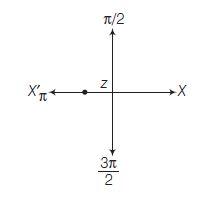
$x < 0$

Let $z$be a complex number and $z = x + iy$ then $\left| z \right| = \sqrt {{x^2} + {y^2}}$.

Let

  $z = x + 0i{\text{ and }}x < 0$

  $|z| = \sqrt {{{( - 1)}^2} + \left( {{0^2}} \right)}  = 1$ 

Since, the point $(x, 0)$ represent $z = x + 0i$ lies on the negative side of real axis. 

$\therefore$ Principal $\arg (z) = \pi$

seo images


Q50Written answer

If $f(z) = \dfrac{{7 - z}}{{1 - {z^2}}}$, where $z = 1 + 2i$, then $|f(z)|$ is equal to

(A) $\dfrac{{|z|}}{2}$

(B) $\left| {z} \right|$

(C) $2\left| {z} \right|$

(D) None of these

Show solutionHide solution
Worked solution

Ans: Option A is correct answer

$f(z) = \dfrac{{7 - z}}{{1 - {z^2}}}$, where $z = 1 + 2i$

Let $z$ be a complex number and $z = x + iy$ then $\left| z \right| = \sqrt {{x^2} + {y^2}}$.

${{\text{ Let }}} {z = 1 + 2i}$ 

 $\Rightarrow {|z| = \sqrt {1 + 4}  = \sqrt 5 } $

Now, 

  $f(z) = \dfrac{{7 - z}}{{1 - {z^2}}} = \dfrac{{7 - 1 - 2i}}{{1 - {{(1 + 2i)}^2}}}$

 $\Rightarrow \dfrac{{6 - 2i}}{{1 - 1 - 4{i^2} - 4i}} = \dfrac{{6 - 2i}}{{4 - 4i}}$ 

$\Rightarrow \dfrac{{(3 - i)(2 + 2i)}}{{(2 - 2i)(2 + 2i)}} = \dfrac{{6 - 2i + 6i - 2{i^2}}}{{4 - 4{i^2}}}$

 $\Rightarrow \dfrac{{6 + 4i + 2}}{{4 + 4}} = \dfrac{{8 + 4i}}{8}$

 $\Rightarrow 1 + \dfrac{1}{2}i$ 

 $f(z) = 1 + \dfrac{1}{2}i$

$\therefore |f(z)| = \sqrt {1 + \dfrac{1}{4}}$ 

$\Rightarrow \sqrt {\dfrac{{4 + 1}}{4}}  = \dfrac{{\sqrt 5 }}{2} = \dfrac{{|z|}}{2}$


An overview of NCERT Exemplar for Class 11 Mathematics - Complex Numbers and Quadratic Equations

NCERT Exemplar for Class 11 Mathematics - Complex Numbers and Quadratic Equations - is a Chapter filled with equations and different concepts to cover. Vedantu’s team is aware that students alone might find it difficult to comprehend such equations in one attempt. So, to offer the best resolution, their team of expert tutors of the respective subject help and guide students in the right direction.


The entire syllabus has been planned and covered by Vedantu in such a manner that students not only study well, but they are also able to make the most of their study by planning everything in a calculative manner. Students feel encouraged to create a regular timetable so that they won’t miss a single question by the time the exam reaches closer. Vedantu even assures students of their ability to provide round the clock guidance whenever they find themselves stuck in tricky questions. This way, students can learn everything in the flow which contributes not only to their daily goals but it creates consistency so that they can reap the complete benefits of their persistent hard work later. 


Are you ready to boost your performance? Then, choose Vedantu today and secure your future study goals.