If tan (A + B) = p, tan (A – B) = q, then show that tan 2A = (p + q) / (1 – pq).
[Hint: Use 2A = (A + B) + (A – B)]
Show solutionHide solution
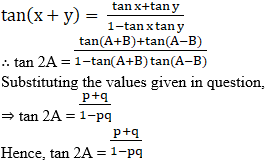
We know that,
tan 2A = tan (A + B + A – B)
And also,

Your cart is empty.
Practice each question, then open the answer or worked solution.
If tan (A + B) = p, tan (A – B) = q, then show that tan 2A = (p + q) / (1 – pq).
[Hint: Use 2A = (A + B) + (A – B)]
We know that,
tan 2A = tan (A + B + A – B)
And also,

If cosα + cosβ = 0 = sinα + sinβ, then prove that cos 2α + cos 2β = –2cos (α + β).
[Hint: cosα + cosβ)2 – (sinα + sinβ)2 = 0]
According to the question,
cosα + cosβ = 0 = sinα + sinβ …(i)
Since, LHS = cos 2α + cos 2β
We know that,
cos 2x = cos2x – sin2x
Therefore,
LHS = cos2α – sin2α + (cos2β – sin2β)
⇒ LHS = cos2α + cos2β – (sin2α + sin2β)
Also, since,
a2 + b2 = (a+b)2 – 2ab
⇒ LHS = (cosα + cosβ)2 – 2cosα cosβ –(sinα + sinβ)2 +2sinα sinβ
From equation (i),
⇒ LHS = 0 – 2cosα cosβ -0 + 2sinα sinβ
⇒ LHS = -2(cosα cosβ – sinα sinβ)
∵ cos (α + β) = cosα cosβ – sinα sinβ
Therefore, LHS = -2 cos (α + β) = RHS
Hence, cos 2α + cos 2β = –2cos (α + β)
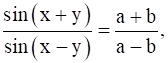
If
then show that 
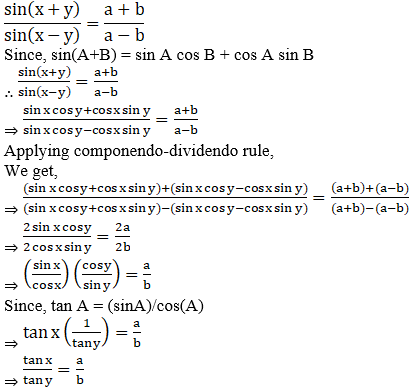
[Hint: Use componendo and Dividendo]
According to the question,

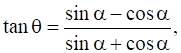
If
then show that sinα + cosα = √2 cos θ.
[Hint: Express tanθ = tan(α – π/2) θ = α – π/4]
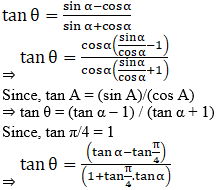
We know that,

We know that,
tan(x-y) = (tan x – tan y) / (1 + tan x . tan y)
Therefore, tan θ = tan ( α – π/4)
⇒ θ = α – π/4
⇒ α = θ + π/4 …(i)
To prove,
sinα + cosα = √2 cos θ
∵ LHS = sinα + cosα
From equation (i)
⇒ LHS = sin(θ + π/4) + cos(θ + π/4)
∵ sin(x + y) = sin x cos y + cos x sin y
And, cos(x + y) = cos x cos y – sin x sin y
Therefore, LHS = sin θ cos(π/4) + sin(π/4)cos θ + cos θ cos(π/4) – sin(π/4)sin θ
∵ sin(π/4)=cos(π/4) = 1/√2
⇒ LHS = sin θ (1/√2) + (1/√2) cos θ + cos θ (1/√2) – sin θ (1/√2)
⇒ LHS = 2 cos θ (1/√2)
⇒ LHS = √2 cos θ = RHS
Therefore, sinα + cosα = √2 cos θ
If sin θ + cos θ = 1, then find the general value of θ.
According to the question,
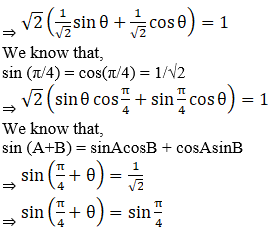
sin θ + cos θ = 1
As, sin θ + cos θ = 1

Since we know,
If sin θ = sinα ⇒ θ = nπ + (-1)nα
We get,
θ + π/4 = nπ + (-1)n(π/4)
⇒ θ = nπ + (π/4)((-1)n – 1)
Find the most general value of θ satisfying the equation tan θ = –1 and cos θ = 1/√2
According to the question,
We have,
tan θ = -1
And cos θ =1/√2 .
⇒ θ = – π/4
So, we know that,
θ lies in IV quadrant.
θ = 2π – π/4 = 7π/4
So, general solution is θ = 7π/4 + 2 n π, n∈ Z
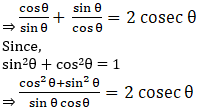
If cot θ + tan θ = 2 cosec θ, then find the general value of θ.
According to the question,

⇒ 1 = 2 cosec θ sin θ cos θ
We know that,
sin θ cosec θ = 1
⇒ 1 = 2 cos θ
⇒ cos θ = 1/2 = cos(π/3)
Hence,
The solution of cos x = cos α can be given by,
x = 2mπ ± α ∀ m ∈ Z
⇒ θ = 2nπ ± π/3, n ∈ Z
If 2sin2θ = 3cos θ, where 0 ≤ θ ≤ 2π, then find the value of θ.
According to the question,
2sin2θ = 3cos θ
We know that,
sin2θ = 1 – cos2θ
Given that,
2 sin2 θ = 3 cos θ
2 – 2 cos2 θ = 3 cos θ
2 cos2 θ + 3 cos θ – 2= 0
(cos θ + 2)(2 cos θ – 1) = 0
Therefore,
cos θ = ½ = cos π/3
θ = π/3 or 2π – π/3
θ = π/3, 5π/3
Therefore, 2(1 – cos2θ) = 3cos θ
⇒ 2 – 2cos2θ = 3cos θ
⇒ 2cos2θ + 3cos θ – 2 = 0
⇒ 2cos2θ + 4cos θ – cos θ – 2 = 0
⇒ 2cos θ (cos θ+ 2) +1 (cos θ + 2) = 0
⇒ (2cos θ + 1)(cos θ + 2) = 0
Since, cos θ ∈ [-1,1] , for any value θ.
So, cos θ ≠ – 2
Therefore,
2 cos θ – 1 = 0
⇒ cos θ = ½
= π/3 or 2π – π/3
θ = π/3, 5π/3
If sec x cos 5x + 1 = 0, where 0 < x ≤ π/2, then find the value of x.
According to the question,
sec x cos 5x = -1
⇒ cos 5x = -1/sec x
We know that,
sec x = 1/cos x
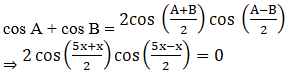
⇒ cos 5x + cos x = 0
By transformation formula of T-ratios,
We know that,

⇒ 2 cos 3x cos 2x = 0
⇒ cos 3x = 0 or cos 2x = 0
∵ 0 < x ≤ π/2
Therefore, 0< 2x ≤ π or 0< 3x ≤ 3π/2
Therefore, 2x = π/2
⇒ x = π/4
3x = π/2
⇒ x = π/6
Or 3x = 3π/2
⇒ x = π/2
Hence, x = π/6, π/4, π/2.
If sin (θ + α) = a and sin (θ + β) = b, then prove that cos 2(α – β) – 4ab cos (α – β) = 1 – 2a2 – 2b2
According to the question,
sin (θ + α) = a and sin(θ + β) = b
LHS = cos 2(α – β) – 4ab cos (α – β)
Using cos 2x = 2cos2x – 1,
Let us solve,
⇒ LHS = 2cos2(α – β) – 1 – 4ab cos(α – β)
⇒ LHS = 2cos (α – β) {cos (α – β) – 2ab} – 1
Since,
cos (α – β) = cos {(θ + α) – (θ + β)}
cos (A – B) = cos A cos B + sin A sin B
⇒ cos (α – β) = cos(θ + α)cos(θ + β) + sin(θ + α)sin(θ + β)
Since,
sin(θ + α) = a
⇒ cos(θ + α) = √(1 – sin2(θ + α) = √(1 – a2)
Similarly,
cos(θ + β) = √(1 – b2)
Therefore,
cos(α – β) = √(1-a2)√(1-b2) + ab
Therefore,
LHS = 2{ab + √(1 – a2)(1 – b2)}{ab + √(1 – a2)(1 – b2) -2ab} – 1
⇒ LHS = 2{√(1 – a2)(1 – b2) + ab}{√(1 – a2)(1 – b2) – ab}-1
Using (x + y)(x – y) = x2 – y2
⇒ LHS = 2{(1-a2)(1-b2) – a2b2} – 1
⇒ LHS = 2{1 – a2 – b2 + a2b2} – 1
⇒ LHS = 2 – 2a2 – 2b2 – 1
⇒ LHS = 1 – 2a2 – 2b2 = RHS
Therefore,
We get,
cos 2(α – β) – 4ab cos (α – β) = 1 – 2a2 – 2b2