My Cart
Your Cart 0

    Your cart is empty.

  • Total (Amount) ₹0.00
NCERT Exemplar · Class 11 · Maths

Chapter 16: Probability

Practice each question, then open the answer or worked solution.

Textbook exercises

43 questions
Q11Written answer

The accompanying Venn diagram shows three events $A$, $B$ and $C$, and also the probabilities of the various intersections (for instance $P\left( {A \cap B} \right) = 0.07$). Determine
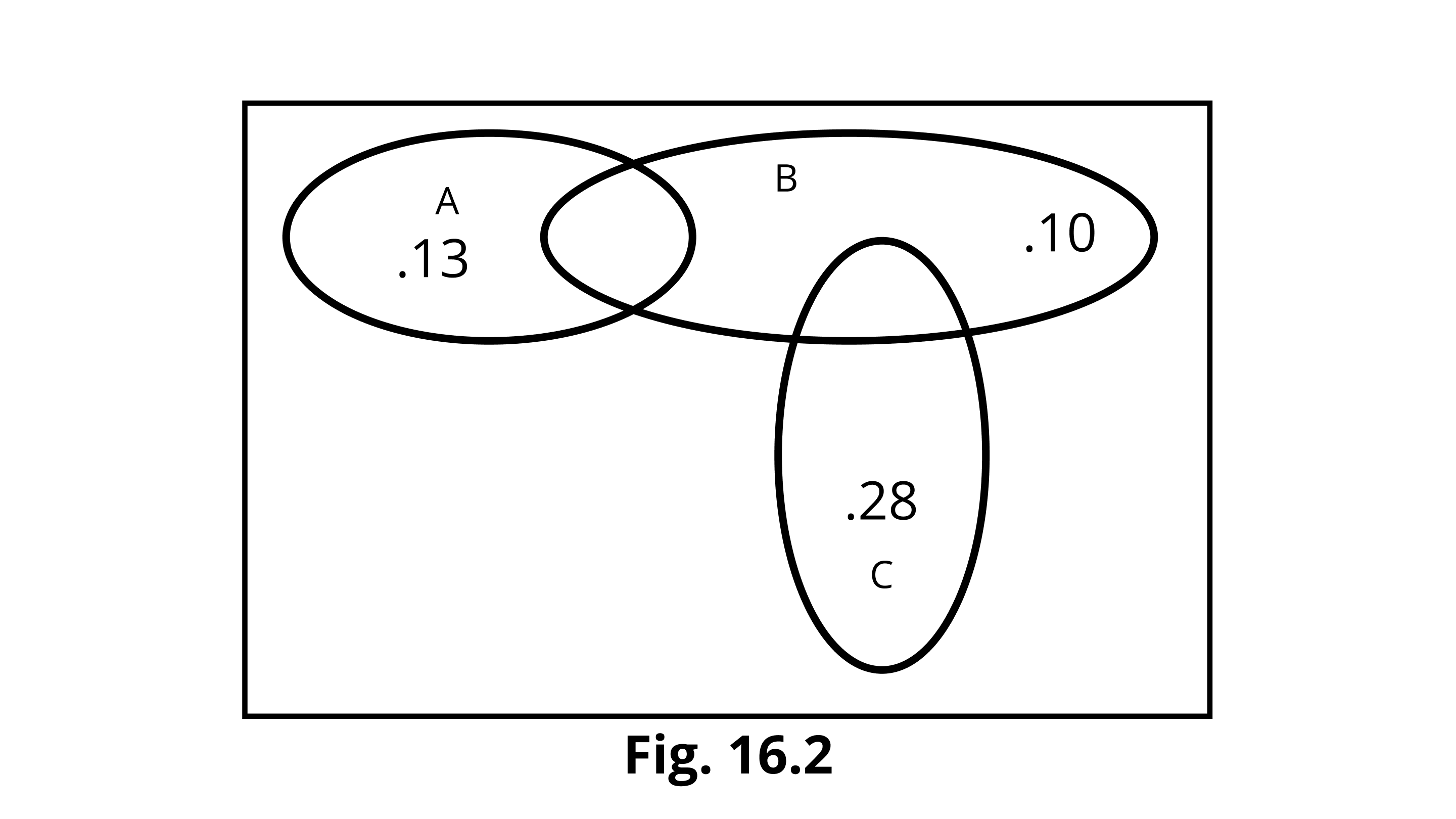

seo images


$\left( a \right)P\left( A \right)$

Show solutionHide solution
Worked solution

Ans: Given:

In the Venn diagram: -

$P\left( {{\text{only }}A} \right) = 0.13$

$P\left( {{\text{only }}B} \right) = 0.10$

\[P\left( {{\text{only }}C} \right) = 0.28\]

$P\left( {A \cap B} \right) = 0.07$

$P\left( {B \cap C} \right) = 0.15$

Using the Venn and the formulas of theory solve for each subpart of the question.

Use the formulas: -

$P\left( {B \cap \overline C } \right) = P\left( B \right) - P\left( {B \cap C} \right)$

$P\left( {A \cap \overline B } \right) = P\left( A \right) - P\left( {A \cap B} \right)$

The probability of occurrence of the event $A$ is \[P\left( A \right) = P\left( {{\text{only }}A} \right) + P\left( {A \cap B} \right)\].

 $\Rightarrow P\left( A \right) = 0.13 + 0.07$

 $\Rightarrow P\left( A \right) = 0.20$ 

$\left( b \right)P\left( {B \cap \overline C } \right)$

Ans: Given:

In the Venn diagram: -

$P\left( {{\text{only }}A} \right) = 0.13$

$P\left( {{\text{only }}B} \right) = 0.10$

\[P\left( {{\text{only }}C} \right) = 0.28\]

$P\left( {A \cap B} \right) = 0.07$

$P\left( {B \cap C} \right) = 0.15$

Using the Venn and the formulas of theory solve for each subpart of the question.

Use the formulas: -

$P\left( {B \cap \overline C } \right) = P\left( B \right) - P\left( {B \cap C} \right)$

$P\left( {A \cap \overline B } \right) = P\left( A \right) - P\left( {A \cap B} \right)$

Here $\left( {B \cap \overline C } \right)$ states the event of occurrence of $B$ and not $C$.

 $\Rightarrow P\left( {B \cap \overline C } \right) = P\left( B \right) - P\left( {B \cap C} \right)$

 $\Rightarrow P\left( {B \cap \overline C } \right) = \left( {0.10 + 0.07 + 0.15} \right) - 0.15$

 $\Rightarrow P\left( {B \cap \overline C } \right) = 0.17$ 

$\left( c \right)P\left( {A \cup B} \right)$

Ans: Given:

In the Venn diagram: -

$P\left( {{\text{only }}A} \right) = 0.13$

$P\left( {{\text{only }}B} \right) = 0.10$

\[P\left( {{\text{only }}C} \right) = 0.28\]

$P\left( {A \cap B} \right) = 0.07$

$P\left( {B \cap C} \right) = 0.15$

Using the Venn and the formulas of theory solve for each subpart of the question.

Use the formulas: -

$P\left( {B \cap \overline C } \right) = P\left( B \right) - P\left( {B \cap C} \right)$

$P\left( {A \cap \overline B } \right) = P\left( A \right) - P\left( {A \cap B} \right)$

Here $P\left( {A \cup B} \right)$ is the probability of occurrence of either $A$ or $B$.

 $\Rightarrow P\left( {A \cup B} \right) = P\left( A \right) + P\left( B \right) - P\left( {A \cap B} \right)$

 $\Rightarrow P\left( {A \cup B} \right) = \left( {0.13 + 0.07} \right) + \left( {0.10 + 0.07 + 0.15} \right) - 0.07$

 $\Rightarrow P\left( {A \cup B} \right) = 0.45$ 

$\left( d \right)P\left( {A \cap \overline B } \right)$

Ans: Given:

In the Venn diagram: -

$P\left( {{\text{only }}A} \right) = 0.13$

$P\left( {{\text{only }}B} \right) = 0.10$

\[P\left( {{\text{only }}C} \right) = 0.28\]

$P\left( {A \cap B} \right) = 0.07$

$P\left( {B \cap C} \right) = 0.15$

Using the Venn and the formulas of theory solve for each subpart of the question.

Use the formulas: -

$P\left( {B \cap \overline C } \right) = P\left( B \right) - P\left( {B \cap C} \right)$

$P\left( {A \cap \overline B } \right) = P\left( A \right) - P\left( {A \cap B} \right)$

Here $\left( {A \cap \overline B } \right)$ states the event of occurrence of $A$ and not $B$.

$\Rightarrow P\left( {A \cap \overline B } \right) = P\left( A \right) - P\left( {A \cap B} \right)$

 $\Rightarrow P\left( {A \cap \overline B } \right) = \left( {0.13 + 0.07} \right) - 0.07$

 $\Rightarrow P\left( {A \cap \overline B } \right) = 0.13$ 

$\left( e \right)P\left( {B \cap C} \right)$

Ans: Given:

In the Venn diagram: -

$P\left( {{\text{only }}A} \right) = 0.13$

$P\left( {{\text{only }}B} \right) = 0.10$

\[P\left( {{\text{only }}C} \right) = 0.28\]

$P\left( {A \cap B} \right) = 0.07$

$P\left( {B \cap C} \right) = 0.15$

Using the Venn and the formulas of theory solve for each subpart of the question.

Use the formulas: -

$P\left( {B \cap \overline C } \right) = P\left( B \right) - P\left( {B \cap C} \right)$

$P\left( {A \cap \overline B } \right) = P\left( A \right) - P\left( {A \cap B} \right)$

Here $\left( {B \cap C} \right)$ states the event of occurrence of both $A$ and $B$.

$\Rightarrow P\left( {B \cap C} \right) = 0.15$

$\left( f \right)$ Probability of exactly one of the three occurs.

Ans: Given:

In the Venn diagram: -

$P\left( {{\text{only }}A} \right) = 0.13$

$P\left( {{\text{only }}B} \right) = 0.10$

\[P\left( {{\text{only }}C} \right) = 0.28\]

$P\left( {A \cap B} \right) = 0.07$

$P\left( {B \cap C} \right) = 0.15$

Using the Venn and the formulas of theory solve for each subpart of the question.

Use the formulas: -

$P\left( {B \cap \overline C } \right) = P\left( B \right) - P\left( {B \cap C} \right)$

$P\left( {A \cap \overline B } \right) = P\left( A \right) - P\left( {A \cap B} \right)$

Probability of exactly one of the three occurs means \[P\left( {{\text{only }}A} \right) + P\left( {{\text{only }}B} \right) + P\left( {{\text{only }}C} \right)\].

$\Rightarrow $ Required probability $= 0.13 + 0.10 + 0.28$

$\Rightarrow $ Required probability $= 0.51$


Q12Written answer

One urn contains two black balls (labelled $B1$ and $B2$) and one white ball. A second urn contains one black ball and two white balls (labelled $W1$ and $W2$). Suppose the following experiment is performed. One of the two urns is chosen at random. Next a ball is randomly chosen from the urn. Then a second ball is chosen at random from the same urn without replacing the first ball.

(a) Write the sample space showing all possible outcomes.

(c) What is the probability that two balls of opposite colour are chosen?

Show solutionHide solution
Worked solution

Ans: Given: Two black balls (labelled $B1$ and $B2$) and one white ball in the first urn.

Two white balls (labelled $W1$ and $W2$) and one black ball in the second urn.

One of the two urns is chosen then a ball is chosen and then a second ball is chosen without replacement.

Find all the possible combinations that can be made in selecting the two balls one after the other and not at once. Check the favourable number of sample spaces for the subparts.

Let us represent the single white ball in the first urn as $W$ and the single black ball in the second urn as $B$. The possible combinations of selecting the two balls one after the other from the urns is the total number of sample spaces given as,

\[n\left( S \right) = \left\{ {B1B2,{\text{ }}B2B1,{\text{ }}B1W,{\text{ }}WB1,{\text{ }}B2W,{\text{ }}WB2,{\text{ }}W1W2,{\text{ }}W2W1,{\text{ }}BW1,{\text{ }}W1B,{\text{ }}BW2,{\text{ }}W2B} \right\} = 12\]


(b) What is the probability that two black balls are chosen?

Ans: Given: Two black balls (labelled $B1$ and $B2$) and one white ball in the first urn.

Two white balls (labelled $W1$ and $W2$) and one black ball in the second urn.

One of the two urns is chosen then a ball is chosen and then a second ball is chosen without replacement.

Find all the possible combinations that can be made in selecting the two balls one after the other and not at once. Check the favourable number of sample spaces for the subparts.

The combinations where two blacks balls are chosen is $n\left( X \right) = \left\{ {B1B2,{\text{ }}B2B1} \right\} = 2$.

Therefore, the required probability is $\dfrac{{n\left( X \right)}}{{n\left( S \right)}} = \dfrac{2}{{12}} = \dfrac{1}{6}$.


Ans: Given: Two black balls (labelled $B1$ and $B2$) and one white ball in the first urn.

Two white balls (labelled $W1$ and $W2$) and one black ball in the second urn.

One of the two urns is chosen then a ball is chosen and then a second ball is chosen without replacement.

Find all the possible combinations that can be made in selecting the two balls one after the other and not at once. Check the favourable number of sample spaces for the subparts.

The combinations where two balls of opposite colours are chosen is $n\left( Y \right) = \left\{ {B1W,{\text{ }}WB1,{\text{ }}B2W,{\text{ }}WB2,BW1,{\text{ }}W1B,{\text{ }}BW2,{\text{ }}W2B} \right\} = 8$.

Therefore, the required probability is $\dfrac{{n\left( Y \right)}}{{n\left( S \right)}} = \dfrac{8}{{12}} = \dfrac{2}{3}$.


Q13Written answer

A bag contains $8$ red and $5$ white balls. Three balls are drawn at random. Find the probability that:

(a) All the three balls are white.

(c) One ball is red and two balls are white.

Show solutionHide solution
Worked solution

Ans: Given: Total number of red balls $= 8$

Total number of white balls $= 5$

Three balls are drawn at random.

Use the formula ${}^{13}{C_3}$ to find the total number of sample spaces.

Select the balls using the formula of combination for each subpart.

Since there are a total of $13$ balls and any $3$ balls can be selected in ${}^{13}{C_3}$ ways, so the total number of sample space is $n\left( S \right) = {}^{13}{C_3}$.

To select all the three white balls they must be selected from the given $5$ white balls, so the number of favourable sample spaces is $n\left( A \right) = {}^5{C_3}$.

Therefore, the required probability is $= \dfrac{{n\left( A \right)}}{{n\left( S \right)}} = \dfrac{{{}^5{C_3}}}{{{}^{13}{C_3}}} = \dfrac{5}{{143}}$.


(b) All the three balls are red.

Ans: Given: Total number of red balls $= 8$

Total number of white balls $= 5$

Three balls are drawn at random.

Use the formula ${}^{13}{C_3}$ to find the total number of sample spaces.

Select the balls using the formula of combination for each subpart.

Since there are a total of $13$ balls and any $3$ balls can be selected in ${}^{13}{C_3}$ ways, so the total number of sample space is $n\left( S \right) = {}^{13}{C_3}$.

To select all the three red balls they must be selected from the given $8$ red balls, so the number of favourable sample spaces is $n\left( B \right) = {}^8{C_3}$.

Therefore, the required probability is $= \dfrac{{n\left( B \right)}}{{n\left( S \right)}} = \dfrac{{{}^8{C_3}}}{{{}^{13}{C_3}}} = \dfrac{{28}}{{143}}$.


Ans: Given: Total number of red balls $= 8$

Total number of white balls $= 5$

Three balls are drawn at random.

Use the formula ${}^{13}{C_3}$ to find the total number of sample spaces.

Select the balls using the formula of combination for each subpart.

Since there are a total of $13$ balls and any $3$ balls can be selected in ${}^{13}{C_3}$ ways, so the total number of sample space is $n\left( S \right) = {}^{13}{C_3}$.

To select one red ball the number of ways is \[{}^8{C_1}\] and to select two white balls the number of ways is \[{}^5{C_2}\]. So the number of favourable sample spaces is $n\left( C \right) = {}^8{C_1} \times {}^5{C_2}$.

Therefore, the required probability is $= \dfrac{{n\left( C \right)}}{{n\left( S \right)}} = \dfrac{{{}^8{C_1} \times {}^5{C_2}}}{{{}^{13}{C_3}}} = \dfrac{{40}}{{143}}$.


Q14Written answer

If the letters of the word ASSASSINATION are arranged at random. Find the probability that

(a) Four S’s come consecutively in the word

(b) Two I’s and two N’s come together

(c) All A’s are not coming together

(d) No two A’s are coming together.

Show solutionHide solution
Worked solution

Ans: Given:The letters of the word Assassination are arranged.

Find the total number of sample spaces by arranging all the thirteen letters of the word and dividing it by the product of the factorial of the number of times each letter is repeating.

Arrange the letters as per the condition given in the subparts to find the favourable sample spaces.

There are $13$ letters in the word ASSASSINATION in which A is repeated $3$ times, S is repeated $4$ times, I is repeated $2$ times and N is repeated $2$ times. So the number of different words that can be formed is the total number of sample spaces $n\left( S \right) = \dfrac{{13!}}{{4!{\text{ }} \times {\text{ }}3!{\text{ }} \times {\text{ }}2!{\text{ }} \times {\text{ }}2!}}$.

All the four S’s come together so they can be assumed as a single unit. Since, they are identical alphabets, so there is no meaning of arranging them among themselves. The remaining $9$ alphabets and this single unit can be considered as $10$ objects and they can be arranged in $n\left( A \right) = \dfrac{{10!}}{{3!{\text{ }} \times {\text{ }}2!{\text{ }} \times {\text{ }}2!}}$ ways.

Therefore, the required probability is $\dfrac{{n\left( A \right)}}{{n\left( S \right)}} = \dfrac{2}{{143}}$.


Ans: Given:The letters of the word ASSASSINATION are arranged.

Find the total number of sample spaces by arranging all the thirteen letters of the word and dividing it by the product of the factorial of the number of times each letter is repeating.

Arrange the letters as per the condition given in the subparts to find the favourable sample spaces.

There are $13$ letters in the word ASSASSINATION in which A is repeated $3$ times, S is repeated $4$ times, I is repeated $2$ times and N is repeated $2$ times. So the number of different words that can be formed is the total number of sample spaces $n\left( S \right) = \dfrac{{13!}}{{4!{\text{ }} \times {\text{ }}3!{\text{ }} \times {\text{ }}2!{\text{ }} \times {\text{ }}2!}}$.

Here two I’s and two N’s come together (IINN). These four letters can be arranged in $\dfrac{{4!}}{{2!{\text{ }} \times {\text{ }}2!}}$ ways among themselves. The remaining $9$ alphabets and this single unit can be considered as $10$ objects and they can be arranged in $\dfrac{{10!}}{{4! \times 3!}}$ ways. So the number of favorable arrangements is $n\left( B \right) = \dfrac{{4!}}{{2!{\text{ }} \times {\text{ }}2!}}{\text{ }} \times {\text{ }}\dfrac{{10!}}{{4!{\text{ }} \times {\text{ }}3!}}$.

Therefore, the required probability is $\dfrac{{n\left( B \right)}}{{n\left( S \right)}} = \dfrac{2}{{143}}$.


Ans: Given:The letters of the word ASSASSINATION are arranged.

Find the total number of sample spaces by arranging all the thirteen letters of the word and dividing it by the product of the factorial of the number of times each letter is repeating.

Arrange the letters as per the condition given in the subparts to find the favourable sample spaces.

There are $13$ letters in the word ASSASSINATION in which A is repeated $3$ times, S is repeated $4$ times, I is repeated $2$ times and N is repeated $2$ times. So the number of different words that can be formed is the total number of sample spaces $n\left( S \right) = \dfrac{{13!}}{{4!{\text{ }} \times {\text{ }}3!{\text{ }} \times {\text{ }}2!{\text{ }} \times {\text{ }}2!}}$.

Let us assume that all the three A’s come together so they can be assumed as a single unit. They are identical alphabets. The remaining $10$ alphabets and this single unit can be considered as $11$ objects and they can be arranged in $n\left( C \right) = \dfrac{{11!}}{{4!{\text{ }} \times {\text{ }}2!{\text{ }} \times {\text{ }}2!}}$ ways.

Therefore, the probability that all the A’s comes together is $\dfrac{{n\left( C \right)}}{{n\left( S \right)}} = \dfrac{1}{{26}}$.

Hence, the probability that all the A’s does not come together is $\left( {1 - \dfrac{{n\left( C \right)}}{{n\left( S \right)}}} \right) = \dfrac{{25}}{{26}}$.


Ans: Given:The letters of the word ASSASSINATION are arranged.

Find the total number of sample spaces by arranging all the thirteen letters of the word and dividing it by the product of the factorial of the number of times each letter is repeating.

Arrange the letters as per the condition given in the subparts to find the favourable sample spaces.

There are $13$ letters in the word ASSASSINATION in which A is repeated $3$ times, S is repeated $4$ times, I is repeated $2$ times and N is repeated $2$ times. So the number of different words that can be formed is the total number of sample spaces $n\left( S \right) = \dfrac{{13!}}{{4!{\text{ }} \times {\text{ }}3!{\text{ }} \times {\text{ }}2!{\text{ }} \times {\text{ }}2!}}$.

Here no two A’s come together. Let us arrange the remaining letters first.

_ S _ S _ S _ S _ I _ N _ T _ I _ O _ N _

The three A’s can be filled at any $3$ of the $11$ blank spaces in ${}^{11}{C_3}$ ways (arrangement not required as they are identical). The remaining $10$ letters can be arranged in $\dfrac{{10!}}{{4!{\text{ }} \times {\text{ }}2!{\text{ }} \times {\text{ }}2!}}$ ways. So the number of favourable arrangements is $n\left( D \right) = {}^{11}{C_3} \times \dfrac{{10!}}{{4!{\text{ }} \times {\text{ }}2!{\text{ }} \times {\text{ }}2!}}$.

Therefore, the required probability is $\dfrac{{n\left( D \right)}}{{n\left( S \right)}} = \dfrac{{15}}{{26}}$.


Q15Written answer

A card is drawn from a deck of $52$ cards. Find the probability of getting a king or a heart or a red card.

Show solutionHide solution
Worked solution

Ans: Given: A deck of $52$ cards and one card is drawn.

Assume $P\left( K \right)$, $P\left( H \right)$ and $P\left( R \right)$ as the probabilities of drawing a king, a heart and a red card respectively.

Use the formula $P\left( {K \cup H \cup R} \right) = P\left( K \right) + P\left( H \right) + P\left( R \right) - P\left( {K \cap H} \right) - P\left( {H \cap R} \right) - P\left( {K \cap R} \right) + P\left( {K \cap H \cap R} \right)$ to solve for the $L.H.S$.

Let us assume $P\left( K \right)$, $P\left( H \right)$ and $P\left( R \right)$ as the probabilities of drawing a king, a heart and a red card respectively. The number of ways to draw a $1$ card from $52$ cards is $n\left( S \right) = {}^{52}{C_1}$.

There are four kings, thirteen hearts cards and 26 red cards.

Now, there is $1$ card which is both king and red, $13$ cards which are both red and hearts, $2$ cards which are both red and king.

There is only one card which is king, hearts and red.

So the probability of drawing a king, a heart or a red card is $P\left( {K \cup H \cup R} \right)$ which is

$= P\left( K \right) + P\left( H \right) + P\left( R \right) - P\left( {K \cap H} \right) - P\left( {H \cap R} \right) - P\left( {K \cap R} \right) + P\left( {K \cap H \cap R} \right)$

$= \dfrac{4}{{52}} + \dfrac{{13}}{{52}} + \dfrac{{26}}{{52}} - \dfrac{1}{{52}} - \dfrac{{13}}{{52}} - \dfrac{2}{{52}} + \dfrac{1}{{52}}$

$= \dfrac{{28}}{{52}}$

$= \dfrac{7}{{13}}$ 


Q16Written answer

A sample space consists of $9$ elementary outcomes ${e_1}$, ${e_2}$, …, ${e_9}$ whose probabilities are

$P\left( {{e_1}} \right) = P\left( {{e_2}} \right) = 0.08$, $P\left( {{e_3}} \right) = P\left( {{e_4}} \right) = P\left( {{e_5}} \right) = 0.1$

$P\left( {{e_6}} \right) = P\left( {{e_7}} \right) = 0.2$, $P\left( {{e_8}} \right) = P\left( {{e_9}} \right) = 0.07$

Suppose $A = \left\{ {{e_1}, {e_2}, {e_8}} \right\}$ and $B = \left\{ {{e_2}, {e_5}, {e_8}, {e_9}} \right\}$.

(a) Calculate $P\left( A \right)$, $P\left( B \right)$, and $P\left( {A \cap B} \right)$.

(b) Using the additional law of probability, calculate $P\left( {A \cup B} \right)$.

(c) List the composition of the event $A’E B$, and calculate $P\left( {A \cup B} \right)$ by adding the probabilities of the elementary outcomes.

(d) Calculate $P\left( {\overline B } \right)$ from $P\left( B \right)$, also calculate $P\left( {\overline B } \right)$ directly from the elementary outcomes of $\overline B $.

Show solutionHide solution
Worked solution

Ans: Given: The $9$ elementary outcomes ${e_1}$, ${e_2}$, …, ${e_9}$ and their probabilities.

$A = \left\{ {{e_1},{\text{ }}{e_2},{\text{ }}{e_8}} \right\}$

$B = \left\{ {{e_2},{\text{ }}{e_5},{\text{ }}{e_8},{\text{ }}{e_9}} \right\}$

Use the formulas: -

$P\left( A \right) = P\left( {{e_1}} \right) + P\left( {{e_2}} \right) + P\left( {{e_8}} \right)$ and $P\left( B \right) = P\left( {{e_2}} \right) + P\left( {{e_5}} \right) + P\left( {{e_8}} \right) + P\left( {{e_9}} \right)$

$P\left( {A \cup B} \right) = P\left( A \right) + P\left( B \right) - P\left( {A \cap B} \right)$

$P\left( {\overline B } \right) = 1 - P\left( B \right)$

Since $A = \left\{ {{e_1},{\text{ }}{e_2},{\text{ }}{e_8}} \right\}$, therefore,

 $\Rightarrow P\left( A \right) = P\left( {{e_1}} \right) + P\left( {{e_2}} \right) + P\left( {{e_8}} \right)$

 $\Rightarrow P\left( A \right) = 0.08 + 0.08 + 0.07$

 $\Rightarrow P\left( A \right) = 0.23$ 

Since $B = \left\{ {{e_2},{\text{ }}{e_5},{\text{ }}{e_8},{\text{ }}{e_9}} \right\}$, therefore,

 $\Rightarrow P\left( B \right) = P\left( {{e_2}} \right) + P\left( {{e_5}} \right) + P\left( {{e_8}} \right) + P\left( {{e_9}} \right)$

 $\Rightarrow P\left( B \right) = 0.08 + 0.1 + 0.07 + 0.07$

 $\Rightarrow P\left( B \right) = 0.32$ 

Now, $\left( {A \cap B} \right)$ is the set of common elementary outcomes of $A$ and $B$. So $\left( {A \cap B} \right) = \left\{ {{e_5},{\text{ }}{e_8}} \right\}$, therefore,

 $\Rightarrow P\left( {A \cap B} \right) = P\left( {{e_5}} \right) + P\left( {{e_8}} \right)$

 $\Rightarrow P\left( {A \cap B} \right) = 0.1 + 0.07$

 $\Rightarrow P\left( {A \cap B} \right) = 0.17$ 


Ans: Given: The $9$ elementary outcomes ${e_1}$, ${e_2}$, …, ${e_9}$ and their probabilities.

$A = \left\{ {{e_1},{\text{ }}{e_2},{\text{ }}{e_8}} \right\}$

$B = \left\{ {{e_2},{\text{ }}{e_5},{\text{ }}{e_8},{\text{ }}{e_9}} \right\}$

Use the formulas: -

$P\left( A \right) = P\left( {{e_1}} \right) + P\left( {{e_2}} \right) + P\left( {{e_8}} \right)$ and $P\left( B \right) = P\left( {{e_2}} \right) + P\left( {{e_5}} \right) + P\left( {{e_8}} \right) + P\left( {{e_9}} \right)$

$P\left( {A \cup B} \right) = P\left( A \right) + P\left( B \right) - P\left( {A \cap B} \right)$

$P\left( {\overline B } \right) = 1 - P\left( B \right)$

According to the addition law of probability $P\left( {A \cup B} \right) = P\left( A \right) + P\left( B \right) - P\left( {A \cap B} \right)$,

$\Rightarrow P\left( {A \cup B} \right) = 0.23 + 0.25 - 0.17$

$\Rightarrow P\left( {A \cup B} \right) = 0.23 + 0.32 - 0.40$ 


Ans: Given: The $9$ elementary outcomes ${e_1}$, ${e_2}$, …, ${e_9}$ and their probabilities.

$A = \left\{ {{e_1},{\text{ }}{e_2},{\text{ }}{e_8}} \right\}$

$B = \left\{ {{e_2},{\text{ }}{e_5},{\text{ }}{e_8},{\text{ }}{e_9}} \right\}$

Use the formulas: -

$P\left( A \right) = P\left( {{e_1}} \right) + P\left( {{e_2}} \right) + P\left( {{e_8}} \right)$ and $P\left( B \right) = P\left( {{e_2}} \right) + P\left( {{e_5}} \right) + P\left( {{e_8}} \right) + P\left( {{e_9}} \right)$

$P\left( {A \cup B} \right) = P\left( A \right) + P\left( B \right) - P\left( {A \cap B} \right)$

$P\left( {\overline B } \right) = 1 - P\left( B \right)$

The event $\left( {A \cup B} \right)$ is the set of all the elements present in either $A$ or $B$. So the composition of $\left( {A \cup B} \right)$ is $\left\{ {{e_1},{\text{ }}{e_2},{\text{ }}{e_5},{\text{ }}{e_8},{\text{ }}{e_9}} \right\}$, therefore,

$\Rightarrow P\left( {A \cup B} \right) = P\left( {{e_1}} \right) + P\left( {{e_2}} \right) + P\left( {{e_5}} \right) + P\left( {{e_8}} \right) + P\left( {{e_9}} \right)$

 $\Rightarrow P\left( {A \cup B} \right) = 0.08 + 0.08 + 0.1 + 0.07 + 0.07$

 $\Rightarrow P\left( {A \cup B} \right) = 0.40$


Ans: Given: The $9$ elementary outcomes ${e_1}$, ${e_2}$, …, ${e_9}$ and their probabilities.

$A = \left\{ {{e_1},{\text{ }}{e_2},{\text{ }}{e_8}} \right\}$

$B = \left\{ {{e_2},{\text{ }}{e_5},{\text{ }}{e_8},{\text{ }}{e_9}} \right\}$

Use the formulas: -

$P\left( A \right) = P\left( {{e_1}} \right) + P\left( {{e_2}} \right) + P\left( {{e_8}} \right)$ and $P\left( B \right) = P\left( {{e_2}} \right) + P\left( {{e_5}} \right) + P\left( {{e_8}} \right) + P\left( {{e_9}} \right)$

$P\left( {A \cup B} \right) = P\left( A \right) + P\left( B \right) - P\left( {A \cap B} \right)$

$P\left( {\overline B } \right) = 1 - P\left( B \right)$

Using $P\left( B \right)$ the value of $P\left( {\overline B } \right)$ is given as $1 - P\left( B \right)$.

 $\Rightarrow P\left( {\overline B } \right) = 1 - P\left( B \right)$

 $\Rightarrow P\left( {\overline B } \right) = 1 - 0.32$

 $\Rightarrow P\left( {\overline B } \right) = 0.68$ 

Since $B = \left\{ {{e_2},{\text{ }}{e_5},{\text{ }}{e_8},{\text{ }}{e_9}} \right\}$, so $\overline B  = \left\{ {{e_1},{\text{ }}{e_3},{\text{ }}{e_4},{\text{ }}{e_6},{\text{ }}{e_7}} \right\}$, therefore,

 $\Rightarrow P\left( {\overline B } \right) = P\left( {{e_1}} \right) + P\left( {{e_3}} \right) + P\left( {{e_4}} \right) + P\left( {{e_6}} \right) + P\left( {{e_7}} \right)$

 $\Rightarrow P\left( {\overline B } \right) = 0.08 + 0.1 + 0.1 + 0.2 + 0.2$

 $\Rightarrow P\left( {\overline B } \right) = 0.68$ 


Q17Written answer

Determine the probability $p$ for each of the following events.

(a) An odd number appears in a single toss of a fair die.

(b) At least one head appears in two tosses of a fair coin.

(c) A king, $9$ of hearts, or $3$ of spades appears in drawing a single card from a well shuffled ordinary deck of $52$ cards.

(d) The sum of $6$ appears in a single toss of a pair of fair dice.

Show solutionHide solution
Worked solution

Ans: write all the sample space and find the favourable events among them.

When the fair die is tossed one time then the sample spaces are $n\left( S \right) = \left\{ {1,{\text{ }}2,{\text{ }}3,{\text{ }}4,{\text{ }}5,{\text{ }}6} \right\} = 6$. There are three odd numbers, so the favourable events are $n\left( A \right) = \left\{ {1,{\text{ }}3,{\text{ }}5} \right\} = 3$.

Therefore, the probability $p$ is $\dfrac{{n\left( A \right)}}{{n\left( S \right)}} = \dfrac{3}{6} = \dfrac{1}{2}$.


Ans: write all the sample space and find the favourable events among them.

When two fair coins are tossed the sample spaces are $n\left( S \right) = \left\{ {HH,{\text{ }}HT,{\text{ }}TH,{\text{ }}TT} \right\} = 4$.

There are three outcomes where at least one head appears, so $n\left( B \right) = \left\{ {HH,{\text{ }}HT,{\text{ }}TH} \right\} = 3$.

Therefore, the probability $p$ is $\dfrac{{n\left( B \right)}}{{n\left( S \right)}} = \dfrac{3}{4}$.


Ans: consider that there are four kings, one $9$ of hearts and one $3$ of spades in a pack.

In a deck of $52$ cards the number of ways to draw a card is the total number of sample spaces given as $n\left( S \right) = {}^{52}{C_1} = 52$.

There are four kings (one in each suit), one $9$ of hearts and one $3$ of spades in a pack. So the number of favourable outcomes is $n\left( C \right) = \left( {4 + 1 + 1} \right) = 6$.

Therefore, the probability $p$ is $\dfrac{{n\left( C \right)}}{{n\left( S \right)}} = \dfrac{6}{{52}} = \dfrac{3}{{26}}$.


Ans: write all the sample space and find the favourable events among them.

When a pair of dice is tossed one time then there are ${6^2} = 36$ combinations of outcomes possible. So the number of sample spaces is $n\left( S \right) = 36$.

The sum of $6$ appears in the cases $\left( {1,5} \right)$, $\left( {5,1} \right)$, $\left( {2,4} \right)$, $\left( {4,2} \right)$ and $\left( {3,3} \right)$, so the number of favourable outcomes is $n\left( D \right) = 5$.

Therefore, the probability $p$ is $\dfrac{{n\left( D \right)}}{{n\left( S \right)}} = \dfrac{5}{{36}}$.


Objective Type Questions:
Q18Written answer

In a non-leap year, the probability of having \[53\] Tuesday or  \[53\] Wednesday is

(A)   \[\dfrac{1}{7}\]

(B)   \[\dfrac{2}{7}\]

(C)   \[\dfrac{3}{7}\]

(D)   None of these.  \[\]

Show solutionHide solution
Worked solution

Ans: Given: Non-leap year, There are  \[365\] days that have \[52\] weeks and \[1\] days.

$P\left( A \right){\text{ }} = \dfrac{{\left\{ {{\text{Tuesday}}} \right\}}}{{\left\{ {S{\text{unday, Monday, Tuesday, Wednesday, Thursday, Friday, Saturday}}} \right\}}}$

$P\left( B \right){\text{ }} = \dfrac{{\left\{ {{\text{Wednesday}}} \right\}}}{{\left\{ {{\text{Sunday, Monday, Tuesday, Wednesday, Thursday, Friday, Saturday}}} \right\}}}$ 

If this day is a Tuesday or Wednesday then, the year will have\[53\]Tuesday

Or \[53\] Wednesday.

\[\therefore \] Required Probability \[ = \dfrac{1}{7} + \dfrac{1}{7} = \dfrac{2}{7}\]

Correct Answer: B


Q19Written answer

Three numbers are chosen from  \[1{\text{ }}\] to \[20\]. Find the probability that they are not consecutive 

(A)  \[\dfrac{{186}}{{190}}\]

(B)  \[\dfrac{{187}}{{190}}\]

(C)  \[\dfrac{{188}}{{190}}\]

(D)  \[\dfrac{{18}}{{^{20}{C_3}}}\]

Show solutionHide solution
Worked solution

Ans: Given: Three numbers are chosen from  \[1{\text{ }}\] to \[20\]

The probability that the numbers are not a consecutive \[ = 1- \] probability of the numbers being consecutive.

Since the set of consecutive numbers are from$1{  -  }20$

  ${\text{P}}\left( {1,{\text{ }}2,{\text{ }}3} \right),{\text{ }}\left( {2,{\text{ }}3{\text{ }},4} \right){\text{ }},\left( {3,{\text{ }}4,{\text{ }}5} \right){\text{ }}........({\text{ }}18,{\text{ }}19,{\text{ }}20){\text{i}}{\text{.e}}.,{\text{ }}18.$

  ${\text{P }}\left( {{\text{ consecutive numbers }}} \right){\text{  =  }}\dfrac{{18}}{{^{20}{C_3}}}$

   $= {\text{ }}\dfrac{{18}}{{\dfrac{{20{ } \times{ }19{ } \times{ }18}}{{3{ }!}}}}{\text{ }} = {\text{ }}\dfrac{3}{{19}}$

  ${\text{P }}\left( {{\text{ three number are not consecutive}}} \right){\text{ }} = {\text{ }}1{\text{ }} - {\text{ }}\dfrac{3}{{190}}{\text{ }} = {\text{ }}\dfrac{{187}}{{190}}$ 

Correct Answer: B


Q20Written answer

While shuffling a pack of \[52\] Playing cards and \[2\] got accidentally dropped. Find the probability that the missing cards to be of different colours is

(A) \[\dfrac{{29}}{{52}}\]

(B) \[\dfrac{1}{2}\]

(C) \[\dfrac{{26}}{{51}}\]

(D) \[\dfrac{{27}}{{51}}\]

Show solutionHide solution
Worked solution

Ans: Given: While shuffling a pack, \[52\] Playing cards and \[2\]  got accidentally dropped.

\[{\text{P}}\left( {{\text{both cards of opposite colour}}} \right) = \dfrac{{^{26}{C_1}\times {{ }^{26}}{C_1}}}{{^{52}{C_2}}}\]

On the back of \[52\] cards,\[26\] red colour and \[26\] black colour.

\[{\text{P}}\left( {{\text{both cards of opposite colour}}} \right) = \dfrac{{^{26}{C_1}\times {{ }^{26}}{C_1}}}{{^{52}{C_2}}} = \dfrac{{26 \times 26}}{{\dfrac{{52 \times 51}}{2}}} = \dfrac{{26}}{{51}}\]

Correct answer: C