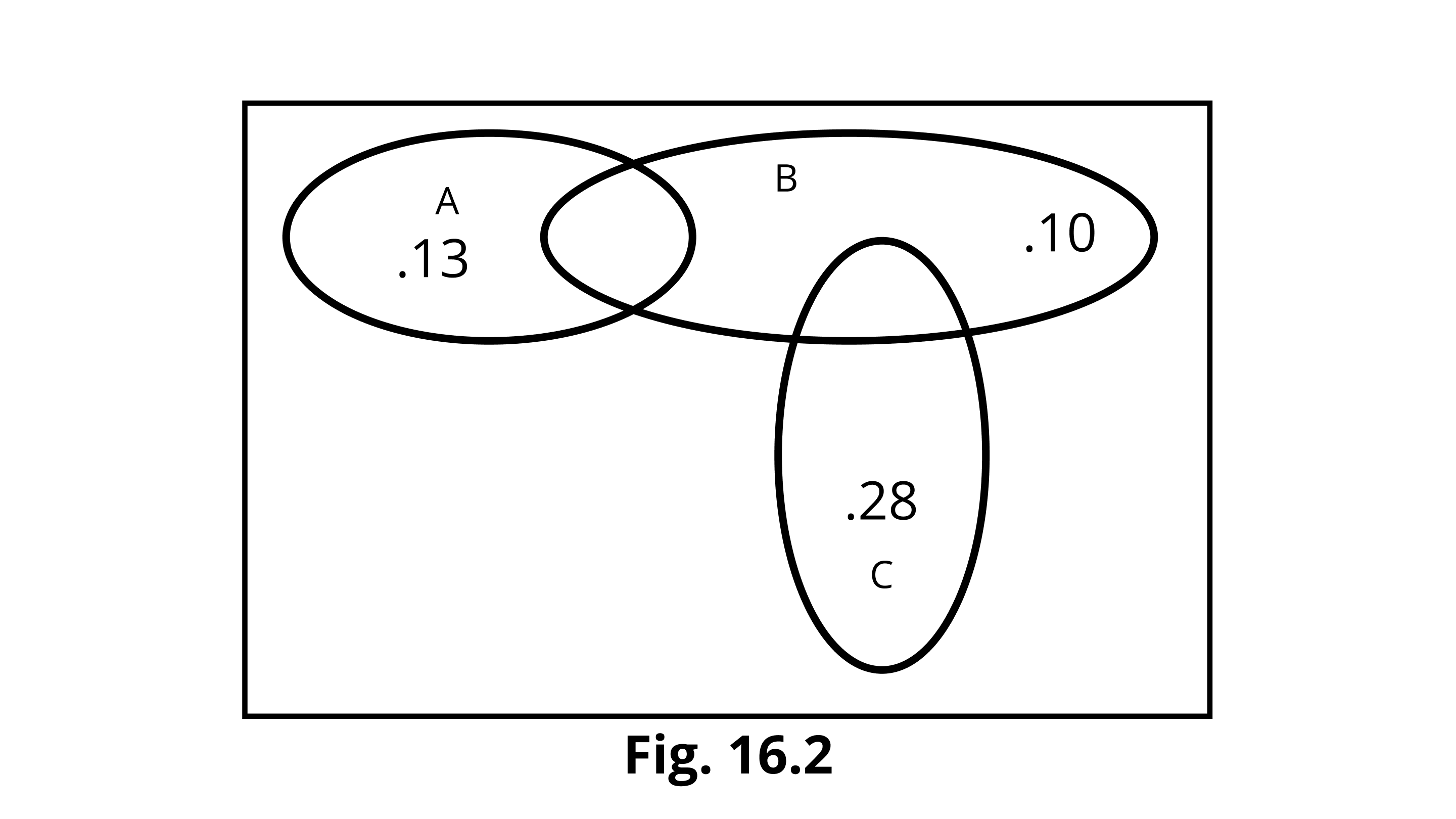
The accompanying Venn diagram shows three events $A$, $B$ and $C$, and also the probabilities of the various intersections (for instance $P\left( {A \cap B} \right) = 0.07$). Determine
$\left( a \right)P\left( A \right)$
Show solutionHide solution
Ans: Given:
In the Venn diagram: -
$P\left( {{\text{only }}A} \right) = 0.13$
$P\left( {{\text{only }}B} \right) = 0.10$
\[P\left( {{\text{only }}C} \right) = 0.28\]
$P\left( {A \cap B} \right) = 0.07$
$P\left( {B \cap C} \right) = 0.15$
Using the Venn and the formulas of theory solve for each subpart of the question.
Use the formulas: -
$P\left( {B \cap \overline C } \right) = P\left( B \right) - P\left( {B \cap C} \right)$
$P\left( {A \cap \overline B } \right) = P\left( A \right) - P\left( {A \cap B} \right)$
The probability of occurrence of the event $A$ is \[P\left( A \right) = P\left( {{\text{only }}A} \right) + P\left( {A \cap B} \right)\].
$\Rightarrow P\left( A \right) = 0.13 + 0.07$
$\Rightarrow P\left( A \right) = 0.20$
$\left( b \right)P\left( {B \cap \overline C } \right)$
Ans: Given:
In the Venn diagram: -
$P\left( {{\text{only }}A} \right) = 0.13$
$P\left( {{\text{only }}B} \right) = 0.10$
\[P\left( {{\text{only }}C} \right) = 0.28\]
$P\left( {A \cap B} \right) = 0.07$
$P\left( {B \cap C} \right) = 0.15$
Using the Venn and the formulas of theory solve for each subpart of the question.
Use the formulas: -
$P\left( {B \cap \overline C } \right) = P\left( B \right) - P\left( {B \cap C} \right)$
$P\left( {A \cap \overline B } \right) = P\left( A \right) - P\left( {A \cap B} \right)$
Here $\left( {B \cap \overline C } \right)$ states the event of occurrence of $B$ and not $C$.
$\Rightarrow P\left( {B \cap \overline C } \right) = P\left( B \right) - P\left( {B \cap C} \right)$
$\Rightarrow P\left( {B \cap \overline C } \right) = \left( {0.10 + 0.07 + 0.15} \right) - 0.15$
$\Rightarrow P\left( {B \cap \overline C } \right) = 0.17$
$\left( c \right)P\left( {A \cup B} \right)$
Ans: Given:
In the Venn diagram: -
$P\left( {{\text{only }}A} \right) = 0.13$
$P\left( {{\text{only }}B} \right) = 0.10$
\[P\left( {{\text{only }}C} \right) = 0.28\]
$P\left( {A \cap B} \right) = 0.07$
$P\left( {B \cap C} \right) = 0.15$
Using the Venn and the formulas of theory solve for each subpart of the question.
Use the formulas: -
$P\left( {B \cap \overline C } \right) = P\left( B \right) - P\left( {B \cap C} \right)$
$P\left( {A \cap \overline B } \right) = P\left( A \right) - P\left( {A \cap B} \right)$
Here $P\left( {A \cup B} \right)$ is the probability of occurrence of either $A$ or $B$.
$\Rightarrow P\left( {A \cup B} \right) = P\left( A \right) + P\left( B \right) - P\left( {A \cap B} \right)$
$\Rightarrow P\left( {A \cup B} \right) = \left( {0.13 + 0.07} \right) + \left( {0.10 + 0.07 + 0.15} \right) - 0.07$
$\Rightarrow P\left( {A \cup B} \right) = 0.45$
$\left( d \right)P\left( {A \cap \overline B } \right)$
Ans: Given:
In the Venn diagram: -
$P\left( {{\text{only }}A} \right) = 0.13$
$P\left( {{\text{only }}B} \right) = 0.10$
\[P\left( {{\text{only }}C} \right) = 0.28\]
$P\left( {A \cap B} \right) = 0.07$
$P\left( {B \cap C} \right) = 0.15$
Using the Venn and the formulas of theory solve for each subpart of the question.
Use the formulas: -
$P\left( {B \cap \overline C } \right) = P\left( B \right) - P\left( {B \cap C} \right)$
$P\left( {A \cap \overline B } \right) = P\left( A \right) - P\left( {A \cap B} \right)$
Here $\left( {A \cap \overline B } \right)$ states the event of occurrence of $A$ and not $B$.
$\Rightarrow P\left( {A \cap \overline B } \right) = P\left( A \right) - P\left( {A \cap B} \right)$
$\Rightarrow P\left( {A \cap \overline B } \right) = \left( {0.13 + 0.07} \right) - 0.07$
$\Rightarrow P\left( {A \cap \overline B } \right) = 0.13$
$\left( e \right)P\left( {B \cap C} \right)$
Ans: Given:
In the Venn diagram: -
$P\left( {{\text{only }}A} \right) = 0.13$
$P\left( {{\text{only }}B} \right) = 0.10$
\[P\left( {{\text{only }}C} \right) = 0.28\]
$P\left( {A \cap B} \right) = 0.07$
$P\left( {B \cap C} \right) = 0.15$
Using the Venn and the formulas of theory solve for each subpart of the question.
Use the formulas: -
$P\left( {B \cap \overline C } \right) = P\left( B \right) - P\left( {B \cap C} \right)$
$P\left( {A \cap \overline B } \right) = P\left( A \right) - P\left( {A \cap B} \right)$
Here $\left( {B \cap C} \right)$ states the event of occurrence of both $A$ and $B$.
$\Rightarrow P\left( {B \cap C} \right) = 0.15$
$\left( f \right)$ Probability of exactly one of the three occurs.
Ans: Given:
In the Venn diagram: -
$P\left( {{\text{only }}A} \right) = 0.13$
$P\left( {{\text{only }}B} \right) = 0.10$
\[P\left( {{\text{only }}C} \right) = 0.28\]
$P\left( {A \cap B} \right) = 0.07$
$P\left( {B \cap C} \right) = 0.15$
Using the Venn and the formulas of theory solve for each subpart of the question.
Use the formulas: -
$P\left( {B \cap \overline C } \right) = P\left( B \right) - P\left( {B \cap C} \right)$
$P\left( {A \cap \overline B } \right) = P\left( A \right) - P\left( {A \cap B} \right)$
Probability of exactly one of the three occurs means \[P\left( {{\text{only }}A} \right) + P\left( {{\text{only }}B} \right) + P\left( {{\text{only }}C} \right)\].
$\Rightarrow $ Required probability $= 0.13 + 0.10 + 0.28$
$\Rightarrow $ Required probability $= 0.51$