Q21Written answer
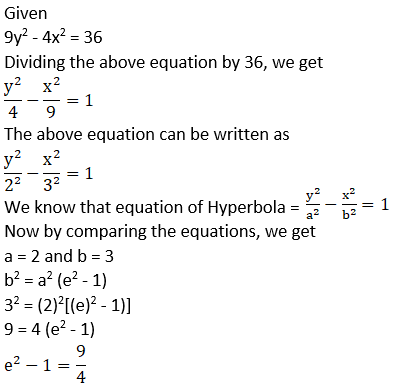
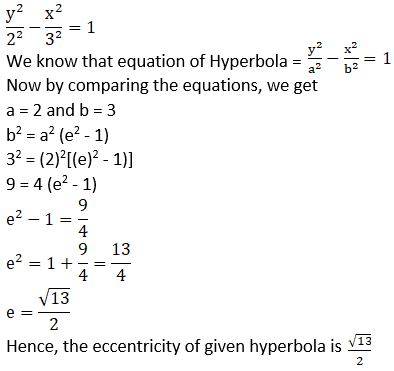
Find the eccentricity of the hyperbola 9y2 – 4x2 = 36.
Show solutionHide solution
Worked solution
Your cart is empty.
Practice each question, then open the answer or worked solution.
Find the eccentricity of the hyperbola 9y2 – 4x2 = 36.
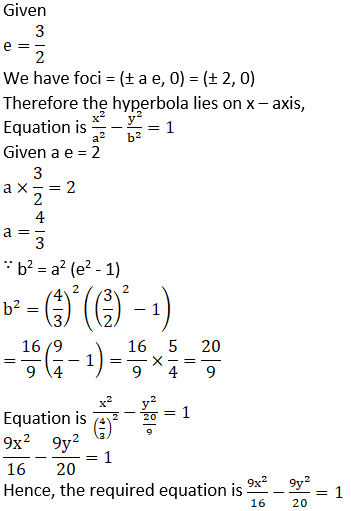
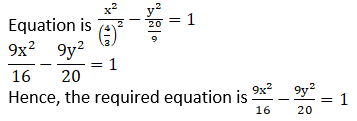
Find the equation of the hyperbola with eccentricity 3/2 and foci at (± 2, 0).
Long Answer type:
If the lines 2x – 3y = 5 and 3x – 4y = 7 are the diameters of a circle of area 154square units, then obtain the equation of the circle.
Since, diameters of a circle intersect at the centre of a circle,
2x – 3y = 5 ………1
3x – 4y = 7 ………..2
Solving the above equations,
Multiplying equation 1 by 3 we get
6x – 9y = 15
Multiplying equation 2 by 2 we get
6x – 8y = 14
y = 1
y = -1
Putting y = -1, in equation 1, we get
2x – 3(-1) = 5
2x + 3 = 5
2x = 2
x = 1
Coordinates of centre = (1,-1)
Given area = 154
Area = πr2 = 154
22/7 × r2 = 154
r2 = 154 × 7/22
r = 7 units
Since, the equation of a circle having centre (h, k), having radius as r units, is
(x – h)2 + (y – k)2 = r2
(x – 1)2 + (y – (-1))2 = 72
x2 – 2x +1 + (y + 1)2 = 49
x2 – 2x + 1 + y2 + 2y + 1 – 49 = 0
x2 – 2x + y2 + 2y – 47 = 0
Hence the required equation of the given circle is x2 – 2x + y2 + 2y – 47 = 0.
Find the equation of the circle which passes through the points (2, 3) and (4, 5) and the centre lies on the straight line y – 4x + 3 = 0.
Since, the equation of a circle having centre (h, k), having radius as r units, is
(x – h)2 + (y – k)2 = r2………..1
Substituting (2, 3) & (4, 5) in the above equation, we get
(2 – h)2 + (3 – k)2 = r2
4 – 4h + h2 + 9 + k2 – 6k = r2
h2 – 4h + k2 – 6k + 13 = r2 …………..2
(4 – h)2 + (5 – k)2 = r2
16 – 8h + h2 + 25 + k2 – 10k = r2
h2 – 8h + k2 – 10k + 41 = r2 ………..3
Equating both the equations 2 & 3, as their RHS are equal, we get
h2 – 4h + k2 – 6k + 13 = h2 – 8h + k2 – 10k + 41
On simplifying we get
8h – 4h + 10k – 6k = 41 – 13
4h + 4k = 28
h + k = 7 ………..4
As centre lies on the given line, so it satisfies the values too,
k – 4h + 3 = 0…………5
Solving equations 3 and 4 simultaneously,
h + k = 7
-4h + k = -3
Subtracting both the equations, we get
5h = 10
h = 2
2 + k = 7
k = 5
Putting h = 2 & k = 5 in equation 2,
h2 – 4h + k2 – 6k + 13 = r2
22 – 4(2) + 52 – 6(5) + 13 = r2
4 – 8 + 25 – 30 + 13 = r2
r2 = 4
r = 2 units
Putting the values of h = 2, k = 5 & r = 2, respectively in equation 1,
(x – h)2 + (y – k)2 = r2
(x – 2)2 + (y – 5)2 = 22
x2 – 4x + 4 + y2 – 10y + 25 = 4
x2 – 4x + y2 – 10y + 25 =0
Hence, the required equation is x2 – 4x + y2 – 10y + 25 = 0.
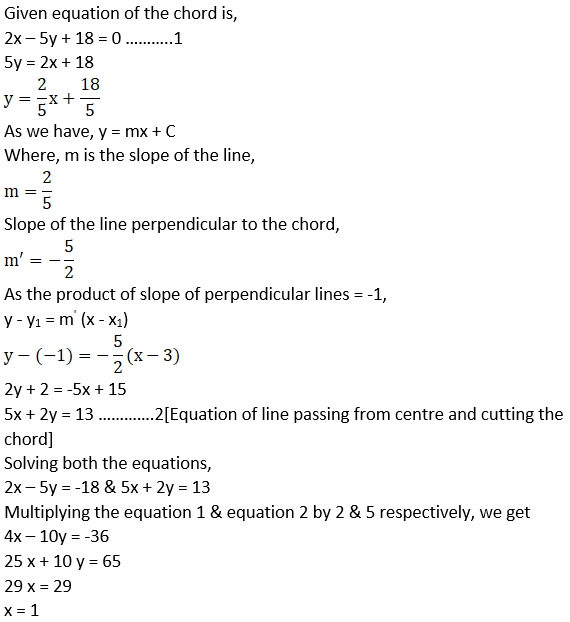
Find the equation of a circle whose centre is (3, –1) and which cuts off a chord of length 6 units on the line 2x – 5y + 18 = 0.
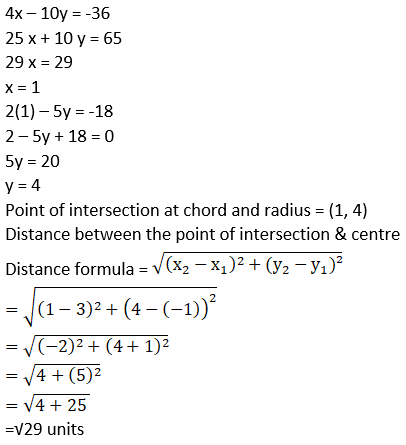
Using Pythagoras Theorem,
(Hypotenuse)2 = (Base)2 + (Perpendicular)2
= (3)2 + (√29)2 = 29 + 9
= √38
Hypotenuse = √38 units (radius)
Since, the radius bisects the chord into two equal halves,
Since, the equation of a circle having centre (h, k), having radius as r units, is
(x – h)2 + (y – k)2 = r2
(x – 3)2 + (y – (-1))2 = (√38)2
x2 – 6x + 9 + (y + 1)2 = 38
x2 – 6x + y2 + 2y + 1 + 9- 38 = 0
x2 – 6x + y2 + 2y – 28 = 0
Hence, the required equation of the circle is x2 – 6x + y2 + 2y – 28 = 0.
Find the equation of a circle of radius 5 which is touching another circle x2 + y2 – 2x – 4y – 20 = 0 at (5, 5).
Given x2 – 2x + y2 – 4y – 20 = 0
x2 – 2x + 1 +y2 – 4y + 4 – 20 – 5 = 0
(x – 1)2 + (y – 2)2 = 25
(x – 1)2 + (y – 2)2 = 52
Since, the equation of a circle having centre (h, k), having radius as r units, is
(x – h)2 + (y – k)2 = r2
Centre = (1, 2)
Point of Intersection = (5, 5)
It intersects the line into 1: 1, as the radius of both the circles is 5 units.
Using Ratio Formula,
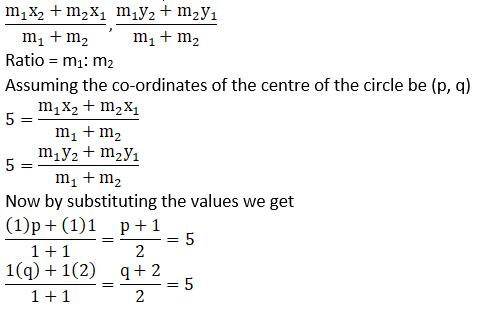
p + 1 = 10, q + 2 = 10
p = 9 & q = 8
Co-ordinates = (9, 8)
Therefore the equation is,
(x – h)2 + (y – k)2 = r2
(x – 9)2 + (y – 8)2 = 52
x2 – 18x + 81 + y2 – 16y + 64 = 25
x2 – 18x + y2 – 16y + 145 – 25 = 0
x2 – 18x + y2 – 16y + 120 = 0
Hence, the required equation is x2 – 18x + y2 – 16y + 120 = 0.
Find the equation of a circle passing through the point (7, 3) having radius 3 units and whose centre lies on the line y = x – 1.
Since, the equation of a circle having centre (h, k), having radius as r units, is
(x – h)2 + (y – k)2 = r2Centre lies on the line i.e., y = x – 1,
Co – Ordinates are (h, k) = (h, h – 1)
(x – h)2 + (y – k)2 = r2
(7 – h)2 + (3 – (h – 1))2 = 32
49 + h2 – 14h + (3 – h +1)2 = 9
On rearranging we get
h2 – 14h + 49 +16 +h2 – 8h – 9 = 0
2h2 – 22h + 56 = 0
h2 – 11h + 28 = 0
h2 – 4h – 7h + 28 = 0
h (h – 4) – 7 (h – 4) = 0
(h – 7) (h – 4) = 0
h = 7 or 4
Centre = (7, 6) or (4, 3)
(x – h)2 + (y – k)2 = r2
Equation, having centre (7, 6)
(x – 7)2 + (y – 6)2 = 32
x2 – 14x + 49 + y2 – 12y + 36 – 9 = 0
x2 – 14x + y2 – 12y + 76 = 0
Equation, having centre (4, 3)
(x – 4)2 + (y – 3)2 = 32
x2 – 8x + 16 + y2 – 6y + 9 – 9 = 0
x2 – 8x + y2 – 6y + 16 = 0
Hence, the required equation is x2 – 14x + y2 – 12y + 76 = 0 or x2 – 8x + y2 – 6y + 16 = 0.
Find the equation of each of the following parabolas
(a) Directrix x = 0, focus at (6, 0)
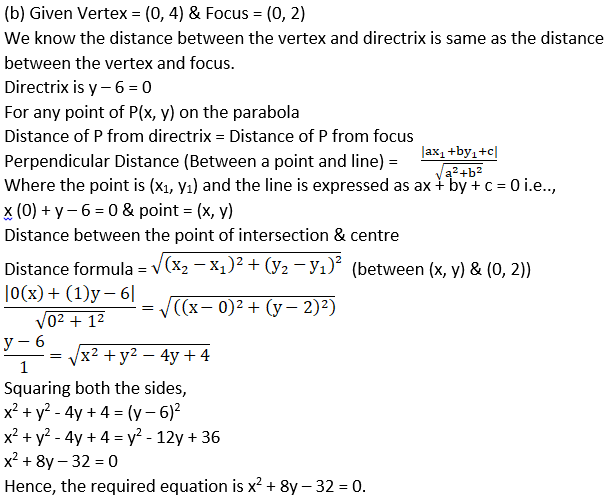
(b) Vertex at (0, 4), focus at (0, 2)
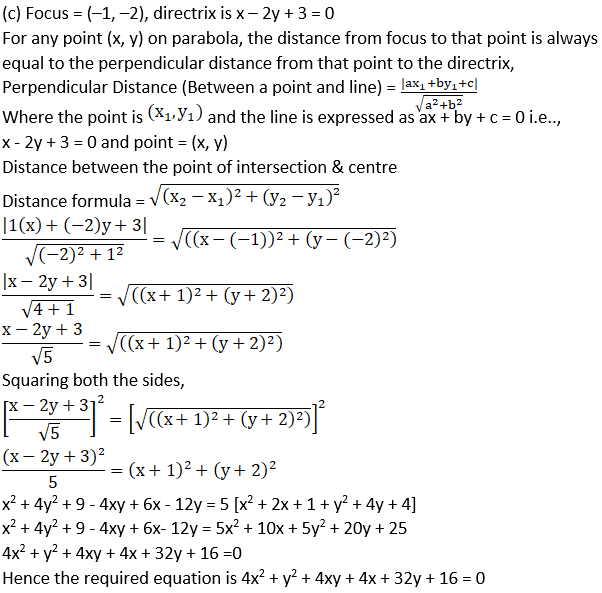
(c) Focus at (–1, –2), directrix x – 2y + 3 = 0
(a) The distance of any point on the parabola from its focus and its directrix is same.
Given that, directrix, x = 0 and focus = (6, 0)
If a parabola has a vertical axis, the standard form of the equation of the parabola is (x – h)2 = 4p (y – k), where p≠ 0.
The vertex of this parabola is at (h, k).
The focus is at (h, k + p) & the directrix is the line y = k – p.
As the focus lies on x – axis,
Therefore the equation is y2 = 4ax or y2 = -4ax
So, for any point P(x, y) on the parabola
Distance of point from directrix = Distance of point from focus
x2 = (x – 6)2 + y2
x2 = x2 – 12x + 36 + y2
y2 – 12x + 36 = 0
Hence the required equation is y2 – 12x + 36 = 0.