My Cart
Your Cart 0

    Your cart is empty.

  • Total (Amount) ₹0.00
NCERT Exemplar · Class 11 · Maths

Chapter 10: Straight Lines

Practice each question, then open the answer or worked solution.

Short Answer Questions

59 questions
Q11Written answer

Find the equation of a straight line on which length of perpendicular from the origin is four units and the line makes an angle of  $ 12{0^o} $ with the positive direction of  $ x -  $ axis. 

Show solutionHide solution
Worked solution

Ans: 

Given: Line makes  $ {120^ \circ } $ with the positive direction of  $ x -  $ axis. 

The line makes  $ {120^ \circ } $  with the positive direction of  $ x -  $ axis.

So, slope of the line is  $ \tan {120^ \circ } =  - \sqrt 3  $ .

Equation of the required line is: 

 $ y =  - \sqrt 3 x + c $ 

 $ \Rightarrow \sqrt 3 x + y - c = 0 $ . 

This line is 4 units away from  $ (0,0) $ .

 $ \Rightarrow \frac{{\left| {\sqrt 3 (0) + 0 - c} \right|}}{{\sqrt {3 + 1} }} = 4 $ 

 $ \Rightarrow \quad |c| = 8 $ 

 $ \Rightarrow c =  \pm 8 $ 

Therefore, the equation of line is  $ \sqrt 3 x + y \pm 8 = 0 $ .

Q12Written answer

Find the equation of one of the sides of an isosceles right angled triangle whose hypotenuse is given by  $ 3x + 4y + 4 = 0 $  and the opposite vertex of the hypotenuse is  $ (2,2) $ .

Show solutionHide solution
Worked solution

Ans: 

Given: $ 3x + 4y + 4 = 0 $ 

The hypotenuse is along the line  $ 3x + 4y + 4 = 0 $ 

Slope of the hypotenuse is  $ \frac{{ - 3}}{4} $ .

As the triangle is isosceles right angled triangle, two angles will be equal to  $ {45^\circ } $ .

Let the slope of the line making  $ {45^\circ } $  with the hypotenuse be  $ m $ .

 $ \Rightarrow \tan {45^\circ } = \left| {\frac{{m - \left( { - \frac{3}{4}} \right)}}{{1 + m\left( { - \frac{3}{4}} \right)}}} \right| $ 

 $ \Rightarrow \tan {45^\circ } = \left| {\frac{{4m + 3}}{{4 - 3m}}} \right| $ 

 $ \Rightarrow \frac{{4m + 3}}{{4 - 3m}} =  \pm 1 $ 

 $ \Rightarrow 4m + 3 = 4 - 3m $ or $ 4m + 3 = 3m - 4 $ 

 $ \Rightarrow m = \frac{1}{7} $ or $ m =  - 7 $ 

Slope of this line is  $ \frac{1}{7} $ , so the equation of this line is  $ y - 2 = (1/7)(x - 2) $  i.e.  $ x - 7y + 12 = 0 $ .

The slope of line perpendicular to it is  $  - 7 $ . 

The equation of this line is:  $ y - 2 =  - 7(x - 2) $  i.e.  $ 7x + y - 16 = 0 $ .

Therefore, the equation of required line is  $ 7x + y - 16 = 0 $ .


Q13Written answer

If the equation of the base of an equilateral triangle is  $ x + y - 2 $  and the vertex is  $ (2, - 1) $ , then find the length of the side of the triangle.

Show solutionHide solution
Worked solution

Ans: 

Given:  $ x + y - 2 $ and  $ (2, - 1) $ .

The altitude from the vertex  $ (2, - 1) $ on the base  $ x + y - 2 $  meets at the midpoint of base. 

The length of altitude is the distance of  $ (2, - 1) $  from $ x + y - 2 $  $  = \left| {\frac{{2 + ( - 1) - 2}}{{\sqrt {{1^2} + {1^2}} }}} \right| = \frac{1}{{\sqrt 2 }} $ .

The triangle is an equilateral triangle. So,  $ \sin {60^\circ } = \frac{{{\text{Altitude}}}}{{{\text{side of triangle}}}} $ .

$ \Rightarrow {\text{length of side of triangle}} = \frac{{{\text{Altitude}}}}{{\sin {{60}^\circ }}} = \frac{{\frac{1}{{\sqrt 2 }}}}{{\frac{{\sqrt 3 }}{2}}} = \sqrt {\frac{2}{3}}  $ .

Therefore, the length of side of the triangle is  $ \sqrt {\frac{2}{3}}  $ .


Q14Written answer

A variable line passes through a fixed point  $ P $ . The algebraic sum of the perpendiculars drawn from the points  $ (2,0),(0,2) $  and  $ (1,1) $  on the line is zero. Find the coordinates of the point  $ P $ .

Show solutionHide solution
Worked solution

Ans: 

Given:  $ (2,0),(0,2) $  and  $ (1,1) $ 

Assume that the variable line passing through the fixed point  $ P $ is  $ ax + by + c = 0 $ .

Perpendicular distance from the point $ A(2,0) = \frac{{2a + 0 + c}}{{\sqrt {{a^2} + {b^2}} }} $ 

Perpendicular distance from the point $ B(0,2) = \frac{{0 + 2b + c}}{{\sqrt {{a^2} + {b^2}} }} $ 

Perpendicular distance from the point $ C(1,1) = \frac{{a + b + c}}{{\sqrt {{a^2} + {b^2}} }} $ 

Given that,  $ \frac{{2a + 0 + c}}{{\sqrt {{a^2} + {b^2}} }} + \frac{{0 + 2b + c}}{{\sqrt {{a^2} + {b^2}} }} + \frac{{a + b + c}}{{\sqrt {{a^2} + {b^2}} }} = 0 $ 

 $ \Rightarrow \quad 3a + 3b + 3c = 0 $ or $ a + b + c = 0 $ 

Therefore, the variable line passes through the fixed point  $ (1,1) $ .


Q15Written answer

In what direction should a line be drawn through the point  $ (1,2) $  so that its point of intersection with the line  $ x + y = 4 $  is at a distance  $ \frac{{\sqrt 6 }}{3} $  from the given point.

Show solutionHide solution
Worked solution

Ans: 

Given:  $ x + y = 4 $ and  $ (1,2) $ .

Let the slope of line be  $ m $ . 

It passes through $ A(1,2) $ 

 So, the equation of line is  $ y - 2 = m(x - 1) $  or  $ mx - y + 2 - m = 0{\text{       }}...{\text{(1)}} $ 

The equation of the given line is  $ x + y - 4 = 0\quad ...(2) $ 

Assume that these lines meet at point  $ B $ .

Solving  $ (1) $ and  $ (2) $ , 

$ B \equiv \left( {\frac{{m + 2}}{{m + 1}},\frac{{3m + 2}}{{m + 1}}} \right) $ 

Given that  $ AB = \frac{{\sqrt 6 }}{3} $ 

$ \Rightarrow \quad A{B^2} = \frac{6}{9} $ 

$ \Rightarrow {\left( {\frac{{m + 2}}{{m + 1}} - 1} \right)^2} + {\left( {\frac{{3m + 2}}{{m + 1}} - 2} \right)^2} = \frac{6}{9} $ 

$ \Rightarrow \quad {\left( {\frac{1}{{m + 1}}} \right)^2} + {\left( {\frac{m}{{m + 1}}} \right)^2} = \frac{2}{3} $ 

$ \Rightarrow \frac{{1 + {m^2}}}{{{{(1 + m)}^2}}} = \frac{2}{3} $ 

$ \Rightarrow \quad 3 + 3{m^2} = 2 + 2{m^2} + 4m $ 

$ \Rightarrow {m^2} - 4m + 1 = 0 $ 

$ \Rightarrow m = \frac{{4 \pm \sqrt {16 - 4} }}{2} = 2 \pm \sqrt 3  = 2 + \sqrt 3  $ or $ 2 - \sqrt 3  $ 

$ \Rightarrow \tan \theta  = 2 + \sqrt 3  $ or $ 2 - \sqrt 3  $ 

$ \Rightarrow \theta  = {75^\circ } $ or  $ \theta  = {15^\circ } $ .

Therefore,  $ \theta  = {75^ \circ }{\text{ or }}\theta  = {15^ \circ } $ 


Q16Written answer

A straight line moves so that the sum of the reciprocals of its intercepts made on axes is constant. Show that the line passes through a fixed point. 

Show solutionHide solution
Worked solution

Ans: 

Given:  $ \frac{1}{a} + \frac{1}{b} =  $  constant

The equation of line in intercept form is  $ \frac{x}{a} + \frac{y}{b} = 1 $ .

As  $ \frac{1}{a} + \frac{1}{b} =  $  constant, 

Let  $ \frac{1}{a} + \frac{1}{b} $  $  = \frac{1}{k} $ . 

So,  $ \frac{k}{a} + \frac{k}{b} = 1 $ 

Thus,  $ (k,k) $  lies on  $ \frac{x}{a} + \frac{k}{b} = 1 $ .

Therefore, the line passes through the fixed point  $ (k,k) $ .


Q17Written answer
Find the equation of the line which passes through the fixed point  $( - 4,3)$   and the portion of the line intercepted between the axes id divided internally in the ratio 5:3 by this point.
Show solutionHide solution
Worked solution
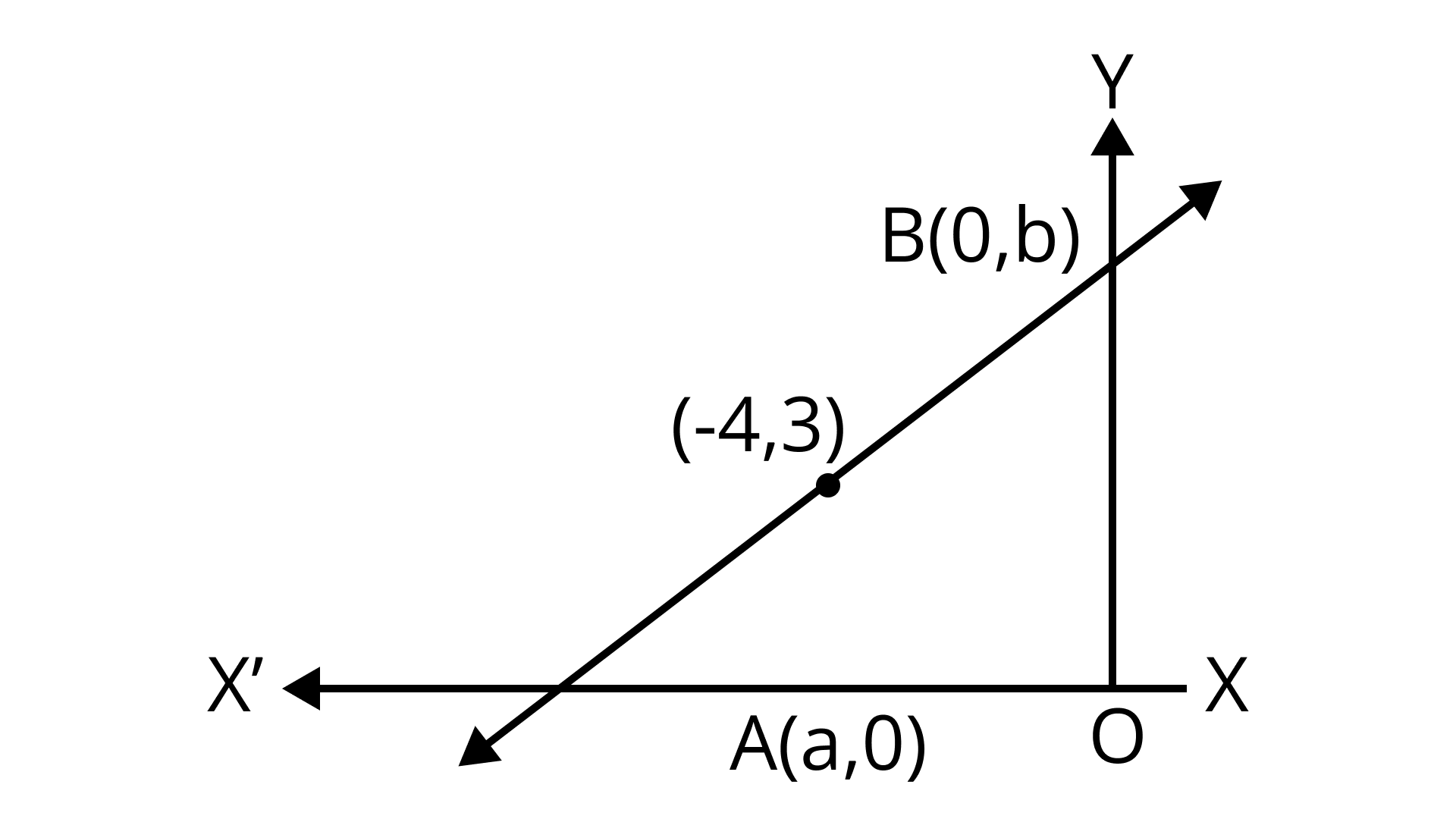
Ans: Let AB be a line passing through a point (- 4, 3) and meets x-axis at A(a, 0) and y-axis at B(0, b).


seo images


$\Rightarrow \therefore  - 4 = \frac{{5 \times 0 + 3a}}{{5 + 3}}$  

$\Rightarrow  - 4 = \frac{{3a}}{8}\left[ {\because X = \frac{{{m_1}{x_2} + {m_2}{x_1}}}{{{m_1} + {m_2}}},y = \frac{{{m_1}{y_2} + {m_2}{y_1}}}{{{m_1} + {m_2}}}} \right]$ 

$\Rightarrow 3a =  - 32$                                                                                                              

$\Rightarrow a = \frac{{ - 32}}{3}$   and  $3 = \frac{{5 \times b + 3 \times 0}}{{5 + 3}}$                                                                

$\Rightarrow 3 = \frac{{5 \times b}}{8} \Rightarrow 5b = 24 \Rightarrow b = \frac{{25}}{5}$  

Intercept form of the line is  $\frac{x}{{\frac{{ - 32}}{3}}} + \frac{y}{{\frac{{24}}{5}}} = 1$                      

$\Rightarrow \frac{{ - 3x}}{{32}} + \frac{{5y}}{{24}} = 1$ 

$\Rightarrow  - 9x + 20y = 96 \Rightarrow 9x - 20y + 96 = 0$  

Hence, The required equation is  $9x - 20y + 96 = 0$ 


Q18Written answer
Find the equation of the lines through the point of intersection of the lines  $x - y + 1 = 0 $   and \[2x--3y + 5 = 0\] and whose distance from the point  $(3,2)$   is  $ \frac{7}{5}. $  
Show solutionHide solution
Worked solution

Ans: Given equation are

$\mathbf{x}-\mathbf{y}+\mathbf{1}=\mathbf{0} \ldots(\mathbf{i}) $  And  $ \mathbf{2} \mathbf{x}-\mathbf{3} \mathbf{y}+\mathbf{5}=\mathbf{0} \ldots(\mathbf{i i})$  Solving eq. (i) and eq. (ii) 

we get  $2 x-2 y+2=0$   $2 x-3 y+5=0$   

$y-3=0, y=3$ 

From eq. (i) we have 

$\mathbf{x}-\mathbf{3}+\mathbf{1}=\mathbf{0} \Rightarrow \mathbf{x}=\mathbf{2}$ 

So,  $(2,3)$  is the point of intersection of eq.(i) and eq. (ii). 

Let m be the slope of the required line

 $\therefore$  Equation of the line is

 $y-3=m(x-2)$ 

 $\Rightarrow y-3=m x-2 m$ 

 $\Rightarrow m x-y+3-2 m=0$ 

Since, the perpendicular distance from  $(3,2)$ 

to the line is  $\frac{7}{5}$  then,

 $\frac{7}{5}=\left|\frac{m(3)-2+3-2 m}{\sqrt{m^{2}+1}}\right|$ 

 $\Rightarrow \frac{49}{25}=\frac{(3 m-2+3-2 m)^{2}}{m^{2}+1}$ 

 $\Rightarrow \frac{49}{25}=\frac{(m+1)^{2}}{m^{2}+1}$ 

 $\Rightarrow 49 m^{2}+49=25 m^{2}+50 m+25$ 

 $\Rightarrow 49 m^{2}-25 m^{2}-50 m+49-25=0$ 

 $\Rightarrow 24 m^{2}-50 m+24=0$ 

 $\Rightarrow 12 m^{2}-25 m+12=0$ 

 $\Rightarrow 12 m^{2}-16 m-9 m+12=0$ 

 $\Rightarrow 4 m(3 m-4)-3(3 m-4)=0$ 

 $\Rightarrow(3 m-4)(4 m-3)=0$ 

 $\Rightarrow 3 m-4=0 \text { and } 4 m-3=0$ 

 $\Rightarrow 3 m-4=0 \text { and } 4 m-3=0$ 

 $\therefore m=\frac{4}{3}, \frac{3}{4}$ 

Equation of the line taking  $ m=\frac{4}{3}$  is

 $y-3=\frac{4}{3}(x-2)$ 

 $\Rightarrow 3 y-9=4 x-8 \Rightarrow 4 x-3 y+1=0$ 

Equation of the line taking  $m=\frac{3}{4}$  is

 $y-3=\frac{3}{4}(x-2)$ 

 $\Rightarrow 4 y-12=3 x-6 \Rightarrow 3 x-4 y+6=0$ 

Hence, the required equation are

 $4 x-3 y+1=0 \text { and } 3 x-4 y+6=0$ 


Q19Written answer
If the sum of the distance of a moving point in a plane from the axes is 1, then find the locus of the point.
Show solutionHide solution
Worked solution

Ans: Let coordinates of a moving point P be  $ (x,y). $  

Given that the sum of the distance from the axes to the point is always 1


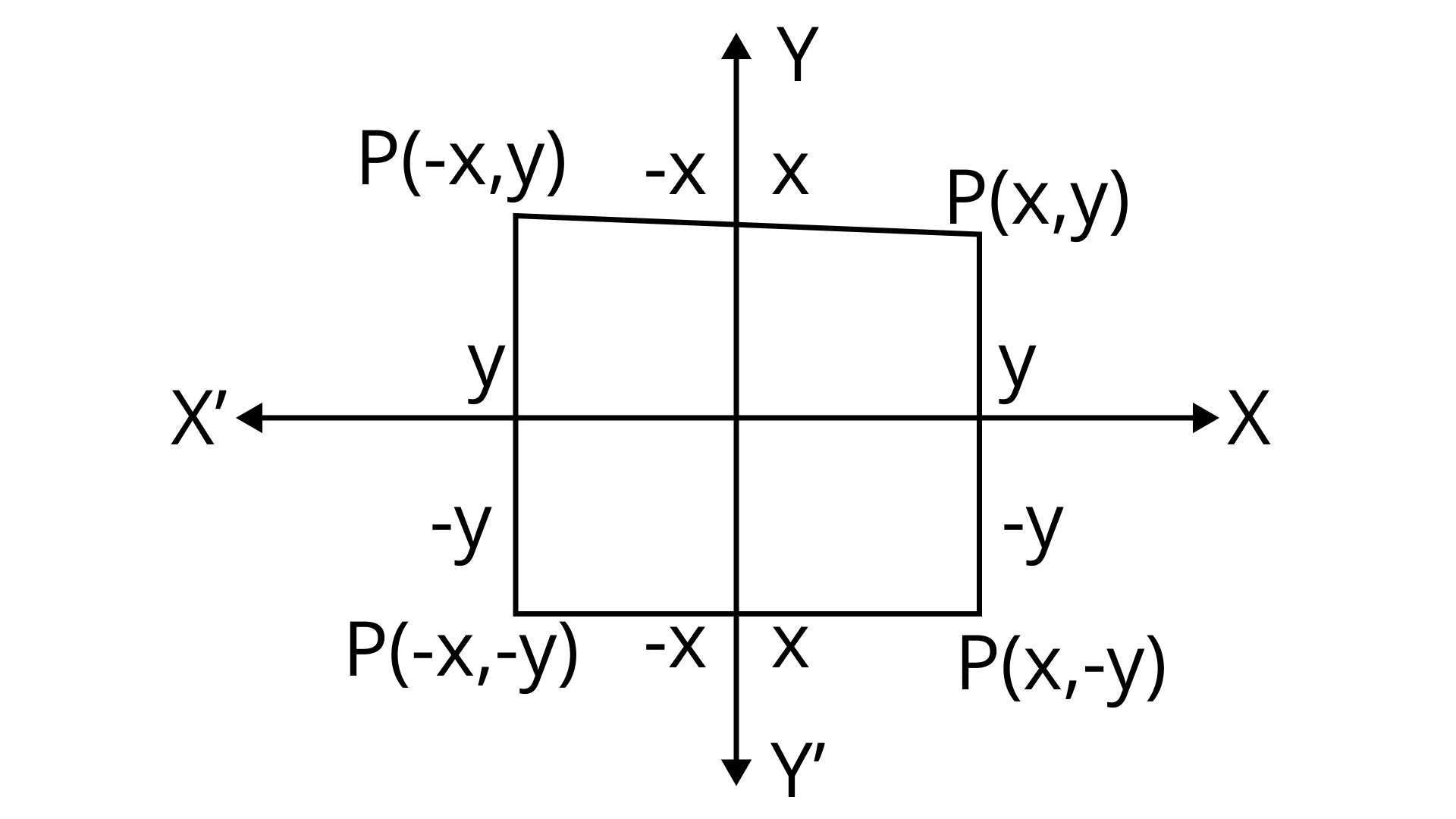
seo images


$ {\therefore \left| x \right|{\text{ }} + {\text{ }}\left| y \right|{\text{ }} = {\text{ }}1} $ 

$ { \Rightarrow x{\text{ }} + {\text{ }}y{\text{ }} = {\text{ }}1} $  

$ { \Rightarrow  - x--y = 1} $  

$ { \Rightarrow  - x + y = 1} $ 

$ { \Rightarrow x--y{\text{ }} = {\text{ }}1} $ 

Hence, these equations gives us the locus of the point P which is a square.


Q20Written answer
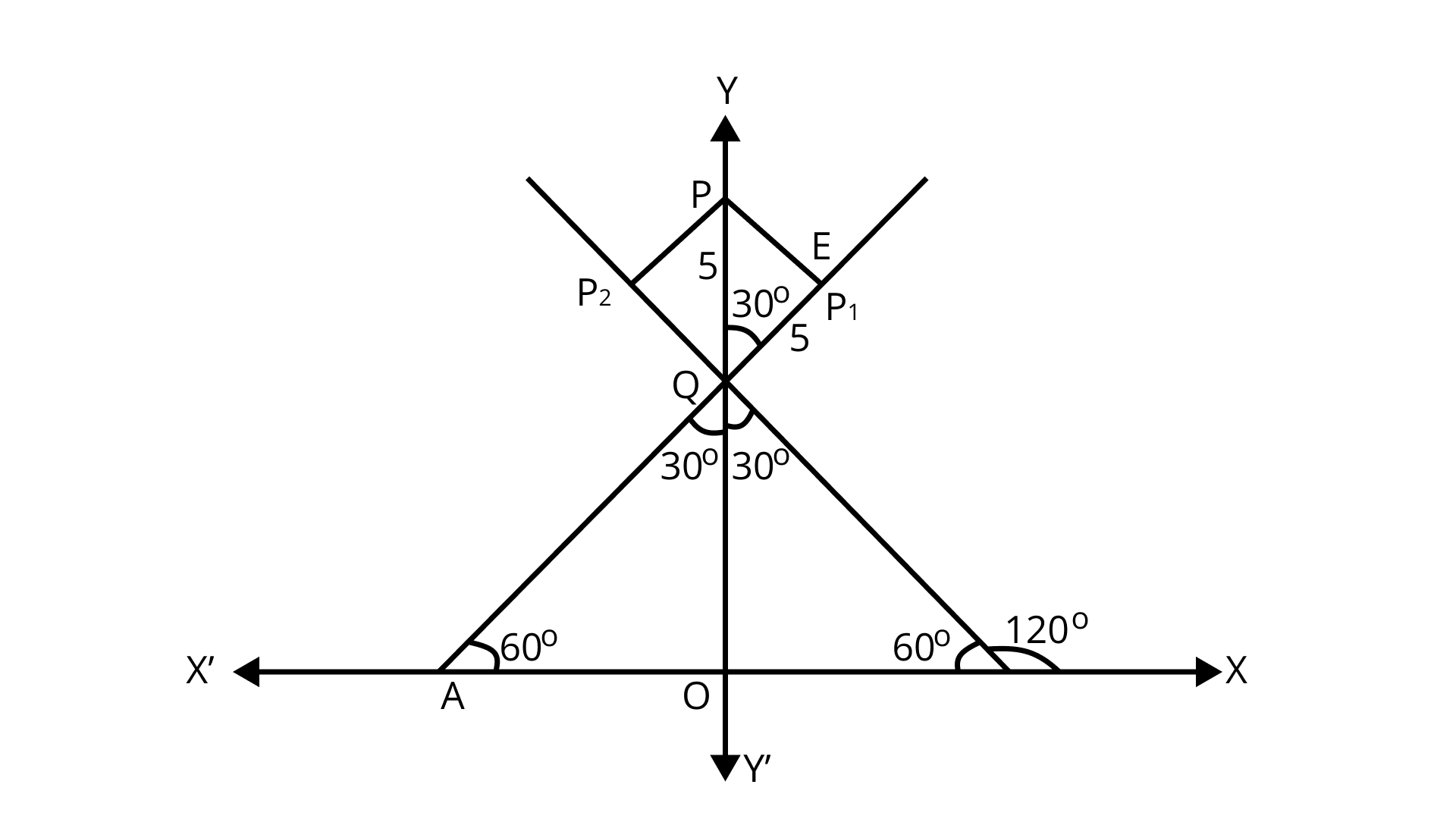
P1, P2 are points on either of the two lines  $ y - \sqrt 3 \left| x \right| = 2 $ at a distance of 5 units from their point of intersection. Find the coordinates of the foot of perpendiculars drawn from P1, P2 on the bisector of the angle between the given lines.


seo images


Show solutionHide solution
Worked solution

Ans: Given lines are  $ y - \sqrt 3 \left| x \right| = 2 $ 

$ \Rightarrow y - \sqrt 3  x = 2 $   if x ≥ 0 …(i)

And  $ y + \sqrt 3  x = 2 $  if x < 0 …(ii)

Slope of eq. (i) is  $ \tan \theta  = \sqrt 3  $    $ \therefore \theta  = {60^o} $  

Slope of eq. (ii) is  $ \tan \theta  =  - \sqrt 3  $    $ \therefore \theta  = {120^o} $ 

120° Solving eq. (i) and eq. (ii) we get

$ y - \sqrt 3 x = 2 $ 

$ y + \sqrt 3 x = 2 $ 

$ \_\_\_\_\_\_\_\_\_\_ $ 

$ 2y = 4 \Rightarrow y = 2 $  

Putting the value of y is eq. (i) we get

$ x = 0 $  

Point of intersection of line (i) and (ii) is  $ Q(0,2) $  

$ \therefore QO = 2 $  

$  $  In  $ \Delta PEQ, $                                                                                                 

$ \cos {30^o} = \frac{{PQ}}{{QE}} \Rightarrow \frac{{\sqrt 3 }}{2} = \frac{{PQ}}{5} $ 

$ \Rightarrow \therefore PQ = \frac{{5\sqrt 3 }}{2} $ 

$ \therefore OP = OQ + PQ $  

$  = 2 + \frac{{5\sqrt 3 }}{2} $  

Hence, the coordinates of the foot of perpendicular  $  = (0,2 + \frac{{5\sqrt 3 }}{2}) $