My Cart
Your Cart 0

    Your cart is empty.

  • Total (Amount) ₹0.00
NCERT Exemplar · Class 11 · Maths

Chapter 1: Sets

Practice each question, then open the answer or worked solution.

Exercise · Page 12

Textbook page 12 · 29 questions
Q21Written answer

For all sets A and B, (A ∪ B) – B = A – B

Show solutionHide solution
Worked solution

According to the question,

There are two sets A and B

To prove: (A ∪ B) – B = A – B

L.H.S = (A ∪ B) – B

Since, A – B = A ∩ B’, we get,

= (A ∪ B) ∩ B’

Since, Distributive property of set: (A ∩ B) ∪ (A ∩ C) = A ∩ (B ∪ C), we get,

= (A ∩ B’) ∪ (B ∩ B’)

Since, A ∩ A’ = Φ, we get,

= (A ∩ B’) ∪ Φ

= A ∩ B’

Since, A – B = A ∩ B’, we get,

= A – B

= R.H.S

Hence Proved

Q22Written answer

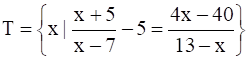
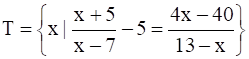
Let, 

NCERT Exemplar Class 11 Maths Chapter 1-10

Is T an empty set? Justify your answer.

Show solutionHide solution
Worked solution

According to the question,

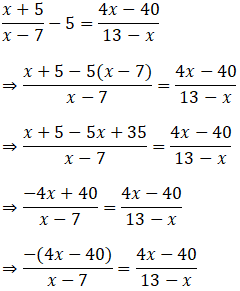
NCERT Exemplar Class 11 Maths Chapter 1-11

To check whether T is an empty set or not,

We solve,

NCERT Exemplar Class 11 Maths Chapter 1-12

⇒ -(4x – 40)(13 – x) = (4x – 40)(x – 7)

⇒ (4x – 40)(x – 7) + (4x – 40)(13 – x) = 0

⇒ (4x – 40)(x – 7 + 13 – x) = 0

⇒ 6(4x – 40) = 0

⇒ 24(x – 10) = 0

⇒ x – 10 = 0

⇒ x = 10

So, T = {10}

⇒ T is not an empty set

Long Answer Type

Q23Written answer

Let A, B and C be sets. Then show that A ∩ (B ∪ C) = (A ∩ B) ∪ (A ∩ C)

Show solutionHide solution
Worked solution

According to the question,

A, B and C are three given sets

To prove: A ∩ (B ∪ C) = (A ∩ B) ∪ (A ∩ C)

Let x ∈ A ∩ (B ∪ C)

⇒ x ∈ A and x ∈ (B ∪ C)

⇒ x ∈ A and (x ∈ B or x ∈ C)

⇒ (x ∈ A and x ∈ B) or (x ∈ A and x ∈ C)

⇒ x ∈ A ∩ B or x ∈ A ∩ C

⇒ x ∈ (A ∩ B) ∪ ( A ∩ C)

⇒ A ∩ (B ∪ C) ⊂ (A ∩ B) ∪ ( A ∩ C) …(i)

Let y ∈ (A ∩ B) ∪ (A ∩ C)

⇒ y ∈ A ∩ B or x ∈ A ∩ C

⇒ (y ∈ A and y ∈ B) or (y ∈ A and y ∈ C)

⇒ y ∈ A and (y ∈ B or y ∈ C)

⇒ y ∈ A and y ∈ (B ∪ C)

⇒ y ∈ A ∩ (B ∪ C)

⇒ (A ∩ B) ∪ (A ∩ C) ⊂ A ∩ (B ∪ C) …(ii)

We know that:

P ⊂ Q and Q ⊂ P ⇒ P = Q

From equations (i) and (ii), we have,

A ∩ (B ∪ C) = (A ∩ B) ∪ (A ∩ C)

Hence Proved

Q24Written answer

Out of 100 students; 15 passed in English, 12 passed in Mathematics, 8 in Science, 6 in English and Mathematics, 7 in Mathematics and Science; 4 in English and Science; 4 in all the three. Find how many passed
(i) in English and Mathematics but not in Science
(ii) in Mathematics and Science but not in English
(iii) in Mathematics only
(iv) in more than one subject only

Show solutionHide solution
Worked solution

According to the question,

Total number of students = 100

Number of students who passed in English = 15

Number of students who passed in Mathematics = 12

Number of students who passed in Science = 8

Number of students who passed in English and Mathematics = 6

Number of students who passed in Mathematics and Science = 7

Number of students who passed in English and Science = 4

Number of students who passed in all three = 4

Let the total number of students = U

Let the number of students passed in English = E

Let the number of students passed in Mathematics = M

Let the number of students passed in Science = S

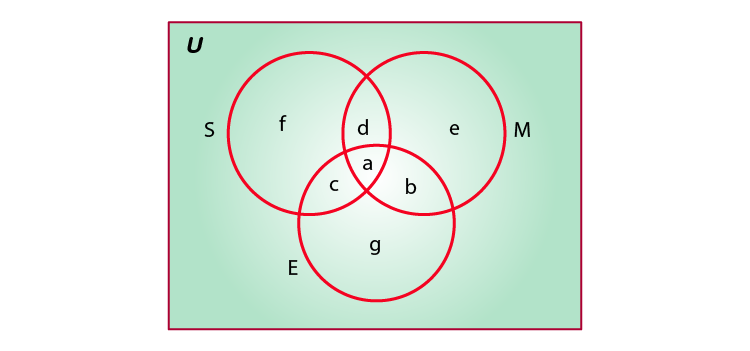
NCERT Exemplar Class 11 Maths Chapter 1-13

n(M ∩ S ∩ E) = a = 4

n(M ∩ S) = a + d = 7

⇒ 4 + d = 7

⇒ d = 3

n(M ∩ E) = a + b = 6

⇒ 4 + b = 6

⇒ b = 2

n(S ∩ E) = a + c = 4

⇒ 4 + c = 4

⇒ c = 0

n(M) = e + d + a + b = 12

⇒ e + 4 + 3 + 2 = 12

⇒ e + 9 = 12

⇒ e = 3

n(E) = g + c + a + b = 15

⇒ g + 0 + 4 + 2 = 15

⇒ g + 6 = 15

⇒ g = 9

n(S) = f + c + a + d = 8

⇒ f + 0 + 4 + 3 = 8

⇒ f + 7 = 8

⇒ f = 1

Therefore, from the above equations, we get that,

(i) Number of students passed in English and Mathematics but not in Science = b = 2

(ii) Number of students in Mathematics and Science but not in English = d = 3

(iii) Number of students in Mathematics only = e = 3

(iv) Number of students in more than one subject only = a + b + c + d = 4 + 3 + 2 + 0 = 9

Q25Written answer

In a class of 60 students, 25 students play cricket and 20 students play tennis, and 10 students play both the games. Find the number of students who play neither?

Show solutionHide solution
Worked solution

According to the question,

Total number of students = 60

Students who play cricket = 25

Students who play tennis = 20

Students who play both the games = 10

To find: number of students who play neither

Let the total number of students = S

Let the number of students who play cricket = C

Let the number of students who play tennis = T

n(S) = 60, n(C) = 25, n(T) = 20, n(C ∩ T) = 10

So, Number of students who play either of them,

n(C ∪ T) = n(C) + n(T) – n(C ∩ T)

= 25 + 20 – 10

= 35

Hence, Number of student who play neither = Total – n(C ∪ T)

= 60 – 35

= 25

Therefore, there are 25 students who play neither cricket nor tennis.

Q26Written answer

In a survey of 200 students of a school, it was found that 120 study Mathematics, 90 study Physics and 70 study Chemistry, 40 study Mathematics and Physics, 30 study Physics and Chemistry, 50 study Chemistry and Mathematics and 20 none of these subjects. Find the number of students who study all the three subjects.

Show solutionHide solution
Worked solution

According to the question,

Total number of students = n(U) = 200

Number of students who study Mathematics = n(M) = 120

Number of students who study Physics = n(P) = 90

Number of students who study Chemistry = n(C) = 70

Number of students who study Mathematics and Physics = n(M ∩ P) = 40

Number of students who study Mathematics and Chemistry = n(M ∩ C) = 50

Number of students who study Physics and Chemistry = n(P ∩ C) = 30

Number of students who study none of them = 20

Let the total number of students = U

Let the number of students who study Mathematics = M

Let the number of students who study Physics = P

Let the number of students who study Chemistry = C

number of students who study all the three subjects n(M ∩ P ∩ C)

Number of students who play either of them = n(P ∪ M ∪ C)

n(P ∪ M ∪ C) = Total – none of them

= 200 – 20

= 180 …(i)

Number of students who play either of them = n(P ∪ M ∪ C)

n(P ∪ M ∪ C) = n(C) + n(P) + n(M) – n(M ∩ P) – n(M ∩ C) – n(P ∩ C) + n(P ∩ M ∩ C)

= 120 + 90 + 70 – 40 – 30 – 50 + n(P ∩ M ∩ C)

= 160 + n(P ∩ M ∩ C) …(ii)

From equation (i) and (ii), we get,

160 + n(P ∩ M ∩ C) = 180

⇒ n(P ∩ M ∩ C) = 180 – 160

⇒ n(P ∩ M ∩ C) = 20

Therefore, there are 20 students who study all the three subjects.

Q27Written answer

In a town of 10,000 families it was found that 40% families buy newspaper A, 20% families buy newspaper B, 10% families buy newspaper C, 5% families buy A and B, 3% buy B and C and 4% buy A and C. If 2% families buy all the three newspapers. Find
(a) The number of families which buy newspaper A only.
(b) The number of families which buy none of A, B and C

Show solutionHide solution
Worked solution

According to the question,

Total number of families = 10,000

Number of families buying newspaper A = n(A) = 40%

Number of families buying newspaper B = n(B) = 20%

Number of families buying newspaper C = n(C) = 10%

Number of families buying newspaper A and B = n(A ∩ B) = 5%

Number of families buying newspaper B and C = n(B ∩ C) = 3%

Number of families buying newspaper A and C = n(A ∩ C) = 4%

Number of families buying all three newspapers = n(A ∩ B ∩ C) = 2%

Let the total number of families = U

Let the number of families buying newspaper A = A

Let the number of families buying newspaper B = B

Let the number of families buying newspaper C = C

(a) Number of families which buy newspaper A only

Percentage of families which buy newspaper A only

= n(A) – n(A ∩ B) – n(A ∩ C) + n(A ∩ B ∩ C)

= 40 – 5 – 4 + 2

= 33%

Number of families which buy newspaper A only

= ((33/100)×10000)

= 3300

Hence, there are 3300 families which buy newspaper A only

(b) Number of families which buy none of A, B and C

Percentage of families which buy either of A, B and C

= n(A ∪ B ∪ C)

= n(A) + n(B) + n(C) – n(A ∩ B) – n(B ∩ C) – n(A ∩ C) + n(A ∩ B ∩ C)

= 40 + 20 + 10 – 5 – 3 – 4 + 2

= 60%

Percentage of families which buy none of A, B and C

= Total percentage – Number of students who play either

= 100% – 60%

= 40%

Number of families which buy none of A, B and C

= ((40/100)×10000)

= 4000

Hence, there are 4000 families which buy none of A, B and C
Q28Written answer

In a group of 50 students, the number of students studying French, English, Sanskrit were found to be as follows:
French = 17, English = 13, Sanskrit = 15
French and English = 09, English and Sanskrit = 4
French and Sanskrit = 5, English, French and Sanskrit = 3. Find the number of students who study
(i) French only
(ii) English only
(iii) Sanskrit only
(iv) English and Sanskrit but not French
(v) French and Sanskrit but not English
(vi) French and English but not Sanskrit
(vii) at least one of the three languages
(viii) none of the three languages

Show solutionHide solution
Worked solution

According to the question,

Total number of students = 50

Number of students studying English = 13

Number of students studying French = 17

Number of students studying Sanskrit = 15

Number of students studying English and French = 9

Number of students studying French and Sanskrit = 5

Number of students studying English and Sanskrit = 4

Number of students studying all three subjects = 3

Let the total number of students = U

Let the number of students studying English = E

Let the number of students studying French = F

Let the number of students studying Sanskrit = S

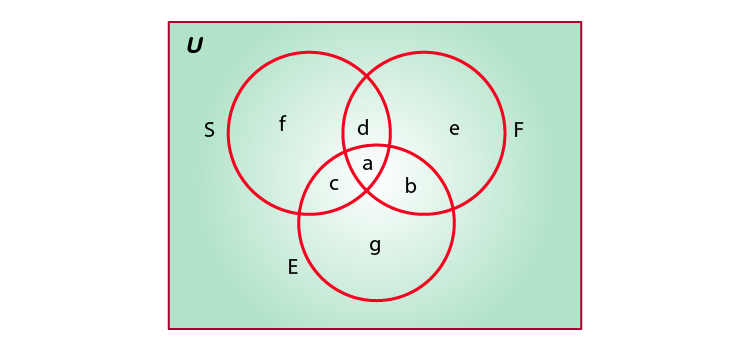
NCERT Exemplar Class 11 Maths Chapter 1-14

n(F ∩ S ∩ E) = a = 3

n(F ∩ S) = a + d = 5

⇒ 3 + d = 5

⇒ d = 2

n(F ∩ E) = a + b = 9

⇒ 3 + b = 9

⇒ b = 6

n(S ∩ E) = a + c = 4

⇒ 3 + c = 4

⇒ c = 1

n(F) = e + d + a + b = 17⇒ e + 2 + 3 + 6 = 17

⇒ e + 11 = 17

⇒ e = 6

n(E) = g + c + a + b = 13

⇒ g + 1 + 3 + 6 = 13

⇒ g + 10 = 13

⇒ g = 3

n(S) = f + c + a + d = 15

⇒ f + 1 + 3 + 2 = 15

⇒ f + 6 = 15

⇒ f = 9

Therefore, from the above equations, we get that,

(i) Number of students studying French only = e = 6

(ii) Number of students studying English only = g = 3

(iii) Number of students studying Sanskrit only = f = 9

(iv) Number of students studying English and Sanskrit but not French = c = 1

(v) Number of students studying French and Sanskrit but not English = d = 2

(vi) Number of students studying French and English but not Sanskrit = b = 6

(vii) Number of students studying at least one of the three languages = a + b + c + d + e + f + g

= 3 + 6 + 1 + 2 + 6 + 9 + 3

= 30

(viii) Number of students studying none of the three languages = Total – (a+b+c+d+e+f+g)

= 50 – (3 + 6 + 1 + 2 + 6 + 9 + 3)

= 50 – 30

= 20

Q29Written answer

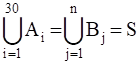
Suppose A1, A2, …, A30 are thirty sets each having 5 elements and B1, B2, …, Bn are n sets each with 3 elements, let 

NCERT Exemplar Class 11 Maths Chapter 1-15

and each element of S belongs to exactly 10 of the Ai’s and exactly 9 of the B,’S. then n is equal to
A. 15
B. 3
C. 45
D. 35

Show solutionHide solution
Worked solution

According to the question,

NCERT Exemplar Class 11 Maths Chapter 1-15

Since elements are not repeating, number of elements in A1∪ A2∪ A3∪ ………∪ A30 = 30 × 5

Now, since each element is used 10 times

We get,

10 × S = 30 × 5

⇒ 10 × S = 150

⇒ S = 15

Since elements are not repeating, number of elements in B1∪ B2∪ B3∪ ………∪ Bn = 3 × n

Now, since each element is used 9 times

We get,

9 × S = 3 × n

⇒ 9 × S = 3n

⇒ S = n/3

⇒ n/3 = 15

⇒ n = 45

Therefore, the value of n is 45

Hence, Option (C) 45, is the correct answer.