My Cart
Your Cart 0

    Your cart is empty.

  • Total (Amount) ₹0.00
NCERT Exemplar · Class 11 · Maths

Chapter 1: Sets

Practice each question, then open the answer or worked solution.

Exercise · Page 12

Textbook page 12 · 29 questions
Q1Written answer

Write the following sets in the roaster form:

(i) A = {x : x ∈ R, 2x + 11 = 15}
(ii) B = {x | x2 = x, x ∈ R}
(iii) C = {x | x is a positive factor of a prime number p}

Show solutionHide solution
Worked solution

(i) According to the question,

A = {x : x ∈ R, 2x + 11 = 15}

Roster form,

2x + 11 = 15

⇒ 2x = 15 – 11

⇒ 2x = 4

⇒ x = 2

Hence, A = {2}

(ii) According to the question,

B = {x | x2 = x, x ∈ R}

Roster form,

x2 = x

⇒ x2 – x = 0

⇒ x(x – 1) = 0

⇒ x = 0 or 1

Hence, B = {0, 1}

(iii) According to the question,

C = {x | x is a positive factor of a prime number p}

Roster form,

Only possible positive factors of a prime number p = 1 and p itself.

Therefore,

x = 1 or p

Hence, C = {1, p}
Q2Written answer

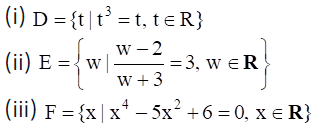
Write the following sets in the roaster form:

NCERT Exemplar Class 11 Maths Chapter 1-1

Show solutionHide solution
Worked solution

(i) According to the question,

D = {t | t3 = t, t ∈ R}

Roster form,

t3 = t

⇒ t3 – t = 0

⇒ t(t2 – 1) = 0

⇒ t(t – 1)(t + 1) = 0

⇒ t = 0, -1 or 1

Hence, D = {-1, 0, 1}

(ii) According to the question,

NCERT Exemplar Class 11 Maths Chapter 1-2

Roster form,

((W – 2)/(W + 3))=3

⇒ w – 2 = 3(w + 3)

⇒ w – 2 = 3w + 9

⇒ 3w – w = – 9 – 2

⇒ 2w = –11

⇒ w = –11/2

Hence, E = {– 11/2}

(iii) According to the question,

F = {x | x4 – 5x2 + 6 = 0, x ∈ R}

Roster form,

x4 – 5x2 + 6 = 0

⇒ x4 – 3x2 – 2x2 + 6 = 0

⇒ x2(x2 – 3) – 2(x2 – 3) = 0

⇒ (x2 – 3) (x2 – 2) = 0

⇒ x2 = 3 or 2

⇒ x = ±√3 or ±√2

⇒ x = √3, –√3, √2 or –√2

Hence, F = {–√3, –√2, √2, √3}

Q3Written answer

If Y = {x | x is a positive factor of the number 2p – 1 (2p – 1), where 2p – 1 is a prime number}. Write Y in the roaster form.

Show solutionHide solution
Worked solution

According to the question,

Y = {x | x is a positive factor of the number 2p – 1(2p – 1), where 2p – 1 is a prime number}.

Roster form of given set,

Only possible positive factors of a prime number p are 1 and p itself.

Possible factors of 2p – 1 (2p – 1) are all possible factors of 2p – 1 and 2p – 1 individually.

Possible factors of 2p – 1 are 20, 21… 2p – 1 and that of 2p – 1 are 1 and 2p – 1 {∵ 2p – 1 is prime number}

Therefore,

x = 1, 21… 2p – 1, 2p – 1

Hence, Y = {1, 21… 2p – 1, 2p – 1}

Q4Written answer

State which of the following statements are true and which are false. Justify your answer.
(i) 35 ∈ {x | x has exactly four positive factors}.
(ii) 128 ∈ {y | the sum of all the positive factors of y is 2y}
(iii) 3 ∉ {x | x4 – 5x3 + 2x2 – 112x + 6 = 0}
(iv) 496 ∉ {y | the sum of all the positive factors of y is 2y}.

Show solutionHide solution
Worked solution

(i) True

According to the question,

35 ∈ {x | x has exactly four positive factors}

The possible positive factors of 35 = 1, 5, 7, 35

35 belongs to given set

Since, 35 has exactly four positive factors

⇒ The given statement 35 ∈ {x | x has exactly four positive factors} is true.

(ii) False

According to the question,

128 ∈ {y | the sum of all the positive factors of y is 2y}

The possible positive factors of 128 are 1, 2, 4, 8, 16, 32, 64, 128

The sum of them

= 1 + 2 + 4 + 8 + 16 + 32 + 64 + 128

= 255

2y = 2 × 128 = 256

Since, the sum of all the positive factors of y is not equal to 2y

128 does not belong to given set

⇒ The given statement 128 ∈ {y | the sum of all the positive factors of y is 2y} is false.

(iii) True

According to the question,

3 ∉ {x | x4 – 5x3 + 2x2 – 112x + 6 = 0}

x4 – 5x3 + 2x2 – 112x + 6 = 0

On putting x = 3 in LHS:

(3)4 – 5(3)3 + 2(3)2 – 112(3) + 6

= 81 – 135 + 18 – 336 + 6

= –366

≠ 0

So, 3 does not belong to given set

⇒ The given statement 3 ∉ {x | x4 – 5x3 + 2x2 – 112x + 6 = 0} is true.

(iv) False

According to the question,

496 ∉ {y | the sum of all the positive factors of y is 2y}

The possible positive factors of 496 are 1, 2, 4, 8, 16, 31, 62, 124, 248, 496

The sum of them

= 1 + 2 + 4 + 8 + 16 + 31 + 62 + 124 + 248 + 496

= 996

2y = 2 × 496 = 992

Since, the sum of all the positive factors of y is equal to 2y

496 belongs to given set

⇒ The given statement 496 ∉ {y | the sum of all the positive factors of y is 2y} is false.

Q5Written answer

Given L = {1, 2, 3, 4}, M = {3, 4, 5, 6} and N = {1, 3, 5}. Verify that L–(M∪N) = (L–M)∩(L–N).

Show solutionHide solution
Worked solution

According to the question,

L = {1, 2, 3, 4}, M = {3, 4, 5, 6} and N = {1, 3, 5}

To verify:

L – (M ∪ N) = (L – M) ∩ (L – N)

M = {3, 4, 5, 6}, N = {1, 3, 5} ⇒ M ∪ N = {1, 3, 4, 5, 6}

L = {1, 2, 3, 4} and M ∪ N = {1, 3, 4, 5, 6}

⇒ L – (M ∪ N) = {2}………………(i)

L = {1, 2, 3, 4} and M = {3, 4, 5, 6} ⇒ L – M = {1, 2}

L = {1, 2, 3, 4} and N = {1, 3, 5} ⇒ L – N = {2, 4}

L – M = {1, 2} and L – N = {2, 4}

⇒ (L – M) ∩ (L – N) = {2}………………(ii)

From equations (i) and (ii),

We have,

L – (M ∪ N) = (L – M) ∩ (L – N)

Hence verified

Q6Written answer

If A and B are subsets of the universal set U, then show that
(i) A ⊂ A ∪ B
(ii) A ⊂ B ⇔ A ∪ B = B
(iii) (A ∩ B) ⊂ A

Show solutionHide solution
Worked solution

(i) According to the question,

A and B are two subsets

To prove: A ⊂ A ∪ B

Proof:

Let x ∈ A

⇒ x ∈ A or x ∈ B

⇒ x ∈ A ∪ B

⇒ A ⊂ A ∪ B

Hence Proved

(ii) According to the question,

A and B are two subsets

To prove: A ⊂ B ⇔ A ∪ B = B

Proof:

Let x ∈ A ∪ B

⇒ x ∈ A or x ∈ B

Since, A ⊂ B, we get,

⇒ x ∈ B

⇒ A ∪ B ⊂ B …(i)

We know that,

B ⊂ A ∪ B …(ii)

From equations (i) and (ii),

We get,

A ∪ B = B

Now,

Let y ∈ A

⇒ y ∈ A ∪ B

Since, A ∪ B = B, we get,

⇒ y ∈ B }

⇒ A ⊂ B

So,

A ⊂ B ⇔ A ∪ B = B

Hence Proved

(iii) According to the question,

A and B are two subsets

To prove: (A ∩ B) ⊂ A

Proof:

Let x ∈ A ∩ B

⇒ x ∈ A and x ∈ B

⇒ x ∈ A

⇒ A ∩ B ⊂ A

Hence Proved

Q7Written answer

Given that N = {1, 2, 3,…, 100}. Then write

(i) the subset of N whose elements are even numbers.
(ii) the subset of N whose element are perfect square numbers.

Show solutionHide solution
Worked solution

We know that,

A set ‘A’ is a subset of a set ‘B’, if ‘A’ is “contained” inside ‘B’. Hence, all elements of ‘A’ are also elements of ‘B’.

(i) According to the question,

N = {1, 2, 3 ,…, 100}

Hence, subset of N whose elements are even numbers

= {2, 4, 6, 8,………,100}

(ii) According to the question,

N = {1, 2, 3 ,…, 100}

Hence, subset of N whose elements are perfect square numbers

= {1, 4, 9, 16, 25, 36, 49, 64, 81, 100}

Q8Written answer

If X = {1, 2, 3}, if n represents any member of X, write the following sets containing all numbers represented by:

(i) 4n
(ii) n + 6
(iii) n/2
(iv) n – 1

Show solutionHide solution
Worked solution

(i) According to the question,

X = {1, 2, 3} where n represents any member of X

X = {1, 2, 3}

{4n | n ∈ x}

= {4×1, 4×2, 4×3}

= {4, 8, 12}

(ii) According to the question,

X = {1, 2, 3} where n represents any member of X

X = {1, 2, 3}

{n + 6 | n ∈ x}

= {1 + 6, 2 + 6, 3 + 6}

= {7, 8, 9}

(iii) According to the question,

X = {1, 2, 3} where n represents any member of X

X = {1, 2, 3}

NCERT Exemplar Class 11 Maths Chapter 1-3

= { ½, 1, 3/2}

(iv) According to the question,

X = {1, 2, 3} where n represents any member of X

X = {1, 2, 3}

{n – 1 | n ∈ x}

= {1 – 1, 2 – 1, 3 – 1}

= {0, 1, 2}

Q9Written answer

If Y = {1, 2, 3,…, 10}, and a represents any element of Y, write the following sets, containing all the elements satisfying the given conditions.
(i) a ∈ Y but a2∉ Y
(ii) a + 1 = 6, a ∈ Y
(iii) a is less than 6 and a ∈ Y

Show solutionHide solution
Worked solution

(i) According to the question,

Y = {1, 2, 3,…, 10} where a represents any element of Y

Y = {1, 2, 3,…, 10}

12 = 1, 22 = 4, 32 = 9

1, 4, 9 ∈ Y ⇒ 1, 2, 3 do not satisfy given condition

Hence,

{a: a ∈ Y and a2∉ Y} = {4, 5, 6, 7, 8, 9, 10}

(ii) According to the question,

Y = {1, 2, 3,…, 10} where a represents any element of Y

Y = {1, 2, 3,…, 10}

a + 1 = 6 ⇒ a = 5

⇒ 5 satisfies the given condition

Hence,

{a: a + 1 = 6, a ∈ Y } = {5}

(iii) According to the question,

Y = {1, 2, 3,…, 10} where a represents any element of Y

Y = {1, 2, 3,…, 10}

a is less than 6 ⇒ 1, 2, 3, 4, 5

1, 2, 3, 4, 5 satisfy the given condition

Hence,

{a: a is less than 6, a ∈ Y } = {1, 2, 3, 4, 5}

Q10Written answer

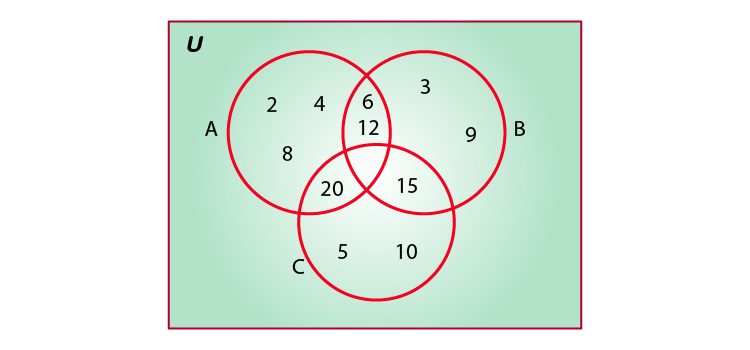
A, B and C are subsets of Universal Set U. If A = {2, 4, 6, 8, 12, 20}, B = {3, 6, 9, 12, 15}, C = {5, 10, 15, 20} and U is the set of all whole numbers, draw a Venn diagram showing the relation of U, A, B and C.

Show solutionHide solution
Worked solution

According to the question,

A = {2, 4, 6, 8, 12, 20}, B = {3, 6, 9, 12, 15}, C = {5, 10, 15, 20}

Here, U is a universal set

Therefore,

⇒ A ∩ B = {2, 4, 6, 8, 12, 20}∩{3, 6, 9, 12, 15}

= {6, 12},

⇒ B ∩ C = {3, 6, 9, 12, 15}∩{5, 10, 15, 20}

= {15},

⇒ A ∩ C = {2, 4, 6, 8, 12, 20}∩{5, 10, 15, 20}

= {20},

⇒ A ∩ B ∩ C = {2, 4, 6, 8, 12, 20}∩{3, 6, 9, 12, 15}∩{5, 10, 15, 20}

= {}

Hence, the Venn diagram showing relation of given sets is:

NCERT Exemplar Class 11 Maths Chapter 1-4