My Cart
Your Cart 0

    Your cart is empty.

  • Total (Amount) ₹0.00
NCERT Exemplar · Class 11 · Chemistry

Chapter 4: Chemical Bonding and Molecular Structure

Practice each question, then open the answer or worked solution.

Questions

51 questions
Q41Written answer

Give reasons for the following :

(i) Covalent bonds are directional bonds while ionic bonds are nondirectional.

(ii) The water molecule has a bent structure whereas carbon dioxide molecule is linear.

(iii) Ethyne molecule is linear.

Show solutionHide solution
Worked solution

(i) A covalent bond is formed by the overlapping of atomic orbitals. The direction of overlapping gives the direction of the bond.

(ii) In a water molecule, the oxygen atom is sp3 hybridized and has two lone pairs of electrons.

(iii) In the ethyne molecule, both the carbon atoms are sp hybridized. The two sp hybrid orbitals of both the carbon atoms are oriented in the opposite direction forming an angle of 180°.
Q42Written answer

What is an ionic bond? With two suitable examples, explain the difference between an ionic and a covalent bond.

Show solutionHide solution
Worked solution

when a positively charged ion forms a bond with a negatively charged ions and one atom transfers electrons to another. An example of an ionic bond is the chemical compound Sodium Chloride (NaCl).

The difference between an ionic bond and covalent bond is that An ionic bond essentially donates an electron to the other atom participating in the bond, while electrons in a covalent bond are shared equally between the atoms.

Q43Written answer

Arrange the following bonds in order of increasing ionic character giving a reason

N—H, F—H, C—H and O—H

Show solutionHide solution
Worked solution

The ionic character is greater in the molecules that have the greatest electronegativity difference because the electron pair shifts toward a more electronegative atom, increasing the ionic character.

Thus, the ionic character order will be:

C-H<N-H<O-H< F-H

Q44Written answer

Explain why CO32- ion cannot be represented by a single Lewis structure. How can it be best represented?

Show solutionHide solution
Worked solution

Carbonate ion is present in the form of a resonating hybrid structure. These structures are equivalent. Resonance all 3 C-O bonds get a double character in one of the resonating structures.

Thus, all the bonds are equivalent and have equal length hence carbonate ion cannot be represented by a single Lewis structure.

Q45Written answer

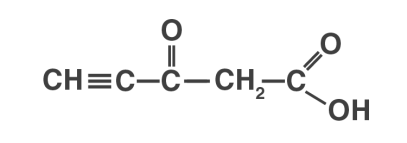
Predict the hybridisation of each carbon in the molecule of the organic compound given below. Also indicate the total number of sigma and pi bonds in this molecule.

NCERT Exemplar Solutions of Class 11 Chemistry Chapter 4 Chemical Bonding and Molecular Structure-7

Show solutionHide solution
Worked solution

The hybridization of Carbon 1 is sp, carbon 2 is sp, carbon 3 sp2, carbon 4 is sp3 and carbon 5 is sp2.

The triple bond has 2 pie bonds and one sigma bond.

Each double bond has one sigma and one pie bond.

Every single bond is a sigma bond.

Thus, the total number of sigma bonds is 11 and pie bonds are 4.

Q46Written answer

Group the following as linear and non-linear molecules :

H2O, HOCl, BeCl2, Cl2O

Show solutionHide solution
Worked solution

BeCl2 has a linear structure

HOCl is also non-linear in structure.

H2O has a V-shaped structure.

Cl2O has a V-shaped structure.

Q47Written answer

Elements X, Y and Z have 4, 5 and 7 valence electrons respectively.

(i) Write the molecular formula of the compounds formed by these elements individually with hydrogen.

(ii) Which of these compounds will have the highest dipole moment?

Show solutionHide solution
Worked solution

(i); XH4, H3Y, and HZ

Hydrogen has only one electron in its outermost shell it shares one electron to form a covalent bond or accepts or donates one electron to form an ionic bond.

(ii) The compound HZ has a linear shape and the difference in the electronegativity of Hydrogen and element Z is maximum.

Q48Written answer

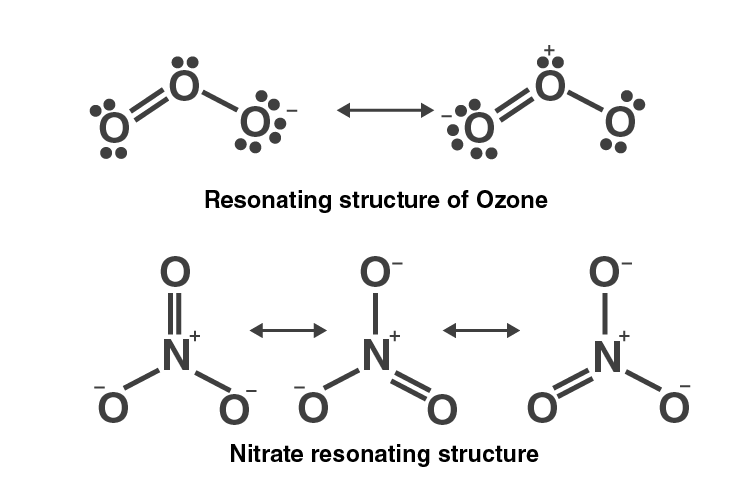
Draw the resonating structure of

(i) Ozone molecule

(ii) Nitrate ion

Show solutionHide solution
Worked solution

NCERT Exemplar Solutions of Class 11 Chemistry Chapter 4 Chemical Bonding and Molecular Structure-8

Q49Written answer

Predict the shapes of the following molecules based on hybridisation.

BCl3, CH4, CO2, NH3

Show solutionHide solution
Worked solution

In compound BCl3, Boron has sp2-hybridisation and the shape is Triangular Planar.

In methane CH4, Carbon has sp3 -hybridization and shape are Tetrahedral.

In carbon dioxide CO2, carbon has sp-hybridisation and shape is Linear.

In ammonia NH3, nitrogen has sp3-hybridisation and shape is Pyramidal.

Q50Written answer

All the C—O bonds in carbonate ion (CO2-3 ) are equal in length. Explain

Show solutionHide solution
Worked solution

Carbonate ion is present in the form of a resonating structure. These structures are equivalenting to nature. Resonance all 3 C-O bonds get a double character in one of the resonating structures.