My Cart
Your Cart 0

    Your cart is empty.

  • Total (Amount) ₹0.00
NCERT Exemplar · Class 11 · Chemistry

Chapter 4: Chemical Bonding and Molecular Structure

Practice each question, then open the answer or worked solution.

Questions

51 questions
Q31Written answer

Explain the non-linear shape of H2 S and the non-planar shape of PCl3 using valence shell electron pair repulsion theory.

Show solutionHide solution
Worked solution

In H2S, the Sulphur atom is surrounded by four electron pairs (two bond pairs and two lone pairs).

These four electron pairs adopt tetrahedral geometry.

The repulsion between the lone pair electrons brings distortion in the shape of the H2S.

Thus, H2S is not linear in shape.
Q32Written answer

Using molecular orbital theory, compare the bond energy and magnetic character of O2+ and O2- species.

Show solutionHide solution
Worked solution

The Molecular Orbital configuration of O2+ and O-2 is given below:

O2+ (15): σ1s2 σ *1s2 σ 2s2 σ *2s2 σ 2pz2 π2px2 = π 2py2π *2px1

O2- (17): σ1s2 σ *1s2 σ 2s2 σ *2s2 σ 2pz2 π2px2 = π 2py2π *2px2= π*2py1

Bond order for O2+ = 10-5/2 = 2.5

Bond order for O-2 = 10-7/2 = 1.5

According to Molecular Orbital Theory, the greater the bond order greater is the bond energy.

Thus, O2+ is more stable than O2-

Q33Written answer

Explain the shape of BrF5.

Show solutionHide solution
Worked solution

In BrF5, the central atom is bromine which has the hybridization sp3d2.

Br atom has 7 valence electrons, out of which 5 are used to make pair with the F atoms, and two are used to make lone pair of electrons.

The lone pair and bond pair repel each other. Thus, the shape is square pyramidal.

Q34Written answer

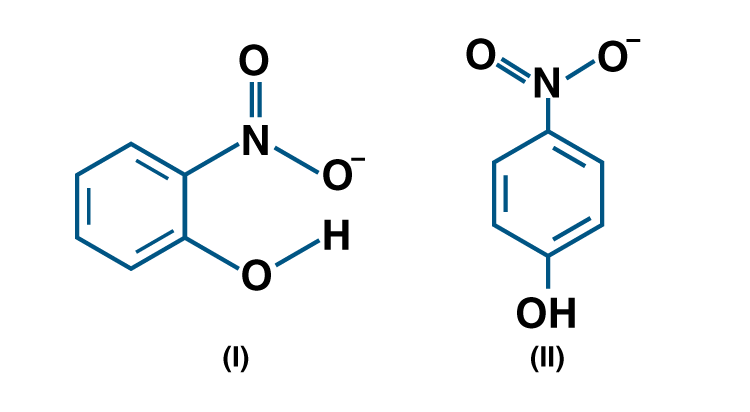
Structures of molecules of two compounds are given below :

NCERT Exemplar Solutions of Class 11 Chemistry Chapter 4 Chemical Bonding and Molecular Structure-2

(a) Which of the two compounds will have intermolecular hydrogen bonding and which compound is expected to show intramolecular hydrogen bonding.

(b) The melting point of a compound depends on, among other things, the extent of hydrogen bonding. On this basis explain which of the above two compounds will show a higher melting point.

(c) The solubility of compounds in water depends on the power to form hydrogen bonds with water. Which of the above compounds will form a hydrogen bond with water easily and be more soluble in it?

Show solutionHide solution
Worked solution

(a) Compound 1 will have intramolecular hydrogen bonding in o-nitrophenol

Compound (II) will have intermolecular hydrogen bonding in p-nitrophenol.

(b) The compound (II) has a higher melting point because of the intermolecular bonding, a large number of molecules that will get attached.

(c) The compound (II) will be more soluble in water because it will form hydrogen bonding with the water molecules easily.

Q35Written answer

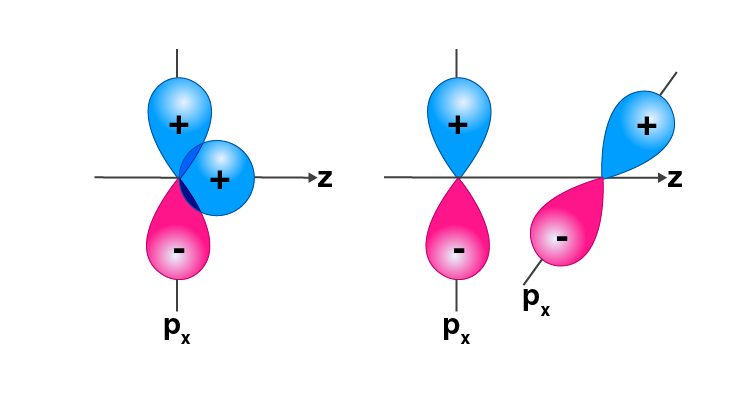
Why does the type of overlap given in the following figure not result in bond

formation?

NCERT Exemplar Solutions of Class 11 Chemistry Chapter 4 Chemical Bonding and Molecular Structure-3

Show solutionHide solution
Worked solution

In the figure (i) the area of the contact of ++ overlap is equal to the area of the +- overlap. The so-net overlap is zero.

In figure (ii) there is no overlap of the orbitals due to the different symmetry.

Q36Written answer

Explain why PCl5 is trigonal bipyramidal whereas IF5 is square pyramidal.

Show solutionHide solution
Worked solution

In PCl5, P has 5 valence electrons in orbitals and makes 5 bonds with 5 Cl atoms, it will share one of its electrons from 3s to 3d orbital, therefore the hybridization will be sp3d and the geometry will be trigonal bipyramidal.

IF5, the Iodine atom has 7 valence electrons in molecular orbitals it will form 5 bonds with 5 Cl atoms using 5 electrons from its molecular orbital, two electrons will form one lone pair on Iodine atom, which gives the square pyramidal geometry.

Q37Written answer

In both water and dimethyl ether (CH3 —Ο — CH3 ), the oxygen atom is the central atom and has the same hybridization, yet they have different bond angles. Which one has a greater bond angle? Give reason.

Show solutionHide solution
Worked solution

Dimethyl ether will have a greater bond angle. There will be more repulsion between bond pairs of CH3 groups attached in ether than between bond pairs of hydrogen atoms attached to oxygen in the water.

Q38Written answer

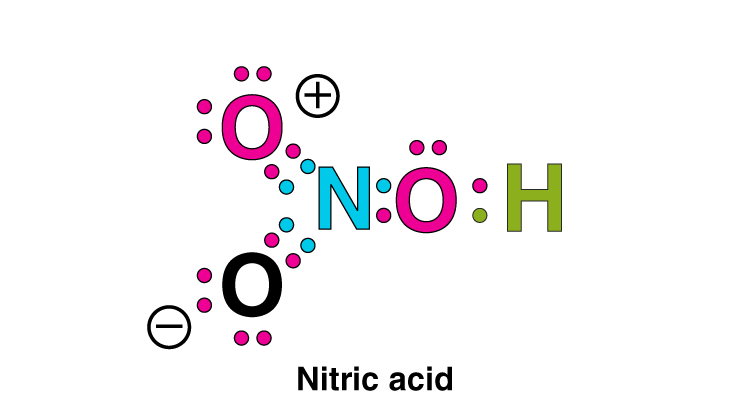
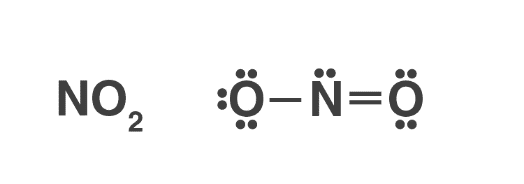
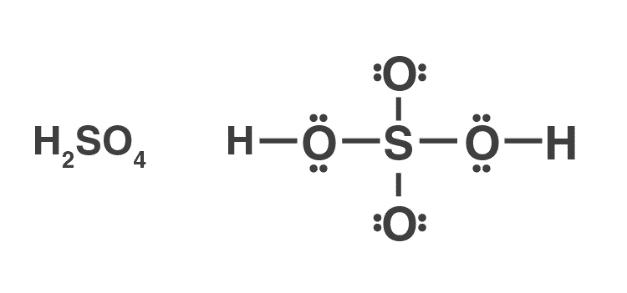
Write Lewis structure of the following compounds and show a formal charge

on each atom.

HNO3, NO2, H2SO4

Show solutionHide solution
Worked solution

NCERT Exemplar Solutions of Class 11 Chemistry Chapter 4 Chemical Bonding and Molecular Structure-4

The formal charge is calculated by

Formal charge = ½ [total no: of bonding or shared electrons]

NCERT Exemplar Solutions of Class 11 Chemistry Chapter 4 Chemical Bonding and Molecular Structure-5

The formal charge on the oxygen with single bond =6-6-2/2 = -1

The formal charge on the oxygen with double bond 6-4-4/2 = 0

The formal charge on nitrogen=5-2-6/2 = 0

NCERT Exemplar Solutions of Class 11 Chemistry Chapter 4 Chemical Bonding and Molecular Structure-6

The formal charge on oxygen 1 and 4 = 6-4-4/2= 0

The formal charge on oxygen 2 and 3 = 6-4-4/2=0

The formal charge on hydrogen 1 and 2 = 1-0-2/2=0

The formal charge on sulfur =6-0-12/2 = 0

Q39Written answer

The energy of σ2pz molecular orbital is greater than π2px and π2py molecular orbitals in nitrogen molecule. Write the complete sequence of energy levels in the increasing order of energy in the molecule. Compare the relative stability and the magnetic behaviour of the following species :

N2, N2+ , N2- , N22+

Show solutionHide solution
Worked solution

The general sequence of the energy level of the molecular orbital is

σ1s < σ*1s < σ2s< σ*2s < π2px = π2py < σ2pz

N2 σ1s2 σ*1s2 σ2s2 σ*2s2 π2p2x = π2p2y σ2p2z

N2+ σ1s2 σ*1s2 σ2s2 σ*2s2 π2p2x = π2p2y σ2p1z

N2- σ1s2 σ*1s2 σ2s2 σ*2s2 π2p2x = π2p2y σ2p2z σ2p2x

N22+ σ1s2 σ*1s2 σ2s2 σ*2s2 π2p2x = π2p2y

Bond order = ½[electrons in BMO – electrons in ABMO]

For N2 = 10-4/2 = 3

Bond order for N2+= 9-4/2 = 2.5

Bond order for N2-= 10-5/2 = 2.5

Bond order for N22+= 8-4/2 = 2

Thus, the order of stability is:

N2> N2- > N2+> N22+

Q40Written answer

What is the effect of the following processes on the bond order in N2 and O2?

(i) N2→ N2+ + e-

(ii) O2→ O2+ + e-

Show solutionHide solution
Worked solution

(i) N2 is having 14 electrons when it donates one electron, these electrons are removed from the Bonding molecular orbital. BO for N2 = 3

(ii) O2 has 16 electrons, 8 electrons in the molecular orbitals and 4 in the antibonding molecular orbitals.

BO for O2 = 2