My Cart
Your Cart 0

    Your cart is empty.

  • Total (Amount) ₹0.00
NCERT Exemplar · Class 11 · Biology

Chapter 6: Anatomy of Flowering Plants

Practice each question, then open the answer or worked solution.

SHORT ANSWER TYPE QUESTIONS

14 questions
Q11Written answer

Write the function of

a. Sieve tube

b. Interfascicular cambium

c. Collenchyma

d. Aerenchyma

Show solutionHide solution
Worked solution

a. Sieve tube – They help in translocation of synthesized food throughout the plant. It is present in phloem tissue.

b. Interfascicular cambium – It facilitates secondary growth in dicot stem and root and also helps in the formation of the vascular cambium.

c. Collenchyma – It provides mechanical support to young stem. Its cells have angular thickening at corners.

d. Aerenchyma – It provides buoyancy to floating plants.
Q12Written answer

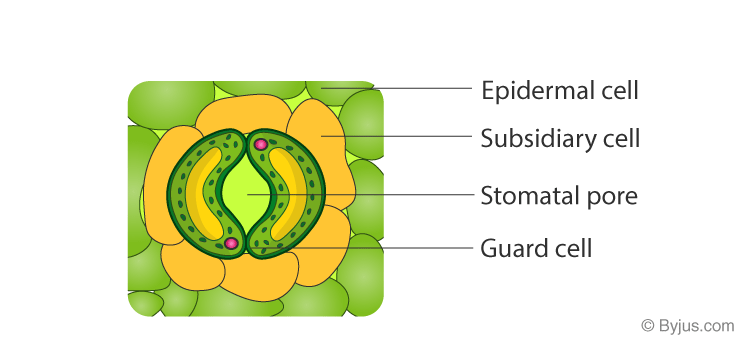
The stomatal pore is guarded by two kidney-shaped guard cells. Name the epidermal cells surrounding the guard cells. How does a guard cell differ from an epidermal cell? Use a diagram to illustrate your answer.

Show solutionHide solution
Worked solution

Stomata regulate the process of transpiration and gaseous exchange. The epidermal cells surrounding the guard cells are known as Subsidiary cells.

NCERT Exemplar Solutions of Class 11 Biology Chapter 6 Anatomy of Flowering Plants-1

Q13Written answer

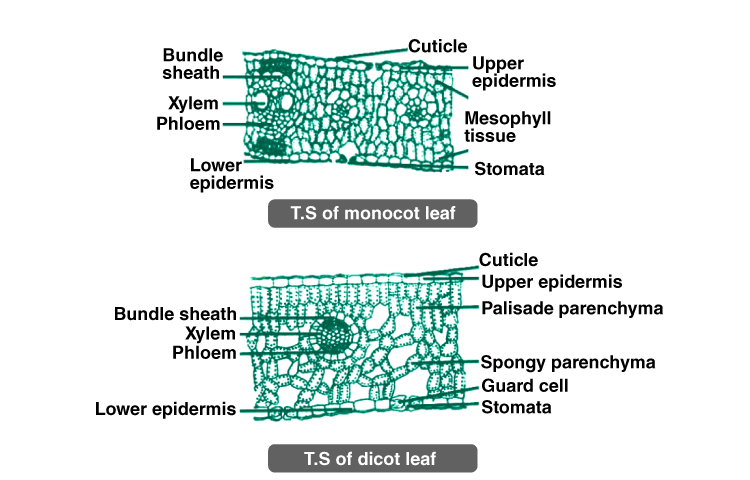
Point out the differences in the anatomy of the leaf of peepal (Ficus religiosa) and maize (Zea mays). Draw the diagrams and label the differences.

Show solutionHide solution
Worked solution

Peepal is a dorsiventral leaf which is a dicot. Stomata are more on the lower surface and mesophyll is made up of two types of tissues. Maize is an isobilateral leaf which is a monocot. Stomata are equal in number on both the surfaces

NCERT Exemplar Solutions of Class 11 Biology Chapter 6 Anatomy of Flowering Plants-2

Q14Written answer

Palm is a monocotyledonous plant, yet it increases in girth. Why and how?

Show solutionHide solution
Worked solution

Palm is a monocotyledonous plant, yet it increases in girth slowly due to secondary growth. It is due to parenchymatous cell division and enlargement in the ground tissue. Thus, repeated divisions cause an increase in the girth of the stem.