My Cart
Your Cart 0

    Your cart is empty.

  • Total (Amount) ₹0.00
NCERT Exemplar · Class 11 · Biology

Chapter 19: Excretory Products and Their Elimination

Practice each question, then open the answer or worked solution.

LONG ANSWER TYPE QUESTIONS

6 questions
Q1Written answer

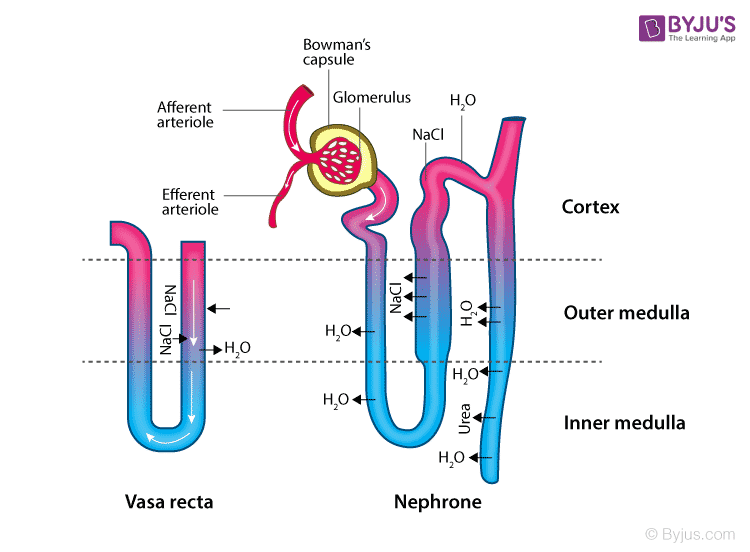
Explain the mechanism of formation of concentrated urine in mammals.

Show solutionHide solution
Worked solution

The Henle’s loop and vasa recta play an important role in the formation of concentrated urine. The transport of sodium chloride in the ascending limb of Henle’s loop results in an osmolar gradient. The creation of a hypertonic medulla is facilitated by the renal tubules and vasa recta in the following manner: There is an active absorption of urea that occurs from the collecting tubule. In the vasa recta, absorption of water into the blood takes place and return of the absorbed solute to the interstitium follows. This is called the countercurrent exchange mechanism.
Q2Written answer

Draw a labelled diagram showing reabsorption and secretion of major substances at different parts of the nephron.

Show solutionHide solution
Worked solution

NCERT Exemplar Solution of Class 11 Biology Chapter 19 Excretory Products and their Elimination-4

Q3Written answer

Explain briefly, micturition and disorders of the excretory system

Show solutionHide solution
Worked solution

The functional unit of the kidney is nephron where the urine is formed and followed by the urinary bladder. The urine will be stored until a voluntary signal is given by the central nervous system. his signal stretched the urinary bladder as it gets filled with urine. In response, the stretch receptors on the bladder walls would now send signals to the CNS that passes on motor messages that would lead to contraction of the muscles of the bladder leading to relaxation of the sphincter. This releases the urine and this process is called micturition.

Disorders of the excretory system:

1. Glomerulonephritis

It is the inflammation of the glomeruli of the kidney

2. Uremia

It is the condition where due to the malfunctioning of kidney some toxic urea will be accumulated in the blood which causes uremia

3. Renal calculi

This disorder is due to the formation of stone-like calcium oxalate which results in kidney stones.

Q4Written answer

How does tubular secretion help in maintaining ionic and acid-base balance in body fluids?

Show solutionHide solution
Worked solution

Tubular secretion is crucial as it helps in the maintenance of ionic balance in the body fluids.

During urine formation, Proximal Convoluted Tubule maintains the pH and ionic balance of the body fluids by selective secretion. Distal Convoluted Tubule is where conditional reabsorption of sodium ions and water takes place and maintain the ionic balance and pH. Collecting Duct: From this long duct, large amounts of water could be reabsorbed to produce concentrated urine.

Q5Written answer

The glomerular filtrate in the loop of Henle gets concentrated in the descending and then gets diluted in the ascending limbs. Explain.

Show solutionHide solution
Worked solution

Reabsorption is minimum in its ascending limb which plays a significant role in the maintenance of high osmolarity of medullary interstitial fluid. The descending limb of the loop of Henle is permeable to water but almost impermeable to electrolytes so water can flow out. This concentrates the filtrate as it moves down. The ascending limb allows transport of electrolytes and impermeable to water. So as the concentrated filtrate passes through the ascending limb, it gets diluted due to the passage of electrolytes to the medullary fluid.

Q6Written answer

Describe the structure of a human kidney with the help of a labelled diagram.

Show solutionHide solution
Worked solution

The kidney is a reddish-brown coloured organ which is a bean-shaped located between the last thoracic and third lumbar vertebra near the abdominal cavity. The hilum is a notch which is present in the inner side of the kidney through which ureter, blood vessels and nerves enter. Columns of Bertini and an inner medulla divided into medullary pyramids projecting into the calyx which is inside the kidney. The glomerulus and the renal tubule are the two functional units of the nephron. The renal tubule starts with a cup-like structure called Bowman’s capsule, by the glomerulus is enclosed and together they are called the renal corpuscle. Then it is followed by proximal convoluted tubule (PCT) followed by a hairpin shaped Henle’s loop having a descending and an ascending limb. The ascending limb continues as another highly coiled tubular structure called distal convoluted tubule (DCT). The DCTs open into a tube called a collecting duct.