My Cart
Your Cart 0

    Your cart is empty.

  • Total (Amount) ₹0.00
NCERT Exemplar · Class 11 · Biology

Chapter 19: Excretory Products and Their Elimination

Practice each question, then open the answer or worked solution.

SHORT ANSWER QUESTIONS

9 questions
Q1Written answer

Show the structure of a renal corpuscle with the help of a diagram.

Solution;
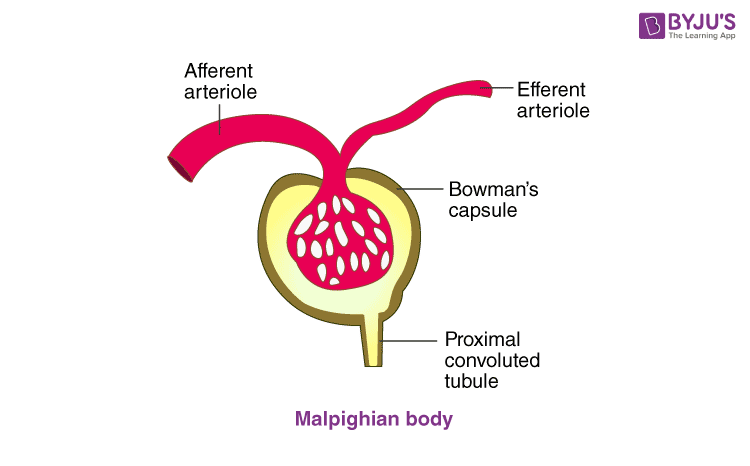
NCERT Exemplar Solution of Class 11 Biology Chapter 19 Excretory Products and their Elimination-1

2. What is the role played by Renin-Angiotensin in the regulation of kidney function?

Show solutionHide solution
Worked solution

When there is a fall in glomerular filtration rate (GFR), they activate the JG cells to release renin which gets converted to angiotensinogen in the blood to angiotensin I and further to angiotensin II. Angiotensin II is a powerful vasoconstrictor that increases GFR. Angiotensin II is also responsible for activating the adrenal cortex to release Aldosterone which causes reabsorption of Na+ and water from the distal parts of the tubule leading to an increase in blood pressure and GFR.
Q2Written answer

What is the role played by Renin-Angiotensin in the regulation of kidney function?

Show solutionHide solution
Worked solution

When there is a fall in glomerular filtration rate (GFR), they activate the JG cells to release renin which gets converted to angiotensinogen in the blood to angiotensin I and further to angiotensin II. Angiotensin II is a powerful vasoconstrictor that increases GFR. Angiotensin II is also responsible for activating the adrenal cortex to release Aldosterone which causes reabsorption of Na+ and water from the distal parts of the tubule leading to an increase in blood pressure and GFR.

Q3Written answer

Aquatic animals generally are ammonotelic in nature whereas terrestrial forms are not. Comment.

Show solutionHide solution
Worked solution

Organisms which generally excrete ammonia as nitrogenous wastes are said to be ammonotelic in nature.

Excretion of urea requires a large amount of water which can only be provided by aquatic animals while on the other hand, terrestrial animals cannot afford to lose so much water. The terrestrial mammals or even amphibians mainly excrete nitrogenous wastes in form of urea and hence are known as ureotelic organisms

Q4Written answer

The composition of glomerular filtrate and urine is not the same. Comment.

Show solutionHide solution
Worked solution

The glomerular filtrate is formed at the first step of the urine formation in the Bowman’s capsule while urine is formed at the end of the nephron.

Q5Written answer

What is the procedure advised for the correction of extreme renal failure? Give a brief account of it.

Show solutionHide solution
Worked solution

The procedure advised for the correction of extreme renal failure is kidney transplantation. Donor compatibility is evaluated by blood tests that match the blood types and antigens.

Q6Written answer

How have the terrestrial organisms adapted themselves for the conservation of water?

Show solutionHide solution
Worked solution

The terrestrial mammals or even amphibians mainly excrete nitrogenous wastes in form of urea and hence are known as ureotelic organisms while reptiles, etc. excrete nitrogenous wastes in form of uric acid and hence are called uricotelic organisms. Thus this is how the conversion of ammonia to urea or uric acid has been the adaptation that the terrestrial organisms have gone through for conservation of water.

Q7Written answer

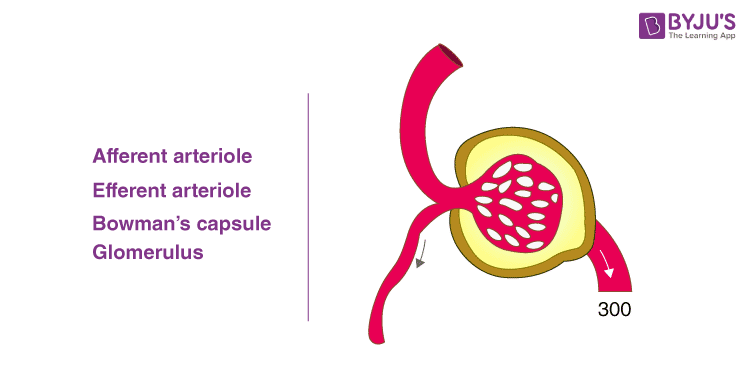
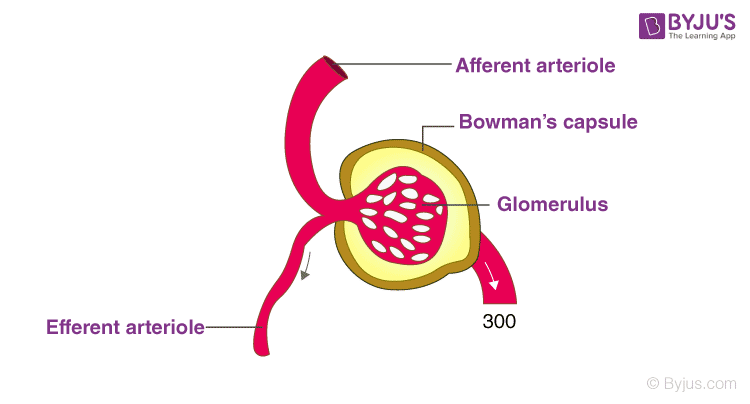
Label the parts in the following diagram.

NCERT Exemplar Solution of Class 11 Biology Chapter 19 Excretory Products and their Elimination-2

Show solutionHide solution
Worked solution

NCERT Exemplar Solution of Class 11 Biology Chapter 19 Excretory Products and their Elimination-3

Q8Written answer

Explain, why a haemodialysis unit called an artificial kidney?

Show solutionHide solution
Worked solution

A haemodialysis unit is also called an artificial kidney because it is responsible for performing the same functions that a kidney functions.

Q9Written answer

Comment upon the hormonal regulation of selective reabsorption.

Show solutionHide solution
Worked solution

Selective reabsorption is the process in which some molecules like glucose, ions and certain amino acids get reabsorbed from the filtrate as they pass through the neuron. ADH i.e. Antidiuretic hormone and ANF i.e. Atrial Natriuretic Factor are the hormones which monitor the function of the kidney. ADH functions as the facilitation of the reabsorption of water from DCT. The adrenal cortex is activated by Angiotensin II as a result of which aldosterone is released. Aldosterone, in turn, induces the DCT to absorb more ions and water. ANF regulates blood flow by causing vasodilation and increasing excretion of sodium.