My Cart
Your Cart 0

    Your cart is empty.

  • Total (Amount) ₹0.00
NCERT Exemplar · Class 11 · Biology

Chapter 17: Breathing and Exchange of Gases

Practice each question, then open the answer or worked solution.

LONG ANSWER TYPE QUESTIONS

3 questions
Q1Written answer

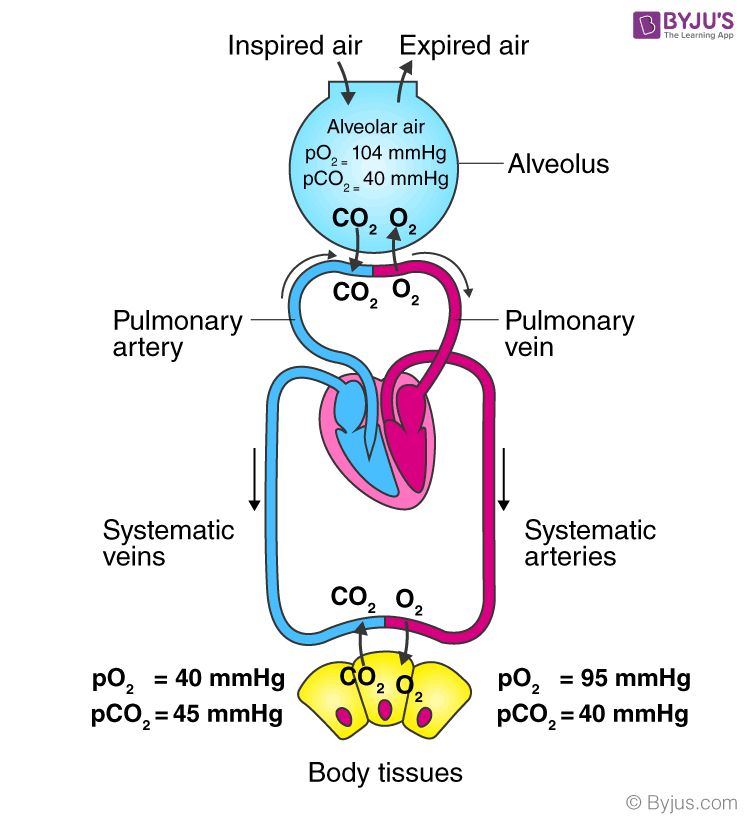
Explain the transport of O2 and CO2 between alveoli and tissue with a diagram.

Show solutionHide solution
Worked solution

Transportation of Oxygen.

1. Oxygen which we inhale reaches the alveoli

2. As the partial pressure of oxygen is greater in alveoli, the diffusion causes from oxygen to capillaries and combines with haemoglobin to form oxyhaemoglobin.

3. The oxygenated blood reaches the organ, which has low partial pressure than alveoli.

4. The bond between oxygen and haemoglobin will be unstable in these organs and breaks, releasing oxygen into the organs.

Transportation of Carbon Dioxide:

1. The carbon dioxide which is released is carried out by various organs to the alveoli via capillaries which have lower intra pulmonary pressure than the organs.

2. Intra-pulmonary pressure is lower in the alveoli than the capillaries so the carbon dioxide will diffuse to alveoli from the capillaries.

3. In red blood cells, carbon dioxide combines with water and forms carbonic acid. It is an unstable form and gets disassociated into hydrogen and bicarbonate ion.

4. Carbon dioxide is also transported through plasma in the form of bicarbonate ions.
NCERT Exemplar Solution of Class 11 Biology Chapter 17 Breathing and Exchange of Gases-1

Q2Written answer

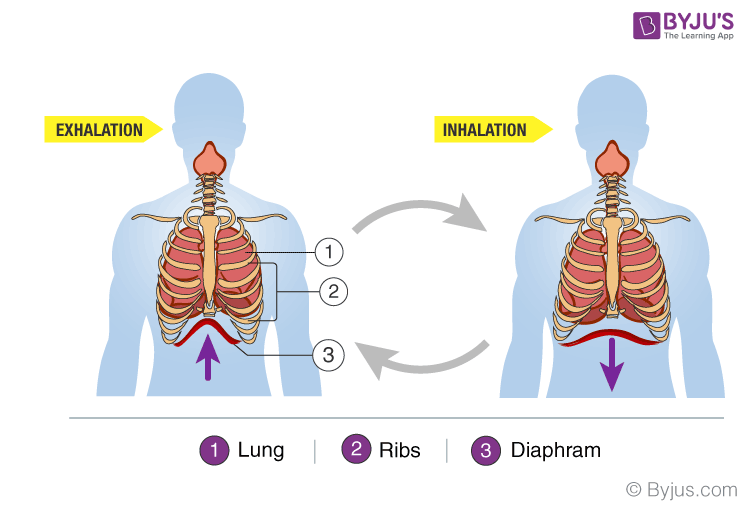
Explain the mechanism of breathing with neat labelled sketches.

Show solutionHide solution
Worked solution

Mainly two processes are involved in breathing

A. Inspiration

B. Expiration

A. Inspiration: It is the process of taking in external air or oxygen into the lungs. It starts when the diaphragm contracts and leads to increased volume of thoracic chamber. After which, the intercostal muscles contract and leads to the pulling of ribs and sternum, which also increases the volume of the thoracic chamber now, the increased volume of thoracic chamber also increases the pulmonary volume.

This further decreases the intra-pulmonary pressure less than the atmospheric pressure and causes the entry of external oxygen into the lungs called inspiration.

B. Expiration: Expiration begins when the diaphragm relaxes. This leads to a decreased volume of thoracic chamber. After which, the intercostal muscles relaxes and leads to the relaxation of ribs and sternum, which also decreases the volume of the thoracic chamber which then increases the pulmonary pressure less than the atmospheric pressure and causes exit of external oxygen called expiration.

NCERT Exemplar Solution of Class 11 Biology Chapter 17 Breathing and Exchange of Gases-2

Q3Written answer

Explain the role of neural system in regulation of respiration.

Show solutionHide solution
Worked solution

There are various centres in the neural system that plays a significant role in the regulation and control of respiration. Those are:

Pneumotaxic centre, Respiratory Rhythm centre or Medullary inspiratory centre, Apneustic centre and chemosensitive centre.

1. Pneumotaxic centre:

It is present in the dorsal part (back) of the pons varolii of the brain. It decreases the time duration of the inspiration and alters the respiration rate.

2. Respiratory Rhythm Centre or Medullary inspiratory Centre:

It is present in the medulla of the brain. It regulates the respiratory rhythm.

3. Apneustic centre is present in the lower part of the pons varolii of the brain. It increases the duration of inspiration.

4. Chemosensitive centre is present in the medulla oblongata and the pons area of the brain.

Chapter 17, Breathing and Exchange of Gases, talks about the process of respiration in which animals and mammals breathe in oxygen and breathe out carbon dioxide. Oxygen goes into the lungs, and carbon dioxide is let out as a by-product. This process is essential for the survival of any species and is termed ‘Respiration’.

Steps in Respiration

  1. Breathing
  2. Exchange of Gases
  3. Transport of Gases
  4. Cellular Respiration