My Cart
Your Cart 0

    Your cart is empty.

  • Total (Amount) ₹0.00
NCERT Exemplar · Class 11 · Biology

Chapter 13: Photosynthesis in Higher Plants

Practice each question, then open the answer or worked solution.

SHORT ANSWER TYPE QUESTIONS

20 questions
Q11Written answer

Find out how Melvin Calvin worked out the complete biosynthetic pathway for synthesis of sugar.

Show solutionHide solution
Worked solution

The following measures were used: carbon dioxide, a radioactive isotope of carbon, was labelled C14 and was supplied to the plants for this experiment. The path C14 was then monitored and analysed. After the experiment on live plant got over, the plant was killed and the labelled compound was extracted from the dead plant and based on the observation in both live and dead Calvin and his colleagues found the pathway.
Q12Written answer

Six turns of the Calvin cycle are required to generate one mole of glucose. Explain.

Show solutionHide solution
Worked solution

Glucose is a 6-carbon compound, so six carbon dioxide molecules are required to produce a single glucose molecule. Hence, six turns of the Calvin Cycle are required to generate one mole of glucose.

Q13Written answer

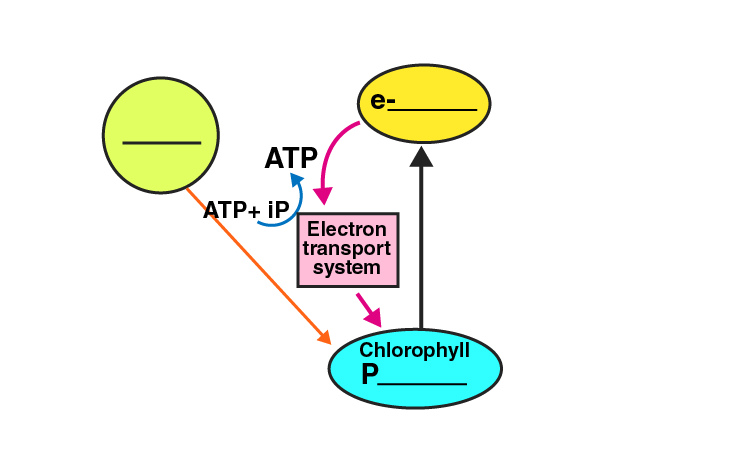
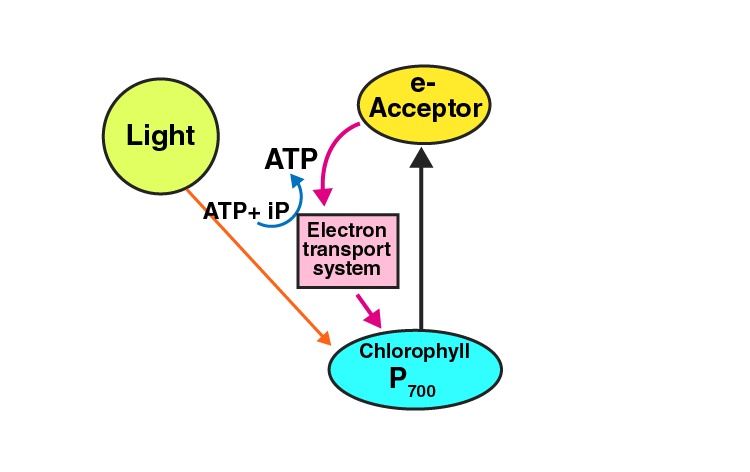
Complete the flow chart for cyclic photophosphorylation of the photosystem-I

NCERT Exemplar Solution of Class 11 Biology Chapter 13 Photosynthesis in Higher Plants-2

Show solutionHide solution
Worked solution

NCERT Exemplar Solution of Class 11 Biology Chapter 13 Photosynthesis in Higher Plants-3

Q14Written answer

In what kind of plants do you come across ‘Kranz’ anatomy? To which conditions are those plants better adapted? How are these plants better adapted than the plants which lack this anatomy?

Show solutionHide solution
Worked solution

C4-plants, such as maize, sugar cane etc. are found in Kranz anatomy. These plants are also suitable for a limited nitrogen and carbon dioxide supply.

Q15Written answer

In a way, green plants and cyanobacteria have synthesized all the food on the earth. Comment.

Show solutionHide solution
Worked solution

Cyanobacteria are unicellular prokaryotic organisms. They have photosynthetic pigments like chlorophyll ac, phycocyanin and phycoerythrin. These enable them to produce food by themselves. Green plants are multicellular organisms capable of making food by using carbon dioxide, water and light energy. Therefore the bacteria and green plants make food for living organisms on earth.

Q16Written answer

Tomatoes, carrots and chillies are red due to the presence of one pigment. Name the pigment. Is it a photosynthetic pigment?

Show solutionHide solution
Worked solution

Tomatoes, carrots and chillies are red due to the presence of carotene pigment. It is an accessory photosynthetic pigment.

Q17Written answer

Why do we believe chloroplast and mitochondria to be semi-autonomous organelle?

Show solutionHide solution
Worked solution

Extra genomic DNA is present in the chloroplast and mitochondria. This enhances the replication of these organelles. Thus believed that chloroplast and mitochondria as semi-autonomous.

Q18Written answer

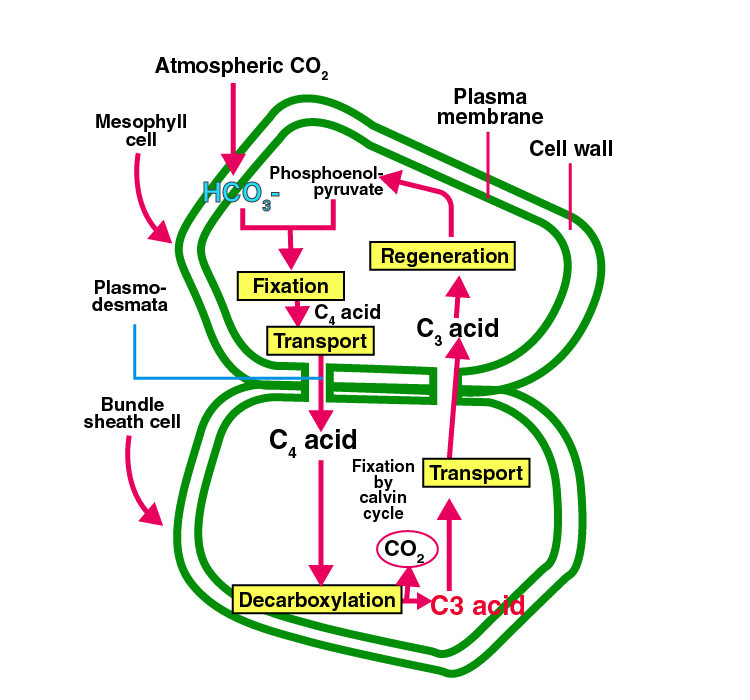
Observe the diagram and answer the following.

NCERT Exemplar Solution of Class 11 Biology Chapter 13 Photosynthesis in Higher Plants-4

a. Which group of plants exhibits these two types of cells?

b. What is the first product of the C4 cycle?

c. Which enzyme is there in bundle sheath cells and mesophyll cells?

Show solutionHide solution
Worked solution

(a) Monocot plants show bundle sheath cells and mesophyll cells.

(b) Oxaloacetic acid

(c) PEP carboxylase or PEP case.

Q19Written answer

A cyclic process is occurring in a C3 plant, which is light-dependent and needs O2. This process doesn’t produce energy rather it consumes energy.

a. Can you name the given process?

b. Is it essential for survival?

c. What are the end products of this process?

d. Where does it occur?

Show solutionHide solution
Worked solution

(a) Photorespiration

(b) It is not essential for survival.

(c) Hydrogen peroxide

(d) It occurs in chloroplast, mitochondria and peroxisome.

Q20Written answer

Suppose Euphorbia and Maize are grown in the tropical area.

a. Which one of them do you think will be able to survive under such conditions?

b. Which one of them is more efficient in terms of photosynthetic activity?

c. What difference do you think are there in their leaf anatomy?

Show solutionHide solution
Worked solution

a. Euphorbia is a CAM plant and maize is a C4 plant. Both can survive in tropical areas.

b. Maize due to the C4 plant

c. Leaves of maize plant show Kranz anatomy which is absent in Euphorbia plant.