My Cart
Your Cart 0

    Your cart is empty.

  • Total (Amount) ₹0.00
NCERT Exemplar · Class 11 · Biology

Chapter 13: Photosynthesis in Higher Plants

Practice each question, then open the answer or worked solution.

VERY SHORT ANSWER TYPE QUESTIONS

12 questions
Q1Written answer

Examine the figureNCERT Exemplar Solution of Class 11 Biology Chapter 13 Photosynthesis in Higher Plants-1
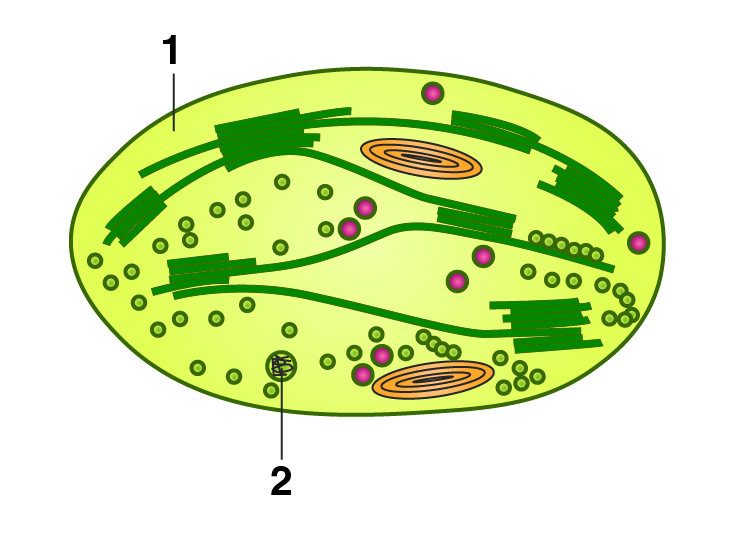
a. Is this structure present in an animal cell or plant cell?

b. Can these be passed on to the progeny? How?

c. Name the metabolic processes taking place in the places marked

(1) and (2)

Show solutionHide solution
Worked solution

(a) This structure is present in the plant cell.

(b) Chloroplast can self-replicate and hence it can be passed on to the progeny.

(c) (1) shows dark reaction and (2) shows the site of replication of chloroplast.

Q2Written answer

2H2O 4H+ + O2 + 4e–

Based on the above equation, answer the following questions:

a. Where does this reaction take place in plants?

b. What is the significance of this reaction?

Show solutionHide solution
Worked solution

a. It takes place in PS II which is a decomposition reaction of the water molecule.

b. Splitting of water continuously provides electrons to the electron transport chain; further steps of photosynthesis.

Q3Written answer

Cyanobacteria and some other photosynthetic bacteria don’t have chloroplasts. How do they conduct photosynthesis?

Show solutionHide solution
Worked solution

In the inner membrane of cyanobacteria, they have folds to take place the photosynthesis. Bluish pigment phycocyanin is there to take photo-synthesis with solar energy.

Q4Written answer

a. NADP reductase enzyme is located on _________________.

b. Breakdown of proton gradient leads to release of _________________.

Show solutionHide solution
Worked solution

a) Outer side of thylakoid membrane (Grana-lamella)

(b) ATP molecules

Q5Written answer

Can girdling experiments be done in monocots? If yes, how? If no, why not?

Show solutionHide solution
Worked solution

No. The monocot stem is scattered over all of the widths of the trunk by vascular bundles. So, we can’t reach a particular band of girdling phloem.

Q6Written answer

3CO2 + 9ATP + 6NADPH + Water glyceraldehyde 3 – phosphate + 9 ADP + 6 NADP+ + 8 Pi

Analyse the above reaction and answer the following questions:

a. How many molecules of ATP & NADPH are required to fix one molecule of CO2?

b. Where in the chloroplast does this process occur?

Show solutionHide solution
Worked solution

(a) 3 molecules of ATP are required for phosphorylation and 2 molecules of NADPH are required for reduction of carbon dioxide.

(b) This reaction occurs in the stroma of the chloroplast.

Q7Written answer

Does moonlight support photosynthesis?

Show solutionHide solution
Worked solution

It does not support photosynthesis because they don’t have enough energy to excite chlorophyll molecules.

Q8Written answer

Some of these terms/chemicals are associated with the C4 cycle. Explain.

a. Hatch slack pathway

b. Calvin cycle

c. PEP carboxylase

d. Bundle sheath cells

Show solutionHide solution
Worked solution

(a) In C4 plants the process is called the Hatch & Slack Pathway, the glucose synthesis process.

(b) Steps leading to the formation of carbohydrate following the division of the water molecule. This happens cyclically and is called the Calvin Cycle.

(c) PEP carboxylase is an enzyme. It is present in mesophyll cells of C4 plants.

(d) The specialized sclerenchyma cells present around vascular bundles in the veins of C4 plants are called bundle sheath cells.

Q9Written answer

Where is NADP reductase enzyme located in the chloroplast? What is the role of this enzyme in proton gradient development?

Show solutionHide solution
Worked solution

NADP reductase enzyme is located on the outer side of the thylakoid membrane. It facilitates the breakdown of the proton gradient to release energy, i.e. NADPH.

Q10Written answer

ATPase enzyme consists of two parts. What are those parts? How are they arranged in the thylakoid membrane? Conformational change occurs in which part of the enzyme?

Show solutionHide solution
Worked solution

Two parts of the enzyme are ATPase: the head of F0 and the head of F1. The F0 head is towards the thylakoid’s inner side while F1 is towards the thylakoid’s outer side. In F1 part of the enzyme, the conformation changes.