My Cart
Your Cart 0

    Your cart is empty.

  • Total (Amount) ₹0.00
NCERT Exemplar · Class 10 · Maths

Chapter 12: Surface Areas and Volumes

Practice each question, then open the answer or worked solution.

Exercise 12.3

7 questions
Q1Written answer

Three metallic solid cubes whose edges are 3 cm, 4 cm and 5 cm are melted and formed into a single cube. Find the edge of the cube so formed.

Show solutionHide solution
Worked solution

We know that,

Volume of cube = a3, where a = side of cube

According to the question,

Side of first cube, a1 = 3 cm

Side of second cube, a2 = 4 cm

Side of third cube, a3 = 5 cm

Let us assume that the side of cube recast from melting these cubes = a

We know that the total volume of the 3 cubes will be the same as the volume of the newly formed cube,

Volume of new cube = (volume of 1st + 2nd + 3rd cube)

⇒ a3 = a13 + a23 + a33

⇒ a3 = (3)3 + (4)3 + (5)3

⇒ a3 = 27 + 64 + 125 = 216

⇒ a = 6 cm

Therefore, side of cube so formed is 6 cm.

Q2Written answer

How many shots each having diameter 3 cm can be made from a cuboidal lead solid of dimensions 9cm × 11cm × 12cm?

Show solutionHide solution
Worked solution

Volume of cuboid = lbh, where, l = length, b = breadth and h = height

Cuboidal lead:

Length, l = 9 cm

Breadth, b = 11 cm

Height, h = 12 cm

Volume of lead = 9(11)(12) = 1188 cm3

Volume of sphere = 4/3πr3, where r = radius of sphere

Spherical shots,

Diameter = 3 cm

Radius, r = 1.5 cm

Volume of one shot = 4/3 × 22/7 × (1.5)3 = 99/7 cm3

NCERT Exemplar Class 10 Maths Chapter 12 Ex. 12.3 Question 2

Hence, the number of bullets that can be made from lead = 84.

Q3Written answer

A bucket is in the form of a frustum of a cone and holds 28.490 litres of water. The radii of the top and bottom are 28 cm and 21 cm, respectively. Find the height of the bucket.

Show solutionHide solution
Worked solution

According to the question,

The bucket is in the form of frustum of a cone.

We know that,

Volume of frustum of a cone = 1/3 πh(r12 + r22 + r1r2), where, h = height, r1 and r2 are the radii(r1 > r2)

For bucket,

Volume of bucket = 28.490 L

1 L = 1000 cm3

Volume of bucket = 28490 cm3

Radius of top, r1 = 28 cm

Radius of bottom, r2 = 21 cm

Let the height = h.

Substituting these values in the equation to find the volume of bucket,

We have.

Volume of bucket = 1/3 πh[282 + 212 + 28(21)]

28490 = 1/3 × 22/7 × h (784 + 441 + 588) = 22/7 × h × 1813

⇒ h = (28490 × 21) / (22 × 1813)

⇒ h = 15

Q4Written answer

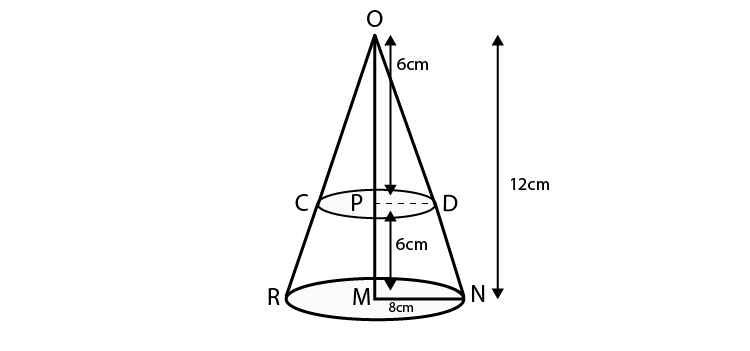
A cone of radius 8 cm and height 12 cm is divided into two parts by a plane through the mid-point of its axis parallel to its base. Find the ratio of the volumes of two parts.

Show solutionHide solution
Worked solution

NCERT Exemplar Class 10 Maths Chapter 12 Ex. 12.3 Question 4

According to the question,

Height of cone = OM = 12 cm

The cone is divided from mid-point.

Hence, let the mid-point of cone = P

OP = PM = 6 cm

From △OPD and △OMN

∠POD = ∠POD [Common]

∠OPD = ∠OMN [Both 90°]

Hence, by the Angle-Angle similarity criterion

We have,

△OPD ~ △OMN

And

Similar triangles have corresponding sides in equal ratio,

So, we have,

PD/MN = OP/OM

PD/8 = 6/12

PD = 4cm

For First part i.e. cone

Base Radius, r = PD = 4 cm

Height, h = OP = 6 cm

We know that,

Volume of cone for radius r and height h, V = 1/3 πr2h

Volume of first part = 1/3 π(4)26 = 32π

For second part, i.e. Frustum

Bottom radius, r1 = MN = 8 cm

Top Radius, r2 = PD = 4 cm

Height, h = PM = 6 cm

We know that,

Volume of frustum of a cone = 1/3 πh(r12 + r22 + r1r2) , where, h = height, r1 and r2 are radii, (r1 > r2)

Volume of second part = 1/3 π(6)[82 + 42 + 8(4)]

= 2π(112) = 224π

Therefore, we get the ratio,

Volume of first part : Volume of second part = 32π : 224π = 1 : 7

Q5Written answer

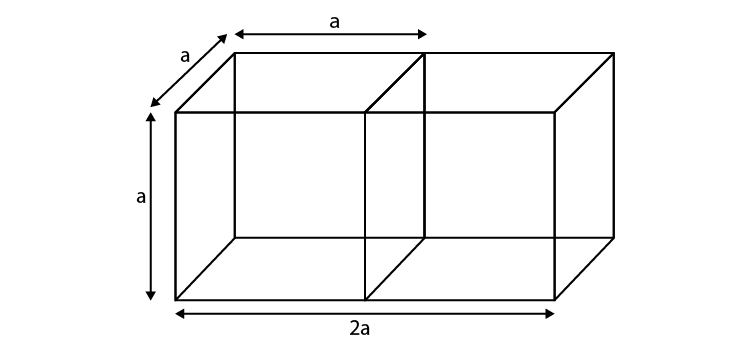
Two identical cubes each of volume 64 cm3 are joined together end to end. What is the surface area of the resulting cuboid?

Show solutionHide solution
Worked solution

NCERT Exemplar Class 10 Maths Chapter 12 Ex. 12.3 Question 5

Let the side of one cube = a

Surfaces area of resulting cuboid = 2(Total surface area of a cube) – 2(area of single surface)

We know that,

Total surface area of cube = 6a2 , where a = side of cube

⇒ Surfaces area of resulting cuboid = 2(6a2) – 2(a2) = 10a2

Also,

According to the question,

Volume of cube = 64 cm3

Volume of cube = a3

64 = a3

a = 4 cm

Therefore,

Surface area of resulting cuboid = 10a2 = 10(4)2 = 160 cm2

Q6Written answer

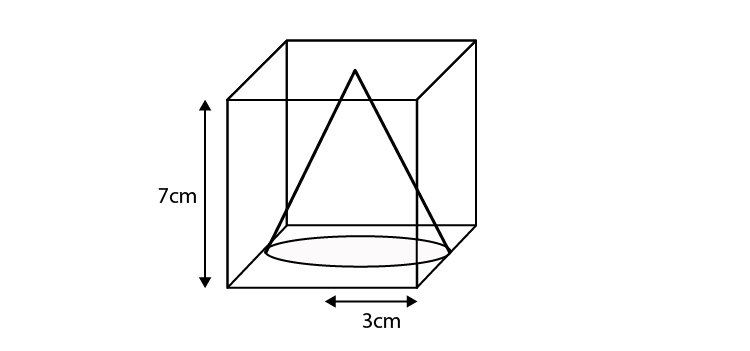
From a solid cube of side 7 cm, a conical cavity of height 7 cm and radius 3 cm is hollowed out. Find the volume of the remaining solid.

Show solutionHide solution
Worked solution

NCERT Exemplar Class 10 Maths Chapter 12 Ex. 12.3 Question 6

From the figure, we get,

Volume of remaining solid = volume of cube – volume of cone

For Cube

Side, a = 7 cm

We know that,

Volume of cube = a3, where a = side of cube

Volume of cube = (7)3 = 343 cm3

For cone

Radius, r = 3 cm

Height, h = 7 cm

Volume of cone = 1/3 πr2h = 1/3 π(3)27 = 3 × (22/7) × 7 = 66 cm3

Volume of remaining solid = volume of cube – volume of cone

= 343 – 66

= 277 cm3

Q7Written answer

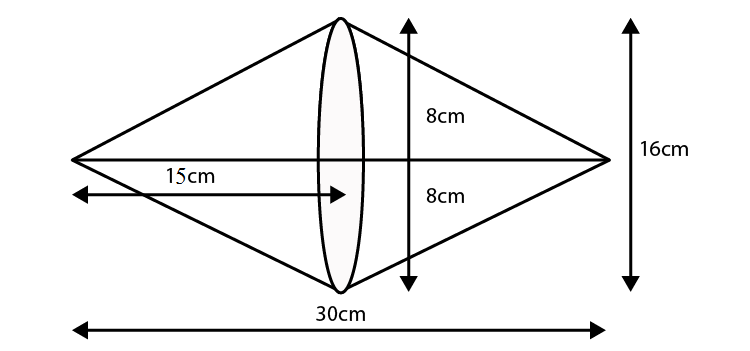
Two cones with same base radius 8 cm and height 15 cm are joined together along their bases. Find the surface area of the shape so formed.

Show solutionHide solution
Worked solution

According to the question,

We get the figure given below,

NCERT Exemplar Class 10 Maths Chapter 12 Ex. 12.3 Question 7

We know that,

Total surface area of shape formed = Curved area of first cone + Curved surface area of second cone

Since, both cones are identical,

We have,

Total surface area of shape formed = Curved area of first cone + Curved surface area of the second cone

= 2(Surface area of cone)

We also know that,

Surface area of cone = πrl, where r = radius and l = slant height

And, the total Surface area of shape so formed = 2πrl

Given in the question that,

Radius, r = 8 cm

Height, h = 15 cm

Therefore,

Area = Curved area of first cone + Curved surface area of the second cone

= 2 (Surface area of the cone)

= 2 × πrl

= 2 × π × r × √(r2 + h2)

= 2 × (22/7) × 8 × √(82 + 152)

= 50.28 × √289

= 854.85 cm2

= 855 cm2 (approx)

Hence, the surface area of shape so formed is 855cm2.