My Cart
Your Cart 0

    Your cart is empty.

  • Total (Amount) ₹0.00
NCERT Exemplar · Class 10 · Maths

Chapter 12: Surface Areas and Volumes

Practice each question, then open the answer or worked solution.

Exercise 12.1

10 questions
Q1Written answer

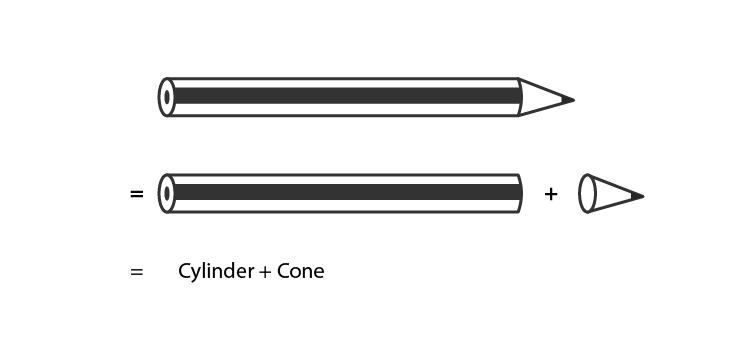
A cylindrical pencil sharpened at one edge is the combination of

(A) a cone and a cylinder (B) frustum of a cone and a cylinder

(C) a hemisphere and a cylinder (D) two cylinders.

Show solutionHide solution
Worked solution

(A) a cone and a cylinder
NCERT Exemplar Class 10 Maths Chapter 12 Ex. 12.1 Question 1

The Nib of a sharpened pencil = conical shape

The rest of the part of a sharpened pencil = cylindrical

Therefore, a pencil is a combination of cylinder and a cone.
Q2Written answer

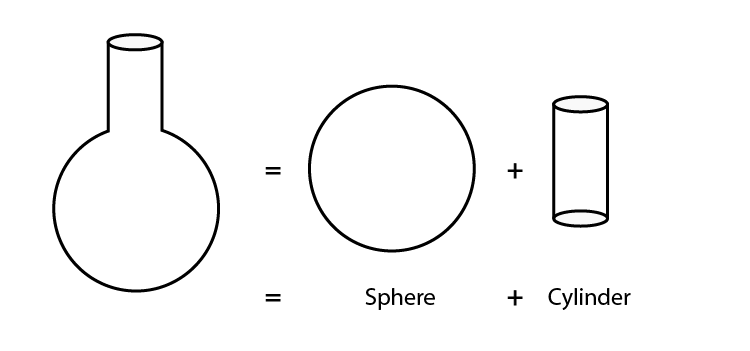
A surahi is the combination of

(A) a sphere and a cylinder (B) a hemisphere and a cylinder

(C) two hemispheres (D) a cylinder and a cone.

Show solutionHide solution
Worked solution

(A) a sphere and a cylinder

NCERT Exemplar Class 10 Maths Chapter 12 Ex. 12.1 Question 2

The top part of surahi = cylindrical shape

Bottom part of surahi = spherical shape

Therefore, surahi is a combination of Sphere and a cylinder.

Q3Written answer

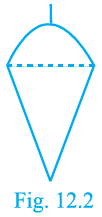
A plumbline (sahul) is the combination of (see Fig. 12.2)

NCERT Exemplar Class 10 Maths Chapter 12 Ex. 12.1 Question 3

(A) a cone and a cylinder (B) a hemisphere and a cone

(C) frustum of a cone and a cylinder (D) sphere and cylinder

Show solutionHide solution
Worked solution

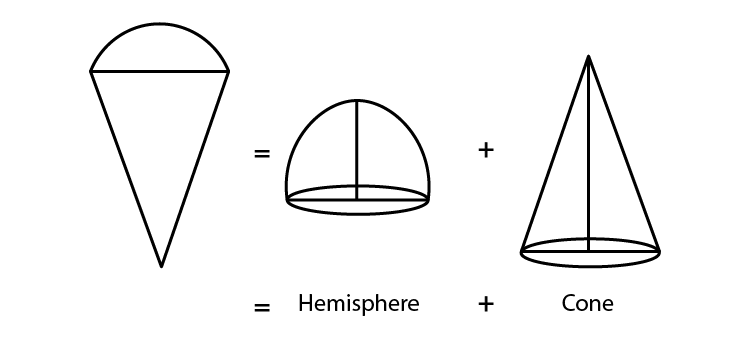
(B) a hemisphere and a cone

NCERT Exemplar Class 10 Maths Chapter 12 Ex. 12.1 Question 3-1

The upper part of plumbline = hemispherical,

The bottom part of plumbline = conical

Therefore, it is a combination of hemisphere and cone.

Q4Written answer

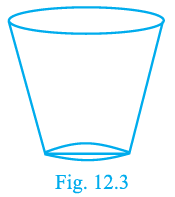
The shape of a glass (tumbler) (see Fig. 12.3) is usually in the form of

NCERT Exemplar Class 10 Maths Chapter 12 Ex. 12.1 Question 4

(A) a cone (B) frustum of a cone

(C) a cylinder (D) a sphere

Show solutionHide solution
Worked solution

(B) frustum of a cone

NCERT Exemplar Class 10 Maths Chapter 12 Ex. 12.1 Question 4-1

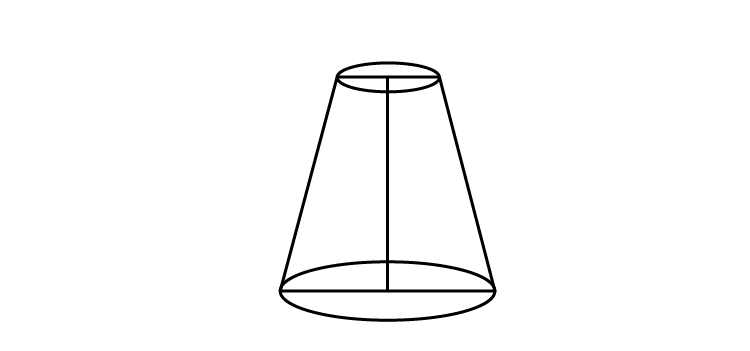
The shape of glass is a frustum or specifically, an inverted frustum.

Q5Written answer

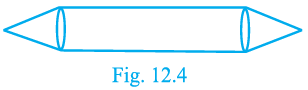
The shape of a gilli, in the gilli-danda game (see Fig. 12.4), is a combination of

NCERT Exemplar Class 10 Maths Chapter 12 Ex. 12.1 Question 5

(A) two cylinders (B) a cone and a cylinder

(C) two cones and a cylinder (D) two cylinders and a cone

Show solutionHide solution
Worked solution

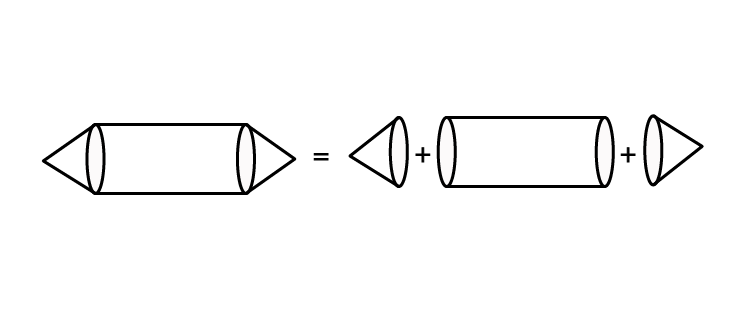
(C) two cones and a cylinder

NCERT Exemplar Class 10 Maths Chapter 12 Ex. 12.1 Question 5-1

The left and right part of a gilli = conical

The central part of a gilli = cylindrical

Therefore, it is a combination of a cylinder and two cones.

Q6Written answer

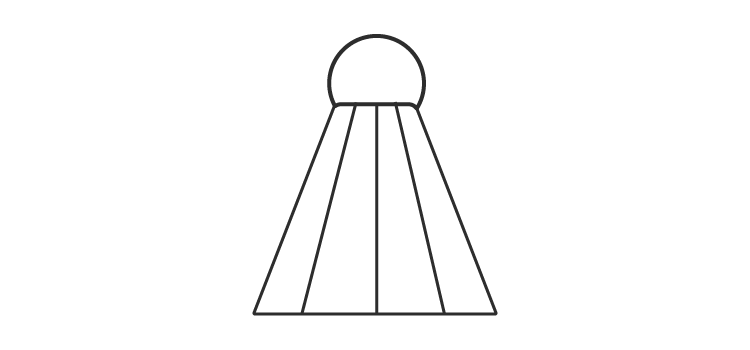
A shuttle cock used for playing badminton has the shape of the combination of

(A) a cylinder and a sphere (B) a cylinder and a hemisphere

(C) a sphere and a cone (D) frustum of a cone and a hemisphere

Show solutionHide solution
Worked solution

(D) frustum of a cone and a hemisphere

NCERT Exemplar Class 10 Maths Chapter 12 Ex. 12.1 Question 6

The cork of a shuttle = hemispherical shapes

The upper part of a shuttle = shape of frustum of a cone.

Therefore, it is a combination of frustum of a cone and a hemisphere.

Q7Written answer

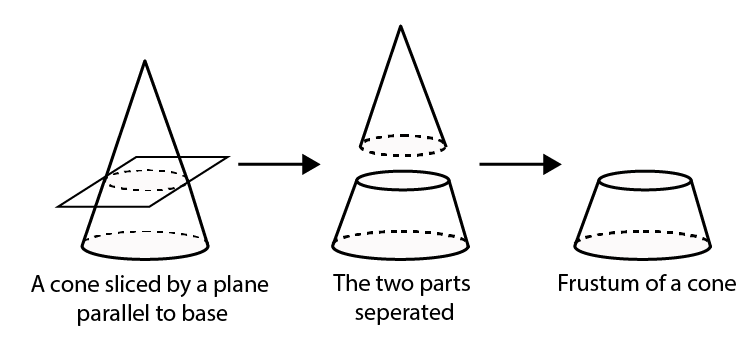
A cone is cut through a plane parallel to its base and then the cone that is formed on one side of that plane is removed. The new part that is left over on the other side of the plane is called

(A) a frustum of a cone (B) cone

(C) cylinder (D) sphere

Show solutionHide solution
Worked solution

(A) a frustum of a cone

NCERT Exemplar Class 10 Maths Chapter 12 Ex. 12.1 Question 7

When a cone is divided into two parts by a plane through any point on its axis parallel to its base, the upper and lower parts obtained are cone and a frustum, respectively.

Q8Written answer

A hollow cube of internal edge 22cm is filled with spherical marbles of diameter 0.5 cm and it is assumed that 1/8 space of the cube remains unfilled. Then the number of marbles that the cube can accommodate is

(A) 142296 (B) 142396

(C) 142496 (D) 142596

Show solutionHide solution
Worked solution

(A) 142296

According to the question,

Volume of cube =223=10648cm3

Volume of cube that remains unfilled =1/8×10648=1331cm3

volume occupied by spherical marbles =10648−1331=9317cm3

Radius of the spherical marble = 0.5/2=0.25cm=1/4cm

Volume of 1 spherical marble = 4/3×22/7 × (1/4)3=11/168cm3

Numbers of spherical marbles, n = 9317 × (11/168) =142296

Q9Written answer

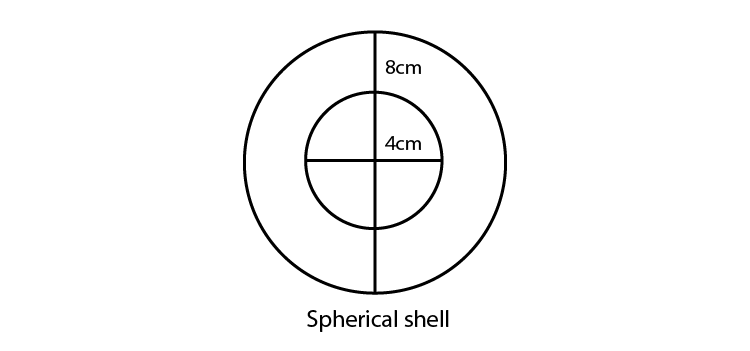
A metallic spherical shell of internal and external diameters 4 cm and 8 cm, respectively is melted and recast into the form a cone of base diameter 8cm. The height of the cone is

(A) 12cm (B) 14cm (C) 15cm (D) 18cm

Show solutionHide solution
Worked solution

(B) 14cm

NCERT Exemplar Class 10 Maths Chapter 12 Ex. 12.1 Question 9

Volume of spherical shell = Volume of cone recast by melting

For Spherical Shell,

Internal diameter, d1 = 4 cm

Internal radius, r1 = 2 cm

External diameter, d2 = 8 cm

External radius, r2 = 4 cm

Now,

As volume of spherical shell= 4/3 π (r23 – r13)

where r1 and r2 are internal and external radii respectively.

volume of given shell = 4/3 π (43 – 23)

= 4/3 π (56)

= (224/3) π

We know that,

Volume of cone = 224π /3 cm3

For cone,

Base diameter = 8 cm

Base radius, r = 4 cm

Let Height of cone = ‘h’.

We know,

Volume of cone = (1/3) π r2h,

Where r = Base radius and h = height of cone

Volume of given cone = (1/3) π 42h

⇒ 224π /3 = 16πh /3

⇒ 16h = 224

h = 14 cm

So, Height of cone is 14 cm.

Q10Written answer

A solid piece of iron in the form of a cuboid of dimensions 49cm × 33cm × 24cm, is moulded to form a solid sphere. The radius of the sphere is

(A) 21cm (B) 23cm (C) 25cm (D) 19cm

Show solutionHide solution
Worked solution

(A) 21cm

As we know,

Volume of cuboid = lbh

Where, l = length, b = breadth and h = height

For given cuboid,

Length, l = 49 cm

Breadth, b = 33 cm

Height, h = 24 cm

Volume of cube = 49× (33) × (24) cm3

Now,

Let the radius of cube be r.

As volume of sphere = 4/3 πr3

Where r = radius of sphere

Also,

Volume of cuboid = volume of sphere moulded

So,

49(33)(24) = 4/3 πr3

⇒ πr3 = 29106

⇒ r3 = 29106 × 22/7

⇒ r3 = 9261

⇒ r = ∛ 9261 cm = 21 cm

Hence, radius of sphere is 21 cm