My Cart
Your Cart 0

    Your cart is empty.

  • Total (Amount) ₹0.00
NCERT Exemplar · Class 10 · Maths

Chapter 11: Areas Related to Circles

Practice each question, then open the answer or worked solution.

Exercise 11.4

10 questions
Q1Written answer

The area of a circular playground is 22176 m2. Find the cost of fencing this ground at the rate of Rs 50 per metre.

Show solutionHide solution
Worked solution

According to the question,

Area of the circular playground = 22176 m2 (Given)

Let r be the radius of the circle.

∴ πr2 = 22176

⇒ (22/7)r2 = 22176

⇒ r2 = 22176 × (22/7)

⇒ r2 = 7056

⇒ r = 84

∴ The radius of the circular playground = 84 m

Now, the circumference of the circle = 2πr

= 2×(22/7)×84

= 528 m

Cost of fencing 1 meter of ground = Rs 50

∴ Cost of fencing the total ground = Rs 528 × 50 = Rs 26,400
Q2Written answer

The diameters of the front and rear wheels of a tractor are 80 cm and 2 m, respectively. Find the number of revolutions that the rear wheel will make in covering a distance in which the front wheel makes 1400 revolutions.

Show solutionHide solution
Worked solution

According to the question,

Diameter of front wheels = d1 = 80 cm

Diameter of rear wheels = d2 = 2 m = 200 cm

Let r1 be the radius of the front wheels = 80/2 = 40 cm

Let r2 be the radius of the rear wheels = 200/2 = 100 cm

Now, the circumference of the front wheels = 2πr

= 2 ×(22/7) × 40

= 1760/7 cm

Circumference of the rear wheels = 2πr = 2 × (22/7) × 100 = 4400/7 cm

No. of revolutions made by the front wheel = 1400

∴ Distance covered by the front wheel = 1400 × (1760/7) = 352000 cm

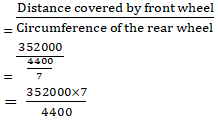
Number of revolutions made by the rear wheel in covering a distance in which the front wheel makes 1400 revolutions,

NCERT Exemplar Class 10 Maths Chapter 11- Ex.11.4 Question 2

= 560 revolutions.

Q3Written answer

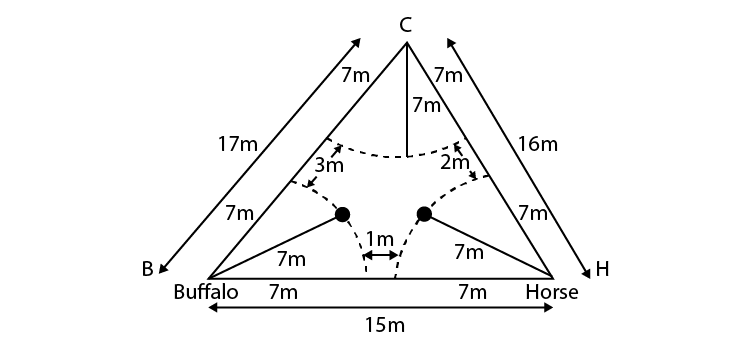
Sides of a triangular field are 15 m, 16 m and 17 m. With the three corners of the field a cow, a buffalo and a horse are tied separately with ropes of length 7 m each to graze in the field. Find the area of the field which cannot be grazed by the three animals.

Show solutionHide solution
Worked solution

According to the question,

The sides of the triangle are 15 m, 16 m, and 17 m.

Now, perimeter of the triangle = (15+16+17) m = 48 m

∴ Semi-perimeter of the triangle = s = 48/2 = 24 m

By Heron’s formula,

Area of the triangle = √(s(s – a)(s – b)(s – c)), where a, b and c are the sides of the triangle

= √(24(24 – 15)(24 – 16)(24 – 17))

= 109.982 m2

NCERT Exemplar Class 10 Maths Chapter 11- Ex.11.4 Question 3

Let B, C and H be the corners of the triangle on which buffalo, cow and horse are tied, respectively, with ropes of 7 m each.

So, the area grazed by each animal will be in the form of a sector.

∴ Radius of each sector = r = 7 m

Let x, y, z be the angles at corners B, C, H, respectively.

∴ Area of sector with central angle x,

= ½ (x/180) × πr2 = (x/360) × π(7)2

Area of sector with central angle y,

= ½ (y/180) × πr2 = (y/360) × π(7)2

Area of sector with central angle z,

= ½ (z/180) × πr2 = (z/360) × π(7)2

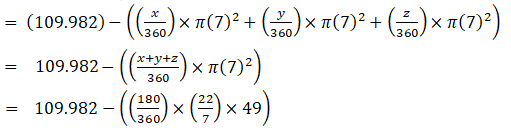
Area of field not grazed by the animals = Area of triangle – (area of the three sectors)

NCERT Exemplar Class 10 Maths Chapter 11- Ex.11.4 Question 3-1

= 109.892 – 77

= 32.982 cm2

Q4Written answer

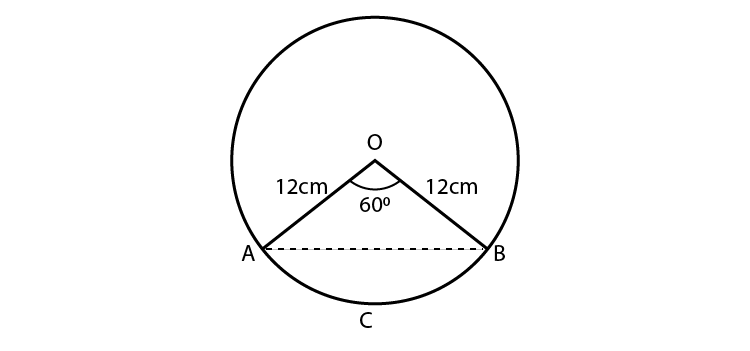
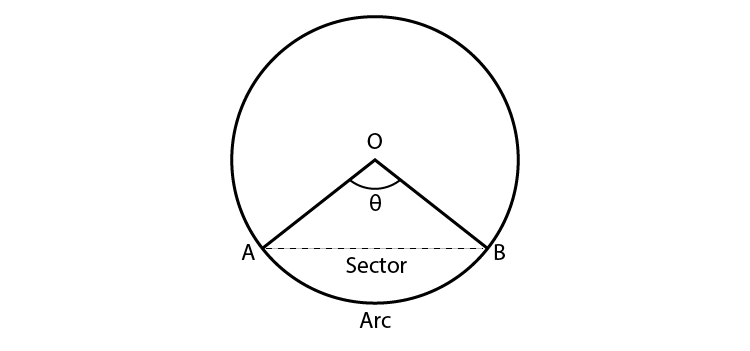
Find the area of the segment of a circle of radius 12 cm whose corresponding sector has a central angle of 60° (Use π = 3.14).

Show solutionHide solution
Worked solution

According to the question,

Radius of the circle = r = 12 cm

∴ OA = OB = 12 cm

∠ AOB = 60° (given)

NCERT Exemplar Class 10 Maths Chapter 11- Ex.11.4 Question 4

Since triangle OAB is an isosceles triangle, ∴ ∠ OAB = ∠ OBA = θ (say)

Also, the sum of interior angles of a triangle is 180°,

∴ θ + θ + 60° = 180°

⇒2θ = 120° ⇒ θ = 60°

Thus, the triangle AOB is an equilateral triangle.

∴ AB = OA = OB = 12 cm

Area of the triangle AOB = (√3 /4)× a2, where a is the side of the triangle.

= (√3 /4) × (12)2

= (√3 /4) × 144

= 36√3 cm2

= 62.354 cm2

Now, Central angle of the sector AOBCA = ∅ = 60° =  (60π / 180) = (π/3) radians

Thus, area of the sector AOBCA = ½ r2 ∅

= ½ × 122 × π/3

= 122 × (22 / (7×6))

= 75.36 cm2

Now, Area of the segment ABCA = Area of the sector AOBCA – Area of the triangle AOB

= (75.36 – 62.354) cm2 = 13.006 cm2

Q5Written answer

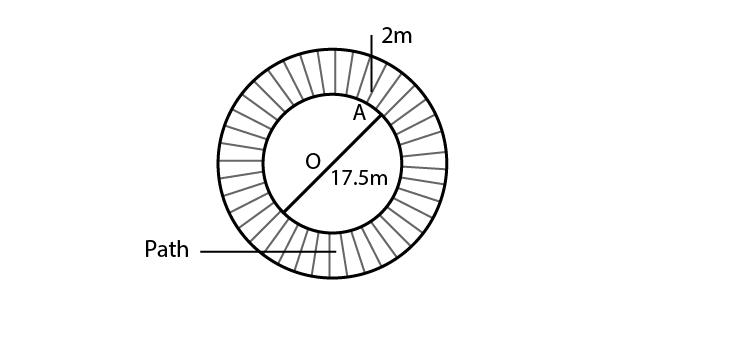
A circular pond is 17.5 m is of diameter. It is surrounded by a 2 m wide path. Find the cost of constructing the path at the rate of Rs 25 per m2

Show solutionHide solution
Worked solution

Diameter of the circular pond = 17.5 m

Let r be the radius of the park = (17.5/2) m = 8.75 m

NCERT Exemplar Class 10 Maths Chapter 11- Ex.11.4 Question 5

According to the question,

The circular pond is surrounded by a path of width 2 m.

So, Radius of the outer circle = R = (8.75+2) m = 10.75 m

Area of the road = Area of the outer circular path – Area of the circular pond

= πr2 – πR2

= 3.14 × (10.75)2 – 3.14 × (8.75)2

= 3.14 × ((10.75)2 – (8.75)2)

= 3.14 × ((10.75 + 8.75) × (10.75 – 8.75))

= 3.14 × 19.5 × 2 = 122.46 m2

Hence, the area of the path is 122.46 m2.

Now, the cost of constructing the path per m2 = Rs. 25

∴ cost of constructing 122.46m2 of the path = Rs. 25 × 122.46 = Rs. 3061.50

Q6Written answer

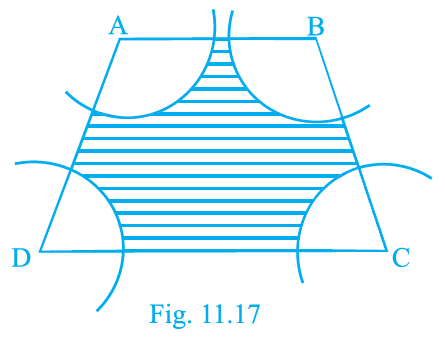
In Fig. 11.17, ABCD is a trapezium with AB || DC, AB = 18 cm, DC = 32 cm and distance between AB and DC = 14 cm. If arcs of equal radii 7 cm with centres A, B, C and D have been drawn, then find the area of the shaded region of the figure.

NCERT Exemplar Class 10 Maths Chapter 11- Ex.11.4 Question 6

Show solutionHide solution
Worked solution

AB = 18 cm, DC = 32 cm

Distance between AB and DC = Height = 14 cm

Now, Area of the trapezium = (1/2) × (Sum of parallel sides) × Height

= (½) × (18+32) × 14 = 350cm2

As AB ∥ DC, ∴ ∠ A +∠ D = 180°

And ∠ B +∠ C = 180°

Also, radius of each arc = 7 cm

Therefore,

Area of the sector with central angle A = (½) × (∠A/180) × π × r2

Area of the sector with central angle D = (½) × (∠D/180) × π × r2

Area of the sector with central angle B = (½) × (∠B/180) × π × r2

Area of the sector with central angle C = (½) × (∠C/180) × π × r2

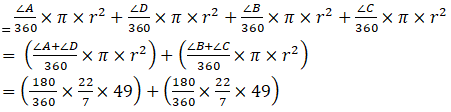
The total area of the sectors,

NCERT Exemplar Class 10 Maths Chapter 11- Ex.11.4 Question 6-1

= 77 + 77

= 154

∴ Area of shaded region = Area of trapezium – (Total area of sectors)

= 350 – 154 = 196 cm2

Hence, the required area of the shaded region is 196 cm2.

Q7Written answer

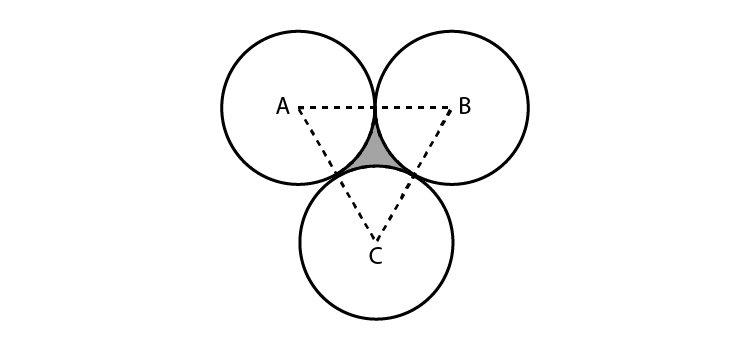
Three circles, each of radius 3.5 cm, are drawn in such a way that each of them touches the other two. Find the area enclosed between these circles.

Show solutionHide solution
Worked solution

The three circles are drawn such that each of them touches the other two.

NCERT Exemplar Class 10 Maths Chapter 11- Ex.11.4 Question 7

By joining the centres of the three circles,

We get,

AB = BC = CA = 2(radius) = 7 cm

Therefore, triangle ABC is an equilateral triangle with each side 7 cm.

∴ Area of the triangle = (√3 /4) × a2, where a is the side of the triangle.

= (√3 /4) × 72

= (49/4) √3 cm2

= 21.2176 cm2

Now, Central angle of each sector = ∅ = 60° (60π/180)

= π/3 radians

Thus, area of each sector = (1/2) r2θ

= (1/2) × (3.5)2 × (π/3)

= 12.25 × (22/ (7×6))

= 6.4167 cm2

Total area of three sectors = 3 × 6.4167 = 19.25 cm2

∴ The area enclosed between three circles = Area of triangle ABC – Area of the three sectors

= 21.2176 – 19.25

= 1.9676 cm2

Hence, the required area enclosed between these circles is 1.967 cm2 (approx.).

Q8Written answer

Find the area of the sector of a circle of radius 5 cm, if the corresponding arc length is 3.5 cm.

Show solutionHide solution
Worked solution

NCERT Exemplar Class 10 Maths Chapter 11- Ex.11.4 Question 8

Radius of the circle = r = 5 cm

Arc length of the sector = l = 3.5 cm

Let the central angle (in radians) be θ.

As, Arc length = Radius × Central angle (in radians)

∴ Central angle (θ) = Arc length / Radius = l / r = 3.5/5 = 0.7 radians

Now, Area of the sector = (½) × r2θ = (½) × 25 × 0.7 = 8.75 cm2

Hence, the required area of the sector of a circle is 8.75 cm2.

Q9Written answer

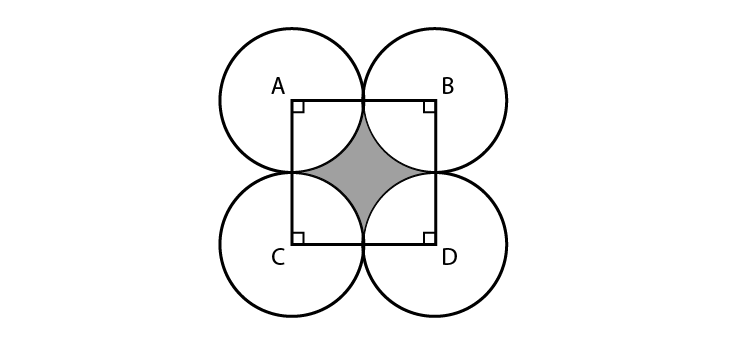
Four circular cardboard pieces of radii 7 cm are placed on a paper in such a way that each piece touches the other two pieces. Find the area of the portion enclosed between these pieces.

Show solutionHide solution
Worked solution

According to the question,

The four circles are placed such that each piece touches the other two pieces.

NCERT Exemplar Class 10 Maths Chapter 11- Ex.11.4 Question 9

By joining the centres of the circles by a line segment, we get a square ABDC with sides,

AB = BD = DC = CA = 2(Radius) = 2(7) cm = 14 cm

Now, Area of the square = (Side)2 = (14)2 = 196 cm2

ABDC is a square,

Therefore, each angle has a measure of 90°.

i.e., ∠ A = ∠ B = ∠ D = ∠ C = 90° = π/2 radians = θ (say)

Given that,

Radius of each sector = 7 cm

Area of the sector with central angle A = (½)r2θ

= ½ r2 θ

= ½ × 49 × π/2

= ½ × 49 × (22/(2×7))

= (77/2) cm2

Since the central angles and the radius of each sector are same, area of each sector is 77/2 cm2

∴ Area of the shaded portion = Area of square – Area of the four sectors

= 196 – (4 × (77/2))

= 196 – 154

= 42 cm2

Therefore, the required area of the portion enclosed between these pieces is 42 cm2.

Q10Written answer

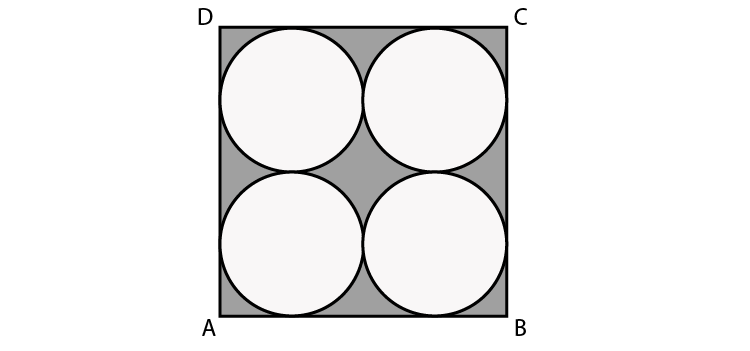
On a square cardboard sheet of area 784 cm2, four congruent circular plates of maximum size are placed such that each circular plate touches the other two plates and each side of the square sheet is tangent to two circular plates. Find the area of the square sheet not covered by the circular plates.

Show solutionHide solution
Worked solution

According to the question,

Area of the square = 784 cm2

∴ Side of the square = √Area = √784 = 28 cm

The four circular plates are congruent,

Then diameter of each circular plate = 28/2 = 14 cm

∴ The radius of each circular plate = 7 cm

We know that,

Area of the sheet not covered by plates = Area of the square – Area of the four circular plates

As all four circular plates are congruent,

We have the area of all four plates equal.

∴ Area of one circular plate = πr2 = (22/7) × 72 = 154 cm2

NCERT Exemplar Class 10 Maths Chapter 11- Ex.11.4 Question 10

Then,

Area of four plates = 4×154 = 616 cm2

Area of the sheet not covered by plates = 784 – 616 = 168 cm2