My Cart
Your Cart 0

    Your cart is empty.

  • Total (Amount) ₹0.00
NCERT Exemplar · Class 10 · Maths

Chapter 11: Areas Related to Circles

Practice each question, then open the answer or worked solution.

Exercise 11.2

6 questions
Q1Written answer

Is the area of the circle inscribed in a square of side a cm, a2 cm2? Give reasons for your answer.

Show solutionHide solution
Worked solution

False

Explanation:

Let a be the side of square.

We are given that the circle is inscribed in the square.
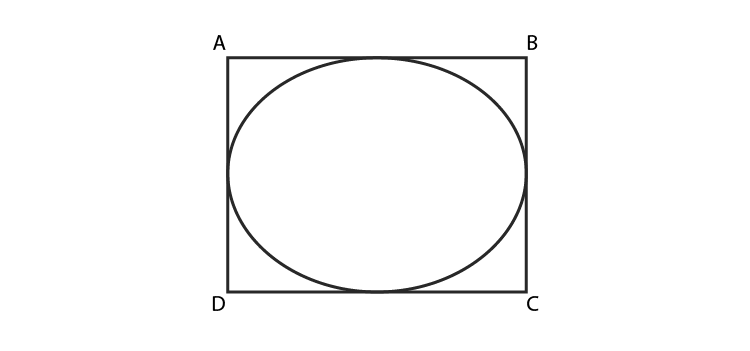
NCERT Exemplar Class 10 Maths Chapter 11- Ex.11.2 Question 1

Diameter of circle = Side of square = a

Radius of the circle = a/2

Area of the circle = πr2 = π(a/2)2 = (πa2)/4 cm2

Hence, area of the circle is (πa2)/4 cm2

Thus the area of the circle inscribed in a square of side a cm is not a2 cm2
Q2Written answer

Will it be true to say that the perimeter of a square circumscribing a circle of radius a cm is 8a cm? Give reasons for your answer.

Show solutionHide solution
Worked solution

True

Explanation:

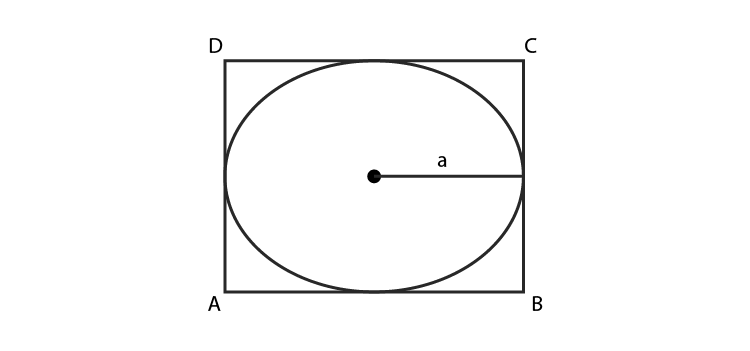
Let r be the radius of circle = a cm

NCERT Exemplar Class 10 Maths Chapter 11- Ex.11.2 Question 2

∴ Diameter of the circle = d = 2 × Radius = 2a cm

As the circle is inscribed in the square, therefore,

Side of a square = Diameter of circle = 2a cm

Hence, Perimeter of a square = 4 × (side) = 4 × 2a = 8a cm

Thus, it will be true to say that the perimeter of a square circumscribing a circle of radius a cm is 8a cm.

Q3Written answer

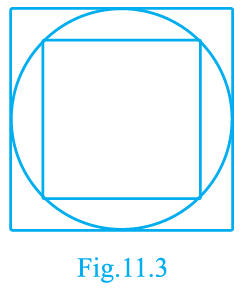
In Fig 11.3, a square is inscribed in a circle of diameter d and another square is circumscribing the circle. Is the area of the outer square four times the area of the inner square? Give reasons for your answer.

NCERT Exemplar Class 10 Maths Chapter 11- Ex.11.2 Question 3

Show solutionHide solution
Worked solution

False

Explanation:

Diameter of the circle = d

Therefore,

Diagonal of inner square EFGH = Side of the outer square ABCD = Diameter of circle = d

Let side of inner square EFGH be a

Now in right-angled triangle EFG,

(EG)2 = (EF)2 + (FG)2

By Pythagoras theorem)

⇒ d2 = a2 +a2

⇒ d2 = 2a2

⇒ a2 = d2/2

∴ Area of inner circle = a2 = d2/2

Also, Area of outer square = d2

∴ the area of the outer circle is only two times the area of the inner circle.

Thus, area of outer square is not equal to four times the area of the inner square.

Q4Written answer

Is it true to say that area of a segment of a circle is less than the area of its corresponding sector? Why?

Show solutionHide solution
Worked solution

False

Explanation:

It is not true because in case of major segment, area is always greater than the area of its corresponding sector. It is true only in the case of minor segment.

Thus, we can conclude that it is not true to say that area of a segment of a circle is less than the area of its corresponding sector.

Q5Written answer

Is it true that the distance travelled by a circular wheel of diameter d cm in one revolution is 2 d cm? Why?

Show solutionHide solution
Worked solution

False

Explanation:

Distance travelled by a circular wheel of radius r in one revolution equals the circumference of the circle.

We know that,

Circumference of the circle = 2πd; where d is the diameter of the circle.

Thus, it is not true that the distance travelled by a circular wheel of diameter d cm in one revolution is 2 d cm.

Q6Written answer

In covering a distance s metres, a circular wheel of radius r metres makes s/2πr revolutions. Is this statement true? Why?

Show solutionHide solution
Worked solution

True

Explanation:

The distance travelled by a circular wheel of radius r m in one revolution is equal to the circumference of the circle = 2πr

No. of revolutions completed in 2πr m distance = 1

No. of revolutions completed in 1 m distance = (1/2πr)

No. of revolutions completed in s m distance = (1/2πr) × s = s/2πr

Thus, the statement “in covering a distance s metres, a circular wheel of radius r metres makes s/2πr revolutions” is true.