My Cart
Your Cart 0

    Your cart is empty.

  • Total (Amount) ₹0.00
NCERT · Class 9 · Science

Chapter 7: Motion

Practice each question, then open the answer or worked solution.

Exercises

Textbook page 112,113 · 10 questions
Q1Written answer

An athlete completes one round of a circular track of diameter 200 m in 40 s. What will be the distance covered and the displacement at the end of 2 minutes 20 s?

Show solutionHide solution
Worked solution

Given, diameter of the track (d) = 200m

Therefore, the circumference of the track (π*d) = 200π meters.

Distance covered in 40 seconds = 200π meters

Distance covered in 1 second = 200π/40

Distance covered in 2minutes and 20 seconds (140 seconds) = 140 * 200π/40 meters

= (140*200*22)/(40* 7) meters = 2200 meters

Number of rounds completed by the athlete in 140 seconds = 140/40 = 3.5

Therefore, the final position of the athlete (with respect to the initial position) is at the opposite end of the circular track. Therefore, the net displacement will be equal to the diameter of the track, which is 200m.

Therefore, the net distance covered by the athlete is 2200 meters and the total displacement of the athlete is 200m.
Q2Written answer

Joseph jogs from one end A to the other end B of a straight 300 m road in 2 minutes 30 seconds and then turns around and jogs 100 m back to point C in another 1 minute. What are Joseph’s average speeds and velocities in jogging (a) from A to B and (b) from A to C?

Show solutionHide solution
Worked solution

Given, distance covered from point A to point B = 300 meters

Distance covered from point A to point C = 300m + 100m = 400 meters

Time taken to travel from point A to point B = 2 minutes and 30 seconds = 150 seconds

Time taken to travel from point A to point C = 2 min 30 secs + 1 min = 210 seconds

Displacement from A to B = 300 meters

Displacement from A to C = 300m – 100m = 200 meters

Average speed = total distance travelled/ total time taken

Average velocity = total displacement/ total time taken

Therefore, the average speed while traveling from A to B = 300/150 ms-1 = 2 m/s

Average speed while traveling from A to C = 400/210 ms-1= 1.9 m/s

Average velocity while traveling from A to B =300/150 ms-1= 2 m/s

Average velocity while traveling from A to C =200/210 ms-1= 0.95 m/s

Q3Written answer

Abdul, while driving to school, computes the average speed for his trip to be 20 km.h–1. On his return trip along the same route, there is less traffic and the average speed is 30 km.h–1. What is the average speed for Abdul’s trip?

Show solutionHide solution
Worked solution

Distance travelled to reach the school = distance travelled to reach home = d (say)

Time taken to reach school = t1

Time taken to reach home = t2

therefore, average speed while going to school = total distance travelled/ total time taken = d/t1 = 20 kmph

Average speed while going home = total distance travelled/ total time taken = d/t2= 30 kmph

Therefore, t1 = d/20 and t2 = d/30

Now, the average speed for the entire trip is given by total distance travelled/ total time taken

= (d+d)/(t1+t2)kmph = 2d/(d/20+d/30)kmph

= 2/[(3 + 2)/60]

= 120/5 kmh-1 = 24 kmh-1

Therefore, Abdul’s average speed for the entire trip is 24 kilometers per hour.

Q4Written answer

A motorboat starting from rest on a lake accelerates in a straight line at a constant rate of 3.0 m s–2 for 8.0 s. How far does the boat travel during this time?

Show solutionHide solution
Worked solution

Given, initial velocity of the boat = 0 m/s

Acceleration of the boat = 3 ms-2

Time period = 8s

As per the second motion equation, s = ut + 1/2 at2

Therefore, the total distance travelled by boat in 8 seconds = 0 + 1/2 (3)(8)2

= 96 meters

Therefore, the motorboat travels a distance of 96 meters in a time frame of 8 seconds.

Q5Written answer

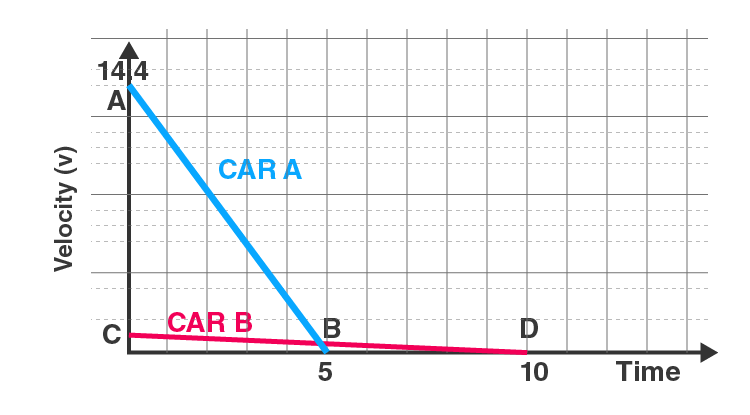
A driver of a car travelling at 52 km h–1 applies the brakes and accelerates uniformly in the opposite direction. The car stops in 5 s. Another driver going at 3 km h–1 in another car applies his brakes slowly and stops in 10 s. On the same graph paper, plot the speed versus time graphs for the two cars. Which of the two cars travelled farther after the brakes were applied?

Show solutionHide solution
Worked solution

The speed v/s time graphs for the two cars can be plotted as follows.

NCERT Solution for Class 9 Science Chapter 8 Question No 5 solution

The total displacement of each car can be obtained by calculating the area beneath the speed-time graph.

Therefore, displacement of the first car = area of triangle AOB

= (1/2)*(OB)*(OA)

But OB = 5 seconds and OA = 52 km.h-1 = 14.44 m/s

Therefore, the area of the triangle AOB is given by: (1/2)*(5s)*(14.44ms-1) = 36 meters

Now, the displacement of the second car is given by the area of the triangle COD

= (1/2)*(OD)*(OC)

But OC = 10 seconds and OC = 3km.h-1 = 0.83 m/s

Therefore, area of triangle COD = (1/2)*(10s)*(0.83ms-1) = 4.15 meters

Therefore, the first car is displaced by 36 meters whereas the second car is displaced by 4.15 meters. Therefore, the first car (which was traveling at 52 kmph) travelled farther post the application of brakes.

Q6Written answer

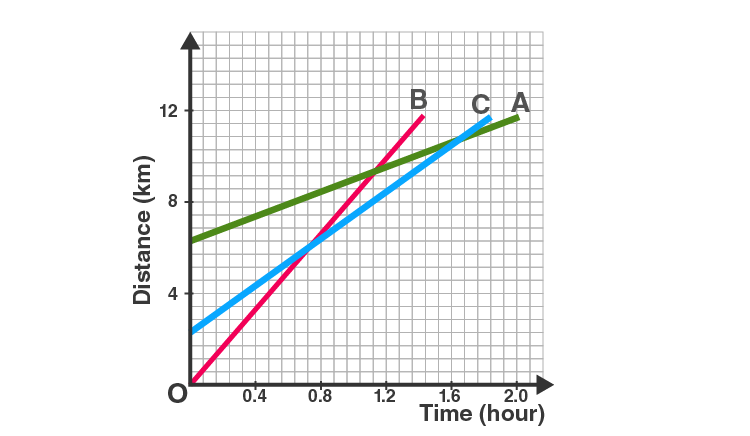
Fig 8.11 shows the distance-time graph of three objects A, B and C. Study the graph and answer the following questions:

NCERT Solution for Class 9 Science Chapter 8 Question No 6 solution

(a) Which of the three is travelling the fastest? (b) Are all three ever at the same point on the road? (c) How far has C travelled when B passes A? (d) How far has B travelled by the time it passes C?

Show solutionHide solution
Worked solution

(a) Since the slope of line B is the greatest, B is travelling at the fastest speed.

(b) Since the three lines do not intersect at a single point, the three objects never meet at the same point on the road.

(c) Since there are 7 unit areas of the graph between 0 and 4 on the Y axis, 1 graph unit equals 4/7 km.

Since the initial point of an object C is 4 graph units away from the origin, Its initial distance from the origin is 4*(4/7)km = 16/7 km

When B passes A, the distance between the origin and C is 8km

Therefore, total distance travelled by C in this time = 8 – (16/7) km = 5.71 km

(d) The distance that object B has covered at the point where it passes C is equal to 9 graph units.

Therefore, total distance travelled by B when it crosses C = 9*(4/7) = 5.14 km

Q7Written answer

A ball is gently dropped from a height of 20 m. If its velocity increases uniformly at the rate of 10 m s-2, with what velocity will it strike the ground? After what time will it strike the ground?

Show solutionHide solution
Worked solution

Given, initial velocity of the ball (u) = 0 (since it began at the rest position)

Distance travelled by the ball (s) = 20m

Acceleration (a) = 10 ms-2

As per the third motion equation,

v2 – u2 = 2as

Therefore,

= 2*(10ms-2)*(20m) + 0

v2 = 400m2s-2

Therefore, v= 20ms-1

The ball hits the ground with a velocity of 20 meters per second.

As per the first motion equation,

Therefore, t = (v-u)/a

= (20-0)ms-1 / 10ms-2

= 2 seconds

Therefore, the ball reaches the ground after 2 seconds.

Q8Written answer

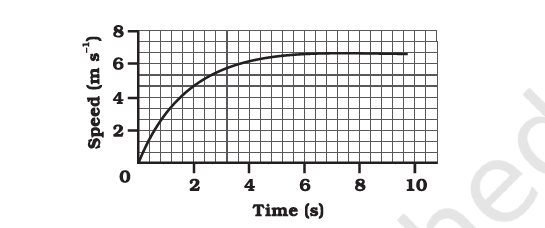
The speed-time graph for a car is shown in Fig. 8.12

NCERT Solution for Class 9 Science Chapter 8 Question No 8

(a) Find how far does the car travel in the first 4 seconds. Shade the area on the graph that represents the distance travelled by the car during the period. (b) Which part of the graph represents uniform motion of the car?

Show solutionHide solution
Worked solution

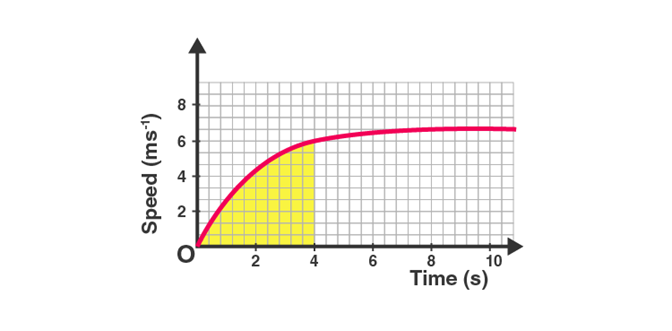
(a)

NCERT Solution for Class 9 Science Chapter 8 Question No 13

The shaded area represents the displacement of the car over a time period of 4 seconds. It can be calculated as:

(1/2)*4*6 = 12 meters. Therefore the car travels a total of 12 meters in the first four seconds.

(b) Since the speed of the car does not change from the points (x=6) and (x=10), the car is said to be in uniform motion from the 6th to the 10th second.

Q9Written answer

State which of the following situations are possible and give an example for each of these: (a) an object with a constant acceleration but with zero velocity (b) an object moving with an acceleration but with uniform speed. (c) an object moving in a certain direction with an acceleration in the perpendicular direction.

Show solutionHide solution
Worked solution

(a) It is possible; an object thrown up into the air has a constant acceleration due to gravity acting on it. However, when it reaches its maximum height, its velocity is zero.

(b) it is possible; acceleration implies an increase or decrease in speed, and uniform speed implies that the speed does not change over time

Circular motion is an example of an object moving with acceleration but with uniform speed.

An object moving in a circular path with uniform speed is still under acceleration because the velocity changes due to continuous changes in the direction of motion.

(c) It is possible; for an object accelerating in a circular trajectory, the acceleration is perpendicular to the direction followed by the object.

Q10Written answer

An artificial satellite is moving in a circular orbit of radius 42250 km. Calculate its speed if it takes 24 hours to revolve around the earth.

Show solutionHide solution
Worked solution

Given, the radius of the orbit = 42250 km

Therefore, circumference of the orbit = 2*π*42250km = 265571.42 km

Time is taken for the orbit = 24 hours

Therefore, speed of the satellite = 11065.4 km.h-1

The satellite orbits the Earth at a speed of 11065.4 kilometers per hour.