My Cart
Your Cart 0

    Your cart is empty.

  • Total (Amount) ₹0.00
NCERT · Class 9 · Science

Chapter 11: Sound

Practice each question, then open the answer or worked solution.

Exercise Questions

Textbook page 174 · 22 questions
Q11Written answer

When a sound is reflected from a distant object, an echo is produced. Let the distance between the reflecting surface and the source of sound production remains the same. Do you hear an echo sound on a hotter day?

Show solutionHide solution
Worked solution

An echo is heard when the time interval between the reflected sound and the original sound is at least 0.1 seconds. As the temperature increases, the speed of sound in a medium also increases. On a hotter day, the time interval between the reflected and original sound will decrease, and an echo is audible only if the time interval between the reflected sound and the original sound is greater than 0.1 s.
Q12Written answer

Give two practical applications of the reflection of sound waves.

Show solutionHide solution
Worked solution

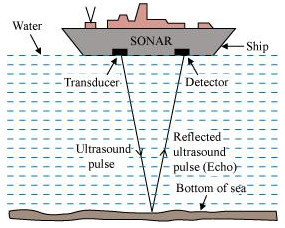
(i) Reflection of sound is used to measure the speed and distance of underwater objects. This method is called SONAR.

(ii) Working of a stethoscope – The sound of a patient’s heartbeat reaches the doctor’s ear through multiple reflections of sound.

Q13Written answer

A stone is dropped from the top of a tower 500 m high into a pond of water at the base of the tower. When is the splash heard at the top? Given, g = 10 m s−2 and speed of sound = 340 m s−1.

Show solutionHide solution
Worked solution

Height (s) of tower = 500 m

Velocity (v) of sound = 340 m s−1

Acceleration (g) due to gravity = 10 m s−1

Initial velocity (u) of the stone = 0

Time (t1) taken by the stone to fall to the tower base:

As per the second equation of motion,

s= ut1 + (½) g (t1)2

500 = 0 x t1 + (½) 10 (t1)2

(t1)2 = 100

t1 = 10 s

Time (t2) taken by sound to reach the top from the tower base = 500/340 = 1.47 s

t = t1 + t2

t = 10 + 1.47

t = 11.47 s

Q14Written answer

A sound wave travels at a speed of 339 m s-1. If its wavelength is 1.5 cm, what is the frequency of the wave? Will it be audible?

Show solutionHide solution
Worked solution

Speed (v) of sound = 339 m s−1

Wavelength (λ) of sound = 1.5 cm = 0.015 m

Speed of sound = Wavelength × Frequency

v = v = λ X v

v = v / λ = 339 / 0.015 = 22600 Hz

The frequency of audible sound for human beings lies between the ranges of 20 Hz to 20,000 Hz. The frequency of the given sound is more than 20,000 Hz; therefore, it is not audible.

Page: 175

Q15Written answer

What is reverberation? How can it be reduced?

Show solutionHide solution
Worked solution

The continuous multiple reflections of sound in a big enclosed space are reverberation. It can be reduced by covering walls and ceilings of enclosed spaces with the help of sound-absorbing materials, such as loose woollens and fibre boards.

Q16Written answer

What is the loudness of sound? What factors does it depend on?

Show solutionHide solution
Worked solution

Loud sounds have high energy. Loudness directly depends on the amplitude of vibrations. It is proportional to the square of the amplitude of vibrations of sound.

Q17Written answer

Explain how bats use ultrasound to catch prey.

Show solutionHide solution
Worked solution

Bats have the ability to produce high-pitched ultrasonic squeaks. These squeaks get reflected by objects, like prey, and return to their ears. This helps a bat to know how far its prey is.

Q18Written answer

How is ultrasound used for cleaning?

Show solutionHide solution
Worked solution

Solution:

Objects that need to be cleansed are put in a cleaning solution, and ultrasonic sound waves are passed through the solution. The high frequency of ultrasound waves helps in detaching the dirt from the objects. In this way, ultrasound is used for cleaning purposes.

Q19Written answer

Explain the working and application of a sonar.

Show solutionHide solution
Worked solution

SONAR is an abbreviation for Sound Navigation and Ranging. It is an acoustic device used in measuring the direction, speed, and depth of underwater objects, such as shipwrecks and submarines, using ultrasound.

Also, it is used to determine the depth of oceans and seas.

A beam of ultrasonic sound is produced and travels through the seawater, which is transmitted by the transducer. When it reflects, an echo is produced, which is detected and recorded by the detector. It is then converted into electrical signals. The distance represented by ‘d’ of the under-water object is calculated from the time (represented as ‘t’) taken by the echo to return with speed (represented as ‘v’) is expressed as,

2d = v × t

This method of measuring distance is also referred to as echo-ranging.

NCERT Solution for Class 9 Science Chapter 12 Image 3

Q20Written answer

A sonar device on a submarine sends out a signal and receives an echo 5 s later. Calculate the speed of sound in water if the distance of the object from the submarine is 3625 m.

Show solutionHide solution
Worked solution

Time (t) taken to hear the echo = 5 s

Distance (d) of an object from submarine = 3625 m

Total distance travelled by SONAR during reception and transmission in water = 2d

Velocity (v) of sound in water = 2d/t = (2 × 3625) / 5

= 1450 ms-1