My Cart
Your Cart 0

    Your cart is empty.

  • Total (Amount) ₹0.00
NCERT · Class 9 · Science

Chapter 11: Sound

Practice each question, then open the answer or worked solution.

Exercise Questions

Textbook page 174 · 22 questions
Q1Written answer

What is sound, and how is it produced?

Show solutionHide solution
Worked solution

Sound is produced due to vibrations. When a body vibrates, it forces the adjacent particles of the medium to vibrate. This results in a disturbance in the medium, which travels as waves and reaches the ear. Hence, the sound is produced.

Q2Written answer

Describe, with the help of a diagram, how compressions and rarefactions are produced in the air near a source of the sound.

Show solutionHide solution
Worked solution

When the school bell is hit with a hammer, it moves forward and backwards, producing compression and rarefaction due to vibrations. When it moves forward, it creates high pressure in its surrounding area. This high-pressure region is known as compression. When it moves backwards, it creates a low-pressure region in its surrounding. This region is called rarefaction.

NCERT Solution for Class 9 Science Chapter 12 Image 1

Q3Written answer

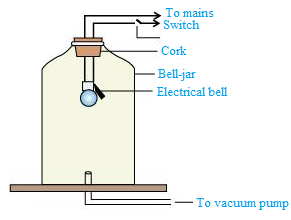
Cite an experiment to show that sound needs a material medium for its propagation.

Show solutionHide solution
Worked solution

Take an electric bell and hang it inside an empty bell jar which is fitted with a vacuum pump (as shown in the figure below).

NCERT Solution for Class 9 Science Chapter 12 Image 2

Initially, one can hear the sound of the ringing bell. Now, pump out some air from the bell jar using the vacuum pump. You will realise that the sound of the ringing bell decreases. If you keep on pumping the air out of the bell jar, then the glass jar will be devoid of any air after some time. Now, try to ring the bell. No sound is heard, but you can see the bell prong is still vibrating. When there is no air present in the bell jar, a vacuum is produced. Sound cannot travel through a vacuum. Therefore, this experiment shows that sound needs a material medium for its propagation.

Q4Written answer

Why is a sound wave called a longitudinal wave?

Show solutionHide solution
Worked solution

The vibration of the medium that travels parallel to the direction of the wave or along in the direction of the wave is called a longitudinal wave. The direction of particles of the medium vibrates parallel to the direction of the propagation of disturbance. Therefore, a sound wave is called a longitudinal wave.

Q5Written answer

Which characteristics of the sound help you to identify your friend by his voice while sitting with others in a dark room?

Show solutionHide solution
Worked solution

Quality of sound is a characteristic that helps us identify the voice of a particular person. Two people may have the same pitch and loudness, but their qualities will be different.

Q6Written answer

Flash and thunder are produced simultaneously. But thunder is heard a few seconds after the flash is seen. Why?

Show solutionHide solution
Worked solution

The speed of sound is 344 m/s, whereas the speed of light is 3 × 10⁸ m/s. The speed of light is less when compared to that of light. Due to this reason, thunder takes more time to reach the Earth as compared to light speed, which is faster. Hence, lightning is seen before whenever we hear thunder.

Q7Written answer

A person has a hearing range from 20 Hz to 20 kHz. What are the typical wavelengths of sound waves in air corresponding to these two frequencies? Take the speed of sound in air as 344 m s−1.

Show solutionHide solution
Worked solution

For sound waves,

Speed = Wavelength × frequency

v = λ × v

Speed of sound wave in air = 344 m/s

(a) For v = 20 Hz

λ1 = v/v1 = 344/20 = 17.2 m

(b) For v2 = 20,000 Hz

λ2 = v/v2 = 344/20,000 = 0.0172 m

Therefore, for human beings, the hearing wavelength is in the range of 0.0172 m to 17.2 m.

Q8Written answer

Two children are at opposite ends of an aluminium rod. One strikes the end of the rod with a stone. Find the ratio of times taken by the sound wave in the air and in aluminium to reach the second child.

Show solutionHide solution
Worked solution

Consider the length of the aluminium rod = d

Speed of sound wave at 25° C, V Al = 6420 ms-1

Time taken to reach the other end is,

T Al = d/ (V Al) = d/6420

Speed of sound in air, V air = 346 ms-1

Time taken by sound to each other end is,

T air = d/ (V air) = d/346

Therefore, the ratio of time taken by sound in aluminium and air is,

T air / t Al = 6420 / 346 = 18.55

Q9Written answer

The frequency of a source of sound is 100 Hz. How many times does it vibrate in a minute?

Show solutionHide solution
Worked solution

Frequency = (Number of oscillations) / Total time

Number of oscillations = Frequency × Total time

Given,

Frequency of sound = 100 Hz

Total time = 1 min (1 min = 60 s)

Number of oscillations or vibrations = 100 × 60 = 6000

The source vibrates 6000 times in a minute and produces a frequency of 100 Hz.

Q10Written answer

Does sound follow the same laws of reflection as light does? Explain.

Show solutionHide solution
Worked solution

Yes. Sound follows the same laws of reflection as light. The reflected sound wave and the incident sound wave make an equal angle with the normal to the surface at the point of incidence. Also, the reflected sound wave, the normal to the point of incidence, and the incident sound wave all lie in the same plane.