My Cart
Your Cart 0

    Your cart is empty.

  • Total (Amount) ₹0.00
NCERT · Class 9 · Maths

Chapter 8: Quadrilaterals

Practice each question, then open the answer or worked solution.

Exercise 8.1

Textbook page 146 · 12 questions
Q1Written answer

The angles of a quadrilateral are in the ratio 3 : 5 : 9 : 13. Find all the angles of the quadrilateral.

Show solutionHide solution
Worked solution

Let the common ratio between the angles be x.

We know that the sum of the interior angles of the quadrilateral = 360°

Now,

3x+5x+9x+13x = 360°

⇒ 30x = 360°

⇒ x = 12°

, Angles of the quadrilateral are:

3x = 3×12° = 36°

5x = 5×12° = 60°

9x = 9×12° = 108°

13x = 13×12° = 156°
Q2Written answer

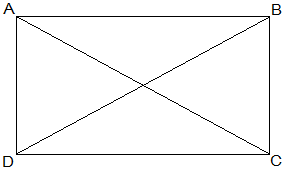
If the diagonals of a parallelogram are equal, then show that it is a rectangle.

Show solutionHide solution
Worked solution

Ncert solutions class 9 chapter 8-1

Given that,

AC = BD

To show that ABCD is a rectangle if the diagonals of a parallelogram are equal

To show ABCD is a rectangle, we have to prove that one of its interior angles is right-angled.

Proof,

In ΔABC and ΔBAD,

AB = BA (Common)

BC = AD (Opposite sides of a parallelogram are equal)

AC = BD (Given)

Therefore, ΔABC ≅ ΔBAD [SSS congruency]

∠A = ∠B [Corresponding parts of Congruent Triangles]

also,

∠A+∠B = 180° (Sum of the angles on the same side of the transversal)

⇒ 2∠A = 180°

⇒ ∠A = 90° = ∠B

Therefore, ABCD is a rectangle.

Hence Proved.

Q3Written answer

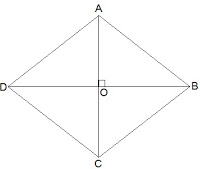
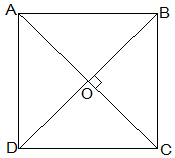
Show that if the diagonals of a quadrilateral bisect each other at right angles, then it is a rhombus.

Show solutionHide solution
Worked solution

Ncert solutions class 9 chapter 8-2

Let ABCD be a quadrilateral whose diagonals bisect each other at right angles.

Given that,

OA = OC

OB = OD

and ∠AOB = ∠BOC = ∠OCD = ∠ODA = 90°

To show that if the diagonals of a quadrilateral bisect each other at right angles, then it is a rhombus, we have to prove that ABCD is a parallelogram and AB = BC = CD = AD

Proof,

In ΔAOB and ΔCOB,

OA = OC (Given)

∠AOB = ∠COB (Opposite sides of a parallelogram are equal)

OB = OB (Common)

Therefore, ΔAOB ≅ ΔCOB [SAS congruency]

Thus, AB = BC [CPCT]

Similarly, we can prove,

BC = CD

CD = AD

AD = AB

, AB = BC = CD = AD

Opposite sides of a quadrilateral are equal. Hence, it is a parallelogram.

ABCD is rhombus as it is a parallelogram whose diagonals intersect at a right angle.

Hence Proved.

Q4Written answer

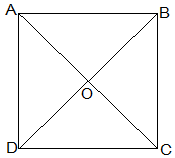
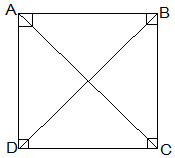
Show that the diagonals of a square are equal and bisect each other at right angles.

Show solutionHide solution
Worked solution

Ncert solutions class 9 chapter 8-3

Let ABCD be a square and its diagonals AC and BD intersect each other at O.

To show that,

AC = BD

AO = OC

and ∠AOB = 90°

Proof,

In ΔABC and ΔBAD,

AB = BA (Common)

∠ABC = ∠BAD = 90°

BC = AD (Given)

ΔABC ≅ ΔBAD [SAS congruency]

Thus,

AC = BD [CPCT]

diagonals are equal.

Now,

In ΔAOB and ΔCOD,

∠BAO = ∠DCO (Alternate interior angles)

∠AOB = ∠COD (Vertically opposite)

AB = CD (Given)

, ΔAOB ≅ ΔCOD [AAS congruency]

Thus,

AO = CO [CPCT].

, Diagonal bisect each other.

Now,

In ΔAOB and ΔCOB,

OB = OB (Given)

AO = CO (diagonals are bisected)

AB = CB (Sides of the square)

, ΔAOB ≅ ΔCOB [SSS congruency]

also, ∠AOB = ∠COB

∠AOB+∠COB = 180° (Linear pair)

Thus, ∠AOB = ∠COB = 90°

, Diagonals bisect each other at right angles

Q5Written answer

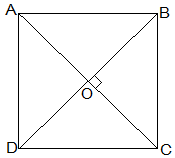
Show that if the diagonals of a quadrilateral are equal and bisect each other at right angles, then it is a square.

Show solutionHide solution
Worked solution

Ncert solutions class 9 chapter 8-4

Given that,

Let ABCD be a quadrilateral and its diagonals AC and BD bisect each other at a right angle at O.

To prove that,

The Quadrilateral ABCD is a square.

Proof,

In ΔAOB and ΔCOD,

AO = CO (Diagonals bisect each other)

∠AOB = ∠COD (Vertically opposite)

OB = OD (Diagonals bisect each other)

, ΔAOB ≅ ΔCOD [SAS congruency]

Thus,

AB = CD [CPCT] — (i)

also,

∠OAB = ∠OCD (Alternate interior angles)

⇒ AB || CD

Now,

In ΔAOD and ΔCOD,

AO = CO (Diagonals bisect each other)

∠AOD = ∠COD (Vertically opposite)

OD = OD (Common)

, ΔAOD ≅ ΔCOD [SAS congruency]

Thus,

AD = CD [CPCT] — (ii)

also,

AD = BC and AD = CD

⇒ AD = BC = CD = AB — (ii)

also,  ∠ADC = ∠BCD  [CPCT]

and ∠ADC+∠BCD = 180° (co-interior angles)

⇒ 2∠ADC = 180°

⇒∠ADC = 90° — (iii)

One of the interior angles is a right angle.

Thus, from (i), (ii) and (iii), given quadrilateral ABCD is a square.

Hence Proved.

Q6Written answer

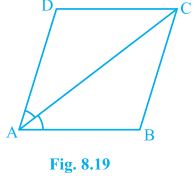
Diagonal AC of a parallelogram ABCD bisects ∠A (see Fig. 8.19). Show that

(i) it bisects ∠C also,

(ii) ABCD is a rhombus.

Ncert solutions class 9 chapter 8-5

Show solutionHide solution
Worked solution

(i) In ΔADC and ΔCBA,

AD = CB (Opposite sides of a parallelogram)

DC = BA (Opposite sides of a parallelogram)

AC = CA (Common Side)

, ΔADC ≅ ΔCBA [SSS congruency]

Thus,

∠ACD = ∠CAB by CPCT

and ∠CAB = ∠CAD (Given)

⇒ ∠ACD = ∠BCA

Thus,

AC bisects ∠C also.

(ii) ∠ACD = ∠CAD (Proved above)

⇒ AD = CD (Opposite sides of equal angles of a triangle are equal)

Also, AB = BC = CD = DA (Opposite sides of a parallelogram)

Thus,

ABCD is a rhombus.

Q7Written answer

ABCD is a rhombus. Show that diagonal AC bisects ∠A as well as ∠C and diagonal BD bisects ∠B as well as ∠D.

Show solutionHide solution
Worked solution

Ncert solutions class 9 chapter 8-6

Given that,

ABCD is a rhombus.

AC and BD are its diagonals.

Proof,

AD = CD (Sides of a rhombus)

∠DAC = ∠DCA (Angles opposite of equal sides of a triangle are equal.)

also, AB || CD

⇒∠DAC = ∠BCA (Alternate interior angles)

⇒∠DCA = ∠BCA

, AC bisects ∠C.

Similarly,

We can prove that diagonal AC bisects ∠A.

Following the same method,

We can prove that the diagonal BD bisects ∠B and ∠D.

Q8Written answer

ABCD is a rectangle in which diagonal AC bisects ∠A as well as ∠C. Show that:

(i) ABCD is a square

(ii) Diagonal BD bisects ∠B as well as ∠D.

Show solutionHide solution
Worked solution

Ncert solutions class 9 chapter 8-7

(i) ∠DAC = ∠DCA (AC bisects ∠A as well as ∠C)

⇒ AD = CD (Sides opposite to equal angles of a triangle are equal)

also, CD = AB (Opposite sides of a rectangle)

,AB = BC = CD = AD

Thus, ABCD is a square.

(ii) In ΔBCD,

BC = CD

⇒ ∠CDB = ∠CBD (Angles opposite to equal sides are equal)

also, ∠CDB = ∠ABD (Alternate interior angles)

⇒ ∠CBD = ∠ABD

Thus, BD bisects ∠B

Now,

∠CBD = ∠ADB

⇒ ∠CDB = ∠ADB

Thus, BD bisects ∠B as well as ∠D.

Q9Written answer

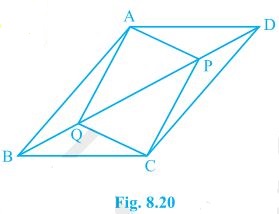
In parallelogram ABCD, two points P and Q are taken on diagonal BD such that DP = BQ (see Fig. 8.20). Show that:

(i) ΔAPD ≅ ΔCQB

(ii) AP = CQ

(iii) ΔAQB ≅ ΔCPD

(iv) AQ = CP

(v) APCQ is a parallelogram

Ncert solutions class 9 chapter 8-8

Show solutionHide solution
Worked solution

(i) In ΔAPD and ΔCQB,

DP = BQ (Given)

∠ADP = ∠CBQ (Alternate interior angles)

AD = BC (Opposite sides of a parallelogram)

Thus, ΔAPD ≅ ΔCQB [SAS congruency]

(ii) AP = CQ by CPCT as ΔAPD ≅ ΔCQB.

(iii) In ΔAQB and ΔCPD,

BQ = DP (Given)

∠ABQ = ∠CDP (Alternate interior angles)

AB = CD (Opposite sides of a parallelogram)

Thus, ΔAQB ≅ ΔCPD [SAS congruency]

(iv) As ΔAQB ≅ ΔCPD

AQ = CP [CPCT]

(v) From the questions (ii) and (iv), it is clear that APCQ has equal opposite sides and also has equal and opposite angles. , APCQ is a parallelogram.

Q10Written answer

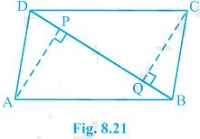
ABCD is a parallelogram and AP and CQ are perpendiculars from vertices A and C on diagonal BD (see Fig. 8.21). Show that

(i) ΔAPB ≅ ΔCQD

(ii) AP = CQ

Ncert solutions class 9 chapter 8-9

Show solutionHide solution
Worked solution

(i) In ΔAPB and ΔCQD,

∠ABP = ∠CDQ (Alternate interior angles)

∠APB = ∠CQD (= 90o as AP and CQ are perpendiculars)

AB = CD (ABCD is a parallelogram)

, ΔAPB ≅ ΔCQD [AAS congruency]

(ii) As ΔAPB ≅ ΔCQD.

, AP = CQ [CPCT]