My Cart
Your Cart 0

    Your cart is empty.

  • Total (Amount) ₹0.00
NCERT · Class 7 · Social Science

Chapter 1: On Equality

Practice each question, then open the answer or worked solution.

Questions

5 questions
Q1Written answer

In a democracy, why is a universal adult franchise important?

Show solutionHide solution
Worked solution

Solution: In a democracy, a universal adult franchise is important, as it is based on the idea of equality. It states that every adult in a country, irrespective of wealth and the communities they belong to, has one vote.
Q2Written answer

Read the box on Article 15 and state two ways in which the article addresses inequality.

Show solutionHide solution
Worked solution

Solution: Article 15 addresses inequality in terms of discrimination based on religion, race, caste, gender, place of birth, etc. It also addresses the fact that the use of public places such as wells, tanks, bathing ghats, and roads under full or partial government funding are not subject to discrimination based on the criteria mentioned above.

Q3Written answer

In what ways was Omprakash Valmiki’s experience similar to that of the Ansaris?

Show solutionHide solution
Worked solution

Solution: Omprakash Valmiki was discriminated against on account of his caste, while the Ansaris were discriminated against on account of their religion. The core similarity is that they both were discriminated against because of their birth, which is prohibited under Article 15. Omprakash Valmiki was not allowed to sit with his fellow classmates on account of his birth as a Dalit and was made to sweep the school and its environs, thus hurting his dignity. The Ansaris were denied a flat to rent, as their religion differed from those of others, who were in the majority among the occupants of the apartment complex.

Q4Written answer

What do you understand by the term “all personnel are equal before the law”? Why do you think it is important in a democracy?

Show solutionHide solution
Worked solution

Solution: The term “all persons are equal before the law” states that all citizens, irrespective of their social or economic background, have to obey the same laws. No person shall be discriminated against in the eyes of the law on the grounds of race, religion, caste or gender.

The very essence of democracy is the idea of equality, as it gives equality and recognition to all. It would never have existed in the first place if there were no inequalities on the basis of race, religion and gender, etc.

Q5Written answer

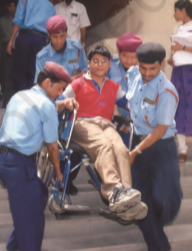
The Government of India passed the Disabilities Act in 1995. This law states that persons with disabilities have equal rights and that the government should make possible their full participation. The government has to provide free education and integrate children with disabilities into mainstream schools. This law also states that all public spaces, including buildings, schools etc., should be accessible and provided with ramps.

Look at the photograph and think about the boy who is being carried with the stair. Do you think that the law stated above is being implemented in this regard? What needs to be done to make the building accessible?

NCERT Class VII - Social & Political Life - II - Chapter 1 – Equality in Indian Democracy

Show solutionHide solution
Worked solution

Solution: It is evident that the boy in the photograph is disabled. As per the Disabilities Act 1995, the building should have been accessible to him. But the law is not being enforced here. In fact, it can be quite dangerous for him to be carried down by the security guards. To remedy this situation, the government can build a ramp along the stairs of every building. In this way, those with physical disabilities can have easy accessibility.