My Cart
Your Cart 0

    Your cart is empty.

  • Total (Amount) ₹0.00
NCERT · Class 7 · Science

Chapter 12: Forests: Our Lifeline

Practice each question, then open the answer or worked solution.

Questions

13 questions
Q1Written answer

Explain how animals dwelling in the forest help it grow and regenerate.

Show solutionHide solution
Worked solution

Animals dwelling in the forest help it grow and regenerate in the following ways:

  • Animals help in dispersing plant seeds.
  • Decaying animal dung provides nutrients for plants to grow
  • Microorganisms convert the dead plants and animals to humus
Q2Written answer

Explain how forests prevent floods.

Show solutionHide solution
Worked solution

Plants in the forests will not allow the rainwater to fall directly on the earth, and these plants also hold water which helps in preventing floods.

Q3Written answer

What are decomposers? Name any two of them. What do they do in the forest?

Show solutionHide solution
Worked solution

The micro-organisms which convert dead plants and animals to humus are known as decomposers. For example, bacteria and fungi. They help in the recycling of nutrients by decomposing dead plants and animals.

Q4Written answer

Explain the role of forests in maintaining the balance between oxygen and carbon dioxide in the atmosphere.

Show solutionHide solution
Worked solution

Plants in the forests consume carbon dioxide and release oxygen through the photosynthesis process. This helps in balancing oxygen and carbon dioxide in the atmosphere.

Q5Written answer

Explain why there is no waste in a forest.

Show solutionHide solution
Worked solution

There is no waste in a forest because the waste created is bio-degradable, which gets converted to humus by the action of microorganisms.

Q6Written answer

List five products we get from forests.

Show solutionHide solution
Worked solution

The five products we get from forests are listed below:

i) Medicines

ii) Spices

iii) Wood

iv) Paper

v) Gum

Q7Written answer

Fill in the blanks:

(a) The insects, butterflies, honeybees and birds help flowering plants in _______.

(b) A forest is a purifier of ________ and ________.

(c) Herbs form the ________ layer in the forest.

(d) The decaying leaves and animal droppings in a forest enrich the ________.

Show solutionHide solution
Worked solution

(a) The insects, butterflies, honeybees and birds help flowering plants in pollination.

(b) A forest is a purifier of air and water.

(c) Herbs form the lowest layer in the forest.

(d) The decaying leaves and animal droppings in a forest enrich the soil.

Q8Written answer

Why should we worry about the conditions and issues related to forests far from us?

Show solutionHide solution
Worked solution

We should worry about the forest for the following reasons:

  • A decrease in forests results in an increase in carbon dioxide content in the atmosphere. This results in global warming.
  • Depletion of forests results in soil erosion
  • The decrease in forests adversely affects the lives of animals living in the forest.
  • The absence of forests leads to flooding more often.
  • Due to the reduction of forests, the land will turn barren, which is called desertification.
Q9Written answer

Explain why there is a need for a variety of animals and plants in a forest.

Show solutionHide solution
Worked solution

A variety of plants and animals in the forests helps plants to regenerate and grow. A wide range of plants supports herbivores, which in turn serve as food for carnivores. Decomposers turn dead animals and plants into humus, thereby maintaining nutrient recycling. This wide variety makes the forest a dynamic living entity.

Q10Written answer

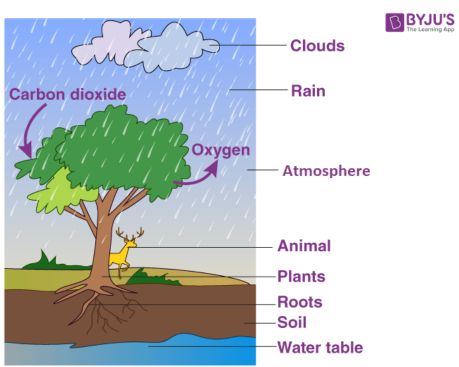
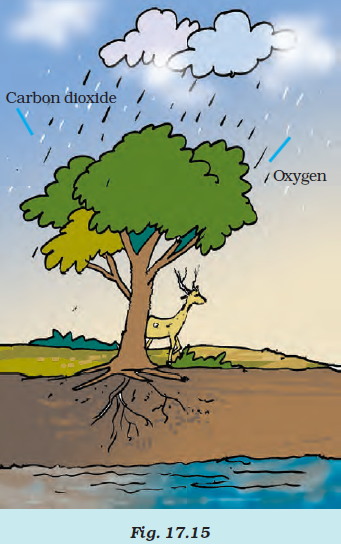
In Fig. 17.15, the artist has forgotten to put the labels and directions on the arrows. Mark the directions on the arrows and label the diagram using the following labels: clouds, rain, atmosphere, carbon dioxide, oxygen, plants, animals, soil, roots, and water table.

forests our lifeline

Show solutionHide solution
Worked solution

forests our lifeline