My Cart
Your Cart 0

    Your cart is empty.

  • Total (Amount) ₹0.00
NCERT · Class 7 · Science

Chapter 1: Nutrition in Plants

Practice each question, then open the answer or worked solution.

Questions

13 questions
Q1Written answer

Why do organisms take food?

Show solutionHide solution
Worked solution

All organisms require energy for their life processes. Plants prepare their food and acquire nutrients from abiotic components like soil, air, water and sunlight. On the other hand, animals need to get food from either plants or other animals to obtain nutrients; hence, animals need to take food to acquire nutrients and energy.

Q2Written answer

Distinguish between a parasite and a saprophyte.

Show solutionHide solution
Worked solution
Saprophytes Parasites
Acquire nutrients from dead and decaying matter. Parasites live on or in a host and get their food at the expense of their host.
Example: Fungi Example: Roundworm
Q3Written answer

How would you test the presence of starch in leaves?

Show solutionHide solution
Worked solution

Take two potted plants of the same kind. Keep one in the dark for 72 hours and the other in the sunlight. Perform the iodine test with the leaves of both plants as given below. Now, leave the pot, which was earlier kept in the dark, undisturbed for 3–4 days and perform the iodine test again on its leaves.

Iodine test:

Put iodine solution on the leaf.

Observation:

Blue-black colour will be observed on the leaves of the plant kept in sunlight, which indicates the presence of starch.

Blue-black colour will not be observed on the leaves of plants kept in the darkroom. This indicates the absence of starch.

Q4Written answer

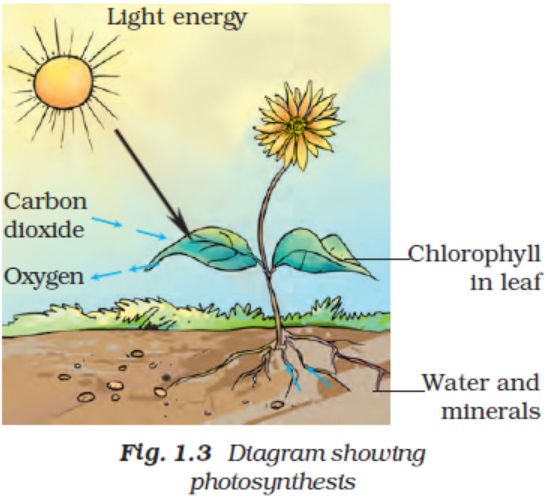
Give a brief description of the process of synthesis of food in green plants.

Show solutionHide solution
Worked solution

Green plants use a process called photosynthesis to prepare their food. The process is as follows

  • Water is taken from the roots of the plant, and it is transported to the leaves of the plant.
  • Carbon dioxide from the air enters the leaves through pores called stomata. This diffuses the cell containing chlorophyll.
  • Water molecule is broken down into Hydrogen and Oxygen with the help of sunlight.
  • Hydrogen combines with Oxygen and Hydrogen to form carbohydrates.
  • Photosynthesis is represented by the following equation.

Photosynthesis equation

Q5Written answer

Show with the help of a sketch that plants are the ultimate source of food.

Show solutionHide solution
Worked solution

sketch that plants are the ultimate source of food

Q6Written answer

Fill in the blanks.

(a) Green plants are called _________________ since they synthesise their own food.

(b) The food synthesised by plants is stored as _________________.

(c) In photosynthesis, solar energy is absorbed by the pigment called ___________.

(d) During photosynthesis, plants take in ______________________ and release __________________ gas.

Show solutionHide solution
Worked solution

(a) Green plants are called autotrophs since they synthesise their food.

(b) The food synthesised by plants is stored as starch.

(c) In photosynthesis, solar energy is absorbed by the pigment called chlorophyll.

(d) During photosynthesis, plants take in carbon dioxide and release oxygen gas.

Q7Written answer

Name the following.

i) A parasitic plant with a yellow, slender and branched stem.

ii) A plant that is partially autotrophic.

iii) The pores through which leaves exchange gases.

Show solutionHide solution
Worked solution

i) Cuscuta

ii) Pitcher plant

iii) Stomata

Q8Written answer

Tick the correct answer.

(a) Cuscuta is an example of:

(i) autotroph

(ii) parasite

(iii) saprotroph
(iv) host

(b) The plant which traps and feeds on insects is:

(i) Cuscuta

(ii) China rose

(iii) pitcher plant

(iv) rose

Show solutionHide solution
Worked solution

(a) (ii) Parasite

(b) (iii) pitcher plant

Q9Written answer

Match the items given in Column I with those in Column II.

Column-I Column-II
Chlorophyll Rhizobium
Nitrogen Heterotrophs
Cuscuta Pitcher plant
Animals Leaf
Insects Parasite
Show solutionHide solution
Worked solution
Column-I Column-II
Chlorophyll Leaf
Nitrogen Rhizobium
Cuscuta Parasite
Animals Heterotrophs
Insects Pitcher plant
Q10Written answer

Mark ‘T’ if the statement is true and ‘F’ if it is false.

(i) Carbon dioxide is released during photosynthesis. (T/F)

(ii) Plants which synthesise their food are called saprotrophs. (T/F)

(iii) The product of photosynthesis is not a protein. (T/F)

(iv) Solar energy is converted into chemical energy during photosynthesis. (T/F)

Show solutionHide solution
Worked solution
  1. False
  2. False
  3. True
  4. True