My Cart
Your Cart 0

    Your cart is empty.

  • Total (Amount) ₹0.00
NCERT · Class 7 · Maths

Chapter 6: The Triangle and Its Properties

Practice each question, then open the answer or worked solution.

Exercise 6.4

Textbook page 126 · 6 questions
Q1Written answer

Is it possible to have a triangle with the following sides?

(i) 2 cm, 3 cm, 5 cm

Show solutionHide solution
Worked solution

Solution:-

Clearly, we have

(2 + 3) = 5

5 = 5

Thus, the sum of any two of these numbers is not greater than the third.

Hence, it is not possible to draw a triangle whose sides are 2 cm, 3 cm and 5 cm.

(ii) 3 cm, 6 cm, 7 cm

Solution:-

Clearly, we have

(3 + 6) = 9 > 7

(6 + 7) = 13 > 3

(7 + 3) = 10 > 6

Thus, the sum of any two of these numbers is greater than the third.

Hence, it is possible to draw a triangle whose sides are 3 cm, 6 cm and 7 cm.

(iii) 6 cm, 3 cm, 2 cm

Solution:-

Clearly, we have

(3 + 2) = 5 < 6

Thus, the sum of any two of these numbers is less than the third.

Hence, it is not possible to draw a triangle whose sides are 6 cm, 3 cm and 2 cm.
Q2Written answer

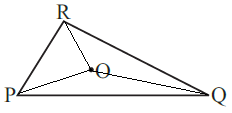
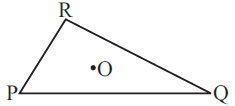
Take any point O in the interior of a triangle PQR. Is

(i) OP + OQ > PQ?

(ii) OQ + OR > QR?

(iii) OR + OP > RP?

NCERT Solutions for Class 7 Maths Chapter 6 The Triangles and Its Properties Image 32

Show solutionHide solution
Worked solution

Solution:-

If we take any point O in the interior of a triangle PQR and join OR, OP, OQ.

Then, we get three triangles ΔOPQ, ΔOQR and ΔORP are shown in the figure below.

NCERT Solutions for Class 7 Maths Chapter 6 The Triangles and Its Properties Image 33

We know that,

The sum of the length of any two sides is always greater than the third side.

(i) Yes, ΔOPQ has sides OP, OQ and PQ.

So, OP + OQ > PQ

(ii) Yes, ΔOQR has sides OR, OQ and QR.

So, OQ + OR > QR

(iii) Yes, ΔORP has sides OR, OP and PR.

So, OR + OP > RP

Q3Written answer

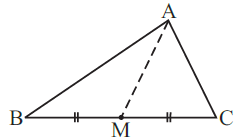
AM is a median of a triangle ABC.

Is AB + BC + CA > 2 AM?

(Consider the sides of triangles ΔABM and ΔAMC.)

NCERT Solutions for Class 7 Maths Chapter 6 The Triangles and Its Properties Image 34

Show solutionHide solution
Worked solution

Solution:-

We know that,

The sum of the length of any two sides is always greater than the third side.

Now consider the ΔABM,

Here, AB + BM > AM … [equation i]

Then, consider the ΔACM

Here, AC + CM > AM … [equation ii]

By adding equations [i] and [ii], we get,

AB + BM + AC + CM > AM + AM

From the figure we have, BC = BM + CM

AB + BC + AC > 2 AM

Hence, the given expression is true.

Q4Written answer

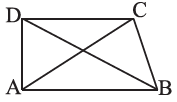
ABCD is a quadrilateral.

Is AB + BC + CD + DA > AC + BD?

NCERT Solutions for Class 7 Maths Chapter 6 The Triangles and Its Properties Image 35

Show solutionHide solution
Worked solution

Solution:-

We know that,

The sum of the length of any two sides is always greater than the third side.

Now consider the ΔABC,

Here, AB + BC > CA … [equation i]

Then, consider the ΔBCD

Here, BC + CD > DB … [equation ii]

Consider the ΔCDA

Here, CD + DA > AC … [equation iii]

Consider the ΔDAB

Here, DA + AB > DB … [equation iv]

By adding equations [i], [ii], [iii] and [iv], we get,

AB + BC + BC + CD + CD + DA + DA + AB > CA + DB + AC + DB

2AB + 2BC + 2CD + 2DA > 2CA + 2DB

Take out 2 on both the side,

2(AB + BC + CA + DA) > 2(CA + DB)

AB + BC + CA + DA > CA + DB

Hence, the given expression is true.

Q5Written answer

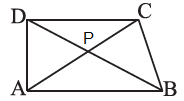
ABCD is quadrilateral. Is AB + BC + CD + DA < 2 (AC + BD)

Show solutionHide solution
Worked solution

Solution:-

Let us consider ABCD as a quadrilateral, and P is the point where the diagonals intersect. As shown in the figure below.

NCERT Solutions for Class 7 Maths Chapter 6 The Triangles and Its Properties Image 36

We know that,

The sum of the length of any two sides is always greater than the third side.

Now consider the ΔPAB,

Here, PA + PB < AB … [equation i]

Then, consider the ΔPBC

Here, PB + PC < BC … [equation ii]

Consider the ΔPCD

Here, PC + PD < CD … [equation iii]

Consider the ΔPDA

Here, PD + PA < DA … [equation iv]

By adding equations [i], [ii], [iii] and [iv], we get,

PA + PB + PB + PC + PC + PD + PD + PA < AB + BC + CD + DA

2PA + 2PB + 2PC + 2PD < AB + BC + CD + DA

2PA + 2PC + 2PB + 2PD < AB + BC + CD + DA

2(PA + PC) + 2(PB + PD) < AB + BC + CD + DA

From the figure, we have, AC = PA + PC and BD = PB + PD

Then,

2AC + 2BD < AB + BC + CD + DA

2(AC + BD) < AB + BC + CD + DA

Hence, the given expression is true.

Q6Written answer

The lengths of two sides of a triangle are 12 cm and 15 cm. Between what two measures should the length of the third side fall?

Show solutionHide solution
Worked solution

Solution:-

We know that,

The sum of the length of any two sides is always greater than the third side.

From the question, it is given that two sides of the triangle are 12 cm and 15 cm.

So, the third side length should be less than the sum of the other two sides,

12 + 15 = 27 cm

Then, it is given that the third side can not be less than the difference of the two sides, 15 – 12 = 3 cm

So, the length of the third side falls between 3 cm and 27 cm.