My Cart
Your Cart 0

    Your cart is empty.

  • Total (Amount) ₹0.00
NCERT · Class 12 · Physics

Chapter 9: Ray Optics and Optical Instruments

Practice each question, then open the answer or worked solution.

Questions

38 questions
Q31Written answer

The virtual image of each square in the figure is to have an area of 6.25 mm2. Find out what should be the distance between the object in Exercise 9.30 and the magnifying glass? If the eyes are too close to the magnifier, would you be able to see the squares distinctly?

Show solutionHide solution
Worked solution

Area of the virtual image of each square, A = 6.25 mm2

Area of each square, A0 = 1 mm2

Hence, the linear magnification of the object can be calculated as

m =

\(\begin{array}{l}\sqrt{\frac{A}{A_{o}}}\end{array} \)

=

\(\begin{array}{l}\sqrt{\frac{6.25}{1}}\end{array} \)

= 2.5

But m =

\(\begin{array}{l}\frac{Image distance(v)}{Object distance (u)}\end{array} \)

Therefore, v = mu

= 2.5u …………. (1)

The magnifying glass has a focal length of f = 10 cm

According to the lens formula, we have the relation

\(\begin{array}{l}\frac{1}{f}\end{array} \)
\(\begin{array}{l}\frac{1}{v}\end{array} \)
\(\begin{array}{l}\frac{1}{u}\end{array} \)


\(\begin{array}{l}\frac{1}{10}\end{array} \)
\(\begin{array}{l}\frac{1}{2.5u}\end{array} \)
\(\begin{array}{l}\frac{1}{u}\end{array} \)

=

\(\begin{array}{l}\frac{1}{u}\left ( \frac{1}{2.5}-\frac{1}{1} \right )\end{array} \)

=

\(\begin{array}{l}\frac{1}{u}\left ( \frac{1-2.5}{2.5} \right )\end{array} \)

Therefore, u = –

\(\begin{array}{l}\frac{1.5\times 10}{2.5}\end{array} \)

And v = 2.5u

= 2.5 x 6

= -15 cm

The virtual image cannot be seen by the eyes distinctly because the image is formed at a distance of 15 cm, which is less than the near point (i.e. 25 cm) of a normal eye.

Q32Written answer

Answer the following questions.

(a) An object subtends an angle at the eye which is equal to the angle subtended at the eye by the virtual image that is produced by a magnifying glass. Does the magnifying glass provide angular magnification? Explain.

(b) A person’s eyes are very close to the lens when he is viewing through a magnifying glass. Does angular magnification change if the eye is moved back?

(c) The focal length of the lens is inversely proportional to the magnifying power of a simple microscope. Why don’t we achieve greater and greater magnifying power by using a convex lens of smaller and smaller focal length?

(d) Why must both the objective and the eyepiece of a compound microscope have short focal lengths?

(e) Our eyes should be positioned not on the eyepiece but a short distance away from it for best viewing when viewing from a compound microscope. Explain why. How much should be the short distance between the eye and the eyepiece?

Show solutionHide solution
Worked solution

Answer 9.32: (a) The angular size of the image and of the object are equal. When the objects are placed at the least distance of distinct vision, they can be viewed with the help of magnifying glass. As the object gets closer, the angular size increases. A magnifying glass is used because it provides angular magnification. Without magnification, it is difficult to place an object closer to the eye.

(b) Yes, the angular magnification changes. As the distance between the eye and the magnifying glass increases, the angular magnification decreases. This is because the angle subtended by the eye is less than that of the angle subtended by the lens. Angular magnification is independent of the image distance.

(c) Manufacturing lenses with small focal lengths is difficult. When the focal length is small, there are chances of the production of spherical and chromatic aberrations. Therefore, there is no such reduction in the focal length of a convex lens.

(d) A compound microscope produces an angular magnification of

\(\begin{array}{l}\left [ \left ( \frac{25}{f_{e}} \right )+1 \right ]\end{array} \)

where,

fe = focal length of the eyepiece

It can be inferred that if fe is small, then the angular magnification of the eyepiece will be large.

The angular magnification of the objective lens of a compound microscope is given as

\(\begin{array}{l}\frac{1}{(\left | u_{o} \right |f_{o})}\end{array} \)

Where uo = object distance for the objective lens

fo = focal length of the objective

When uo > fo, the magnification is large. While using a microscope, the object is kept closer to the objective lens. So, the object distance is very less. As u0 decreases, f0 also decreases. Therefore, in the given situation, both fe and f0 are small.

(e) We are unable to collect much-refracted light when we place our eyes too close to the eyepiece of a compound microscope. As a result, there are substantial decrements in the field of view. Hence, the clarity of the image gets blurred. The eye-ring attached to the eyepiece gives the best position for viewing through a compound microscope. The precise location of the eye depends on the separation between the objective lens and the eyepiece.

Q33Written answer

An angular magnification (magnifying power) of 30X is desired using an objective of focal length 1.25 cm and an eyepiece of focal length 5 cm. How will you set up the compound microscope?

Show solutionHide solution
Worked solution

Answer 9.33: Focal length of the objective lens, fo= 1.25 cm

The focal length of the eyepiece, fe = 5 cm

The least distance of distinct vision, d = 25 cm

The angular magnification of the compound microscope = 30X

The total magnifying power of the compound microscope, m = 30

The angular magnification of the eyepiece is given by the relation

\(\begin{array}{l}m_{e}=\left ( 1+\frac{d}{f_{e}} \right )\end{array} \)

=

\(\begin{array}{l}\left ( 1+\frac{25}{5} \right )\end{array} \)

= 6

The angular magnification of the objective lens (mo) is related to me as

mome = m

\(\begin{array}{l}m_{o}=\frac{m}{m_{e}}\end{array} \)

=

\(\begin{array}{l}\frac{30}{6}\end{array} \)

= 5

We also have the relation

\(\begin{array}{l}m_{o}=\frac{Image distance for the objective lens(v_{o})}{Object distance for the objective lens(-u_{o})}\end{array} \)


\(\begin{array}{l}5=\frac{v_{o}}{-u_{o}}\end{array} \)

Therefore, vo = -5uo ………. (1)

Applying the lens formula for the objective lens,

\(\begin{array}{l}\frac{1}{f_{o}}=\frac{1}{v_{o}} – \frac{1}{u_{o}}\end{array} \)


\(\begin{array}{l}\frac{1}{1.25}=\frac{1}{-5u_{o}}-\frac{1}{u_{o}}\end{array} \)

=

\(\begin{array}{l}\frac{-6}{5u_{o}}\end{array} \)

Therefore, uo =

\(\begin{array}{l}\frac{-6}{5}\times 1.25\end{array} \)

= -1.5 cm

And vo = -5uo

= -5 x (-1.5)

= 7.5 cm

The object should be placed 1.5 cm away from the objective lens to obtain the desired magnification.

Applying the lens formula for the eyepiece,

\(\begin{array}{l}\frac{1}{f_{e}}=\frac{1}{v_{e}} – \frac{1}{u_{e}}\end{array} \)

Where,

ve = Image distance for the eyepiece = -d = -25 cm

ue = Object distance for the eyepiece

\(\begin{array}{l}\frac{1}{u_{e}}=\frac{1}{v_{e}} – \frac{1}{f_{e}}\end{array} \)

=

\(\begin{array}{l}\frac{-1}{25}-\frac{1}{5}\end{array} \)

=

\(\begin{array}{l}\frac{-6}{25}\end{array} \)

Therefore, ue = -4.17 cm

Separation between the objective lens and the eyepiece =

\(\begin{array}{l}\left | u_{e} \right | + \left | v_{o} \right |\end{array} \)

= 4.17 + 7.5

= 11.67 cm

Therefore, 11.67cm is the separation between the objective lens and the eyepiece.
Q34Written answer

A small telescope has an objective lens of focal length 140 cm and an eyepiece of focal length 5.0 cm. What is the magnifying power of the telescope for viewing distant objects when

(a) the telescope is in normal adjustment (i.e., when the final image is at infinity)?

(b) the final image is formed at the least distance of distinct vision (25 cm)?

Show solutionHide solution
Worked solution

Answer 9.34: The focal length of the objective lens, fo= 140 cm

The focal length of the eyepiece, fe = 5 cm

The least distance of distinct vision, d = 25 cm

(a) When the telescope is in normal adjustment, its magnifying power is given as

m =

\(\begin{array}{l}\frac{f_{o}}{f_{e}}\end{array} \)

=

\(\begin{array}{l}\frac{140}{5}\end{array} \)

(b) When the final image is formed at d, the magnifying power of the telescope is given as

\(\begin{array}{l}\frac{f_{o}}{f_{e}}\left [ 1+\frac{f_{e}}{d} \right ]\end{array} \)

=

\(\begin{array}{l}\frac{140}{5}\left [ 1+\frac{5}{25} \right ]\end{array} \)

= 28[1 + 0.2]

= 28 x 1.2 = 33.6

Q35Written answer

(a) For a telescope, what is the separation between the objective lens and the eyepiece?

(b) If this telescope is used to view a 100 m tall tower 3 km away, what is the height of the image of the tower formed by the objective lens?

(c) What is the height of the final image of the tower if it is formed at 25 cm?

Show solutionHide solution
Worked solution

The focal length of the objective lens, fo = 140 cm

The focal length of the eyepiece, fe = 5 cm

(a) In normal adjustment, the separation between the objective lens and the eyepiece = fo + fe

= 140 + 5

= 145 cm

(b) Height of the tower, h1 =100 m

Distance of the tower (object) from the telescope, u = 3Km = 3000 m

The angle subtended by the tower at the telescope is given as

\(\begin{array}{l}\Theta = \frac{h_{1}}{u}\end{array} \)

=

\(\begin{array}{l}\frac{100}{3000}\end{array} \)

=

\(\begin{array}{l}\frac{1}{30}\end{array} \)

The angle subtended by the image produced by the objective lens is given as

\(\begin{array}{l}\Theta = \frac{h_{2}}{f_{o}}\end{array} \)
\(\begin{array}{l}\frac{h_{2}}{140}\end{array} \)

Where h2 = height of the image of the tower formed by the objective lens

\(\begin{array}{l}\frac{1}{30}\end{array} \)
\(\begin{array}{l}\frac{h_{2}}{140}\end{array} \)

Therefore, h2 =

\(\begin{array}{l}\frac{140}{30}\end{array} \)

= 4.7 cm

Therefore, 4.7cm tall is the image of the tower obtained from the objective lens.

(c) Image is formed at a distance, d = 25cm

The magnification of the eyepiece is given by the relation

m = 1 +

\(\begin{array}{l}\frac{d}{f_{e}}\end{array} \)

= 1 +

\(\begin{array}{l}\frac{25}{5}\end{array} \)

= 1 + 5 = 6

Height of the final image = mh2 = 6 x 4.7 = 28.2 cm

Hence, 28.2cm is the height of the final image of the tower.

Q36Written answer

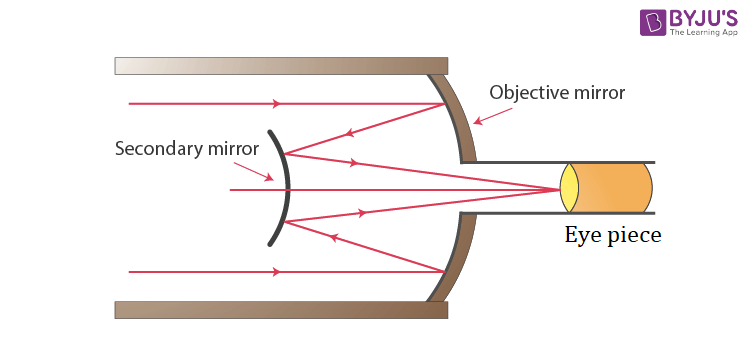
A Cassegrain telescope uses two mirrors, as shown in Fig. 9.33. Such a telescope is built with mirrors 20 mm apart. If the radius of curvature of the large mirror is 220 mm and the small mirror is 140 mm, where will the final image of an object at infinity be?


Show solutionHide solution
Worked solution

Soln: Below is the figure of a Cassegrain telescope. It consists of a concave and a convex mirror.

NCERT Solutions for Class 12 Physics Chapter 9 Ray Optics and Optical Instruments Question 36 Solution

The distance between the objective mirror and the secondary mirror, d = 20 mm

The radius of curvature of the objective mirror, R1 = 220 mm

Hence, the focal length of the objective mirror, f1 =

\(\begin{array}{l}\frac{R_{1}}{2}\end{array} \)

The radius of curvature of the secondary mirror, R2 = 140 mm

Hence, the focal length of the secondary mirror, f2 =

\(\begin{array}{l}\frac{R_{2}}{2}\end{array} \)

=

\(\begin{array}{l}\frac{140}{2}\end{array} \)

= 70 mm

The image of an object placed at infinity, formed by the objective mirror, will act as a virtual object for the secondary mirror.

hence, the virtual object distance for the secondary mirror, u = f1 – d

= 110 – 20

= 90 mm

Applying the mirror formula for the secondary mirror, we can calculate image distance (v) as

\(\begin{array}{l}\frac{1}{v}\end{array} \)
\(\begin{array}{l}\frac{1}{u}\end{array} \)
\(\begin{array}{l}\frac{1}{f_{2}}\end{array} \)


\(\begin{array}{l}\frac{1}{v}\end{array} \)
\(\begin{array}{l}\frac{1}{f_{2}}\end{array} \)
\(\begin{array}{l}\frac{1}{u}\end{array} \)

=

\(\begin{array}{l}\frac{1}{70}\end{array} \)
\(\begin{array}{l}\frac{1}{90}\end{array} \)
\(\begin{array}{l}\frac{2}{630}\end{array} \)

Therefore, v =

\(\begin{array}{l}\frac{630}{2}\end{array} \)

Hence, 315 mm is the distance between the final image and the secondary mirror.

Q37Written answer

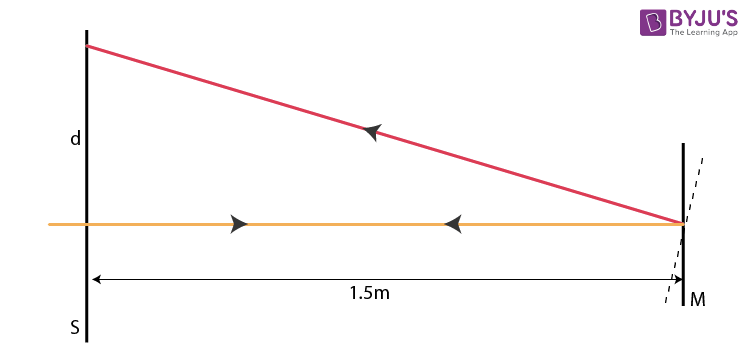
Light incident normally on a plane mirror attached to a galvanometer coil retraces backwards, as shown in Fig. 9.36. A current in the coil produces a deflection of 3.5° of the mirror. What is the displacement of the reflected spot of light on a screen placed 1.5 m away?

NCERT Solutions for Class 12 Physics Chapter 9 Ray Optics and Optical Instruments Question 37

Show solutionHide solution
Worked solution

Soln: Angle of deflection, θ = 3.5°

The distance of the screen from the mirror, D = 1.5 m

The deflection experienced by the reflected rays is twice the angle of deflection.

2θ = 7.0°

Following is the displacement (d) of the reflected spot of light:

\(\begin{array}{l}\tan 2\Theta =\frac{d}{1.5}\end{array} \)

Therefore, d = 1.5 x tan7o = 0.184 m = 18.4 cm

Hence, 18.4 cm is the displacement of the refracted spot of light.

Q38Written answer

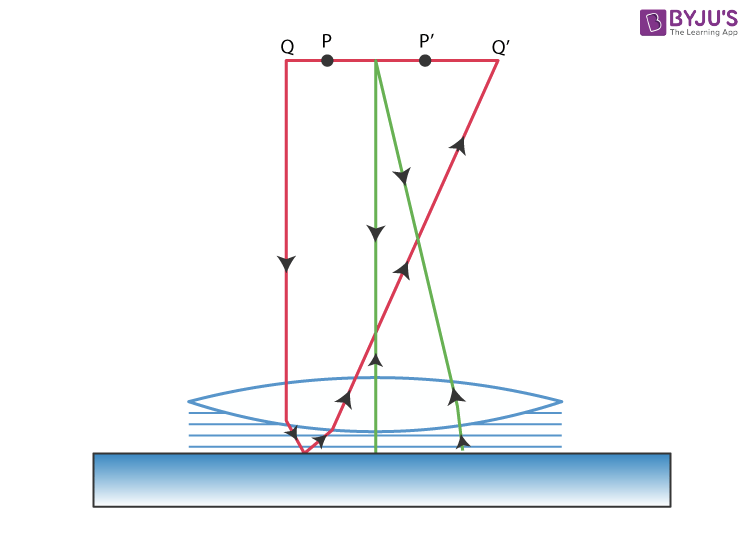
Figure 9.37 shows a biconvex lens (of refractive index 1.50) in contact with a liquid layer on top of a plane mirror. A small needle with its tip on the principal axis is moved along the axis until its inverted image is found at the position of the needle. The distance of the needle from the lens is measured to be 45.0 cm. The liquid is removed, and the experiment is repeated. The new distance is measured to be 30.0 cm. What is the refractive index of the liquid?

NCERT Solutions for Class 12 Physics Chapter 9 Ray Optics and Optical Instruments Question 38

Show solutionHide solution
Worked solution

Soln: Focal length of the convex lens, f1 = 30 cm

The liquid acts as a mirror. The focal length of the liquid = f2

The focal length of the system (convex lens + liquid), f = 45 cm

The equivalent focal length of the pair of optical systems that are in contact is given as

\(\begin{array}{l}\frac{1}{f}\end{array} \)
\(\begin{array}{l}\frac{1}{f_{1}}\end{array} \)
\(\begin{array}{l}\frac{1}{f_{2}}\end{array} \)


\(\begin{array}{l}\frac{1}{f_{2}}\end{array} \)
\(\begin{array}{l}\frac{1}{f}\end{array} \)
\(\begin{array}{l}\frac{1}{f_{1}}\end{array} \)

=

\(\begin{array}{l}\frac{1}{45}\end{array} \)
\(\begin{array}{l}\frac{1}{30}\end{array} \)

= –

\(\begin{array}{l}\frac{1}{90}\end{array} \)

Therefore, f2 = -90 cm

Let

\(\begin{array}{l} \mu_{1}\end{array} \)

R can be obtained using the relation :

\(\begin{array}{l}\frac{1}{f_{1}}=(\mu_{1} -1)(\frac{1}{R}+\frac{1}{-R})\end{array} \)


\(\begin{array}{l}\frac{1}{30}\end{array} \)
\(\begin{array}{l}\left ( \frac{2}{R} \right )\end{array} \)

Therefore, R =

\(\begin{array}{l}\frac{30}{1}\end{array} \)

R = 30 cm

Let

\(\begin{array}{l}\mu _{2}\end{array} \)

The radius of curvature of the liquid on the side of the plane mirror = ∞ Radius of curvature of the liquid on the side of the lens, R = −30 cm

The value of

\(\begin{array}{l}\mu _{2}\end{array} \)
\(\begin{array}{l}\frac{1}{f_{2}}=\left ( \mu _{2} -1\right )\left [ \frac{1}{-R}-\frac{1}{infinity} \right ]\end{array} \)


\(\begin{array}{l}\mu _{2}\end{array} \)
\(\begin{array}{l}\frac{1}{3}\end{array} \)

Therefore,

\(\begin{array}{l}\mu _{2}\end{array} \)

Therefore, 1.33 is the refractive index of the liquid.