My Cart
Your Cart 0

    Your cart is empty.

  • Total (Amount) ₹0.00
NCERT · Class 12 · Physics

Chapter 9: Ray Optics and Optical Instruments

Practice each question, then open the answer or worked solution.

Questions

38 questions
Q11Written answer

A compound microscope consists of an objective lens of focal length 2.0cm and an eyepiece of focal length 6.25cm separated by a distance of 15 cm. How far from the objective should an object be placed in order to obtain the final image at (a) the least distance of distinct vision (25 cm), and (b) at infinity? What is the magnifying power of the microscope in each case?

Show solutionHide solution
Worked solution

The focal length of the objective lens, f1=2.0 cm

The focal length of the eyepiece, f2=6.25 cm

Distance between the objective lens and the eyepiece, d =15 cm

(a) Least distance of distinct vision, d’ = 25 cm

Image distance for the eyepiece,

\(\begin{array}{l}v_{2}\end{array} \)

Object distance for the eyepiece= u2

According to the lens formula, we have the relation

\(\begin{array}{l}\frac{1}{v_{2}}-\frac{1}{u_{2}}=\frac{1}{f_{2}}\end{array} \)


\(\begin{array}{l}\frac{1}{u_{2}}=\frac{1}{v_{2}}-\frac{1}{f_{2}}\end{array} \)


\(\begin{array}{l}\frac{1}{-25}-\frac{1}{6.25}=\frac{-1-4}{25}=\frac{-5}{25}\end{array} \)


\(\begin{array}{l}u_{2}=-5cm\end{array} \)

Image distance for the objective lens,

\(\begin{array}{l}v_{1}=d+u_{2}=15 – 5=10 cm\end{array} \)

Object distance for the objective lens =

\(\begin{array}{l}u_{1}\end{array} \)


\(\begin{array}{l}\frac{1}{v_{1}}-\frac{1}{u_{1}}=\frac{1}{f_{1}}\end{array} \)


\(\begin{array}{l}\frac{1}{u_{1}}=\frac{1}{v_{1}}-\frac{1}{f_{1}}\end{array} \)


\(\begin{array}{l}\frac{1}{10}-\frac{1}{2}=\frac{1-5}{10}=\frac{-4}{10}\end{array} \)


\(\begin{array}{l}u_{1}=-2.5cm\end{array} \)

Magnifying power

\(\begin{array}{l}\\m=\frac{v_{0}}{|u_{0}|}(1+\frac{d}{f_{e}}) \\ \\=\frac{10}{2.5}(1+\frac{25}{6.25}) \\ \\=20\end{array} \)

Hence, 20 is the magnifying power of the microscope.
(b) The final Image is formed at infinity.

Therefore, the image distance for the eyepiece,

\(\begin{array}{l}v_{2}=\infty\end{array} \)

Object distance for the eyepiece=

\(\begin{array}{l} u_{2}\end{array} \)

According to the lens formula, we have the relation

\(\begin{array}{l}\frac{1}{v_{2}}-\frac{1}{u_{2}}=\frac{1}{f_{2}}\end{array} \)


\(\begin{array}{l}\frac{1}{\infty}-\frac{1}{u_{2}}=\frac{1}{6.25}\end{array} \)


\(\begin{array}{l}u_{2}=-6.25cm\end{array} \)

Image distance for the objective lens,

\(\begin{array}{l}v_{1} = d + u_{2}=15 -6.25 = 8.75 cm\end{array} \)

Object distance for the objective lens=u1

The following relation is obtained from the lens formula:

\(\begin{array}{l}\frac{1}{v_{1}}-\frac{1}{u_{1}}=\frac{1}{f_{1}}\end{array} \)


\(\begin{array}{l}\frac{1}{u_{1}}=\frac{1}{v_{1}}-\frac{1}{f_{1}}\end{array} \)


\(\begin{array}{l}\frac{1}{8.75}-\frac{1}{2.0}=\frac{2-8.75}{17.5}\end{array} \)


\(\begin{array}{l}u_{1}=-\frac{17.5}{6.75}=-2.59cm\end{array} \)

Magnitude of the object distance,

\(\begin{array}{l}|u_{1}|\end{array} \)

Following is the relation explaining the magnifying power of a compound microscope:

m=

\(\begin{array}{l}\frac{v_{1}}{|u_{1}|}(\frac{d’}{|u_{2}|})\end{array} \)

=

\(\begin{array}{l}\frac{8.75}{2.59}\times\frac{25}{6.25}\end{array} \)

Hence, 13.51 is the magnifying power of the microscope.

Q12Written answer

A person with a normal near point (25 cm) using a compound microscope with an objective of focal length 8.0 mm and an eyepiece of focal length 2.5cm can bring an object placed at 9.0 mm from the objective in sharp focus. What is the separation between the two lenses? Calculate the magnifying power of the microscope.

Show solutionHide solution
Worked solution

The focal length of the objective lens,

\(\begin{array}{l} f_{o}\end{array} \)

The focal length of the eyepiece,

\(\begin{array}{l} f_{e}\end{array} \)

The object distance for the objective lens,

\(\begin{array}{l} u_{o}\end{array} \)

The least distance of distant vision, d=25 cm

The image distance for the eyepiece,

\(\begin{array}{l} v_{e}\end{array} \)

The object distance for the eyepiece =

\(\begin{array}{l}u_{e}\end{array} \)

Using the lens formula, we can obtain the value of

\(\begin{array}{l}u_{e}\end{array} \)
\(\begin{array}{l}\frac{1}{v_{e}}-\frac{1}{u_{e}}=\frac{1}{f_{e}}\end{array} \)


\(\begin{array}{l}\frac{1}{u_{e}}=\frac{1}{v_{e}}-\frac{1}{f_{e}}\end{array} \)


\(\begin{array}{l}\frac{1}{-25}-\frac{1}{2.5}=\frac{-1-10}{25}\end{array} \)


\(\begin{array}{l}u_{e}=-\frac{25}{11}=-2.27cm\end{array} \)

With the help of the lens formula, the value of the image distance for the objective (v) lens is obtained.

\(\begin{array}{l}\frac{1}{v_{o}}-\frac{1}{u_{o}}=\frac{1}{f_{o}}\end{array} \)


\(\begin{array}{l}\frac{1}{v_{o}}=\frac{1}{f_{o}}+\frac{1}{u_{o}}\end{array} \)


\(\begin{array}{l}=\frac{1}{0.8}-\frac{1}{0.9}\end{array} \)


\(\begin{array}{l}=\frac{1}{7.2}\end{array} \)

vo = 7.2 cm

The separation between two lenses is determined as follows:

= v0 + |ue|

= 7.2 + 2.27

= 9.47 cm

The magnifying power of the microscope is calculated as follows:

Magnifying power, M = Mo × Me

\(\begin{array}{l}\\M = \frac{v_{o}}{u_{o}}(1+\frac{D}{f_{e}}) \\ \\M = \frac{7.2}{0.9}(1+\frac{25}{25})\end{array} \)

= 8 × 11

= 88

Q13Written answer

A small telescope has an objective lens of focal length 144 cm and an eyepiece of focal
length 6.0 cm. What is the magnifying power of the telescope? What is the separation
between the objective and the eyepiece?

Show solutionHide solution
Worked solution


The focal length of the objective lens,

\(\begin{array}{l}f_{o}\end{array} \)

\(\begin{array}{l}f_{e}\end{array} \)


\(\begin{array}{l}\frac{f_{o}}{f_{e}}\end{array} \)

=

\(\begin{array}{l}\frac{144}{6}\end{array} \)

The separation between the objective lens and the eyepiece is calculated as

\(\begin{array}{l}f_{o}+f_{e}\end{array} \)

Therefore, 24 is the magnifying power of the telescope and the separation between the objective lens, and the eyepiece is 150cm.

Q14Written answer

(i) A giant refracting telescope at an observatory has an objective lens of focal
length 15 m. If an eyepiece of focal length 1.0 cm is used, what is the angular
magnification of the telescope?

(ii) If this telescope is used to view the moon, what is the diameter of the image
of the moon formed by the objective lens? The diameter of the moon is

\(\begin{array}{l}3.48 \times 10^{6} m\end{array} \)
, and the radius of the lunar orbit is
\(\begin{array}{l}3.8 \times 10^{8}m\end{array} \)
.

Show solutionHide solution
Worked solution


The focal length of the objective lens,

\(\begin{array}{l}f_{o}\end{array} \)
\(\begin{array}{l}15 \times 10^{2} cm\end{array} \)
\(\begin{array}{l}f_{e}\end{array} \)

(i)
\(\begin{array}{l}\alpha =\frac{f_{o}}{f_{e}}\end{array} \)

=

\(\begin{array}{l}\frac{15\times10^{2}}{1}\end{array} \)


(ii)
\(\begin{array}{l}3.48 \times 10^{6} m\end{array} \)
\(\begin{array}{l}r_{o}\end{array} \)
\(\begin{array}{l}3.8 \times 10^{8} m\end{array} \)


\(\begin{array}{l}\frac{d}{r_{o}}=\frac{d’}{f_{o}}\end{array} \)


\(\begin{array}{l}\frac{3.48\times10^{6}}{3.8\times10^{8}}=\frac{d’}{15}\end{array} \)

Therefore, d’=

\(\begin{array}{l}\frac{3.48}{3.8}\times10^{-2}\times15\end{array} \)


\(\begin{array}{l}13.74\times10^{-2}m=13.74cm\end{array} \)

Therefore, 13.74cm is the diameter of the image of the moon formed by the objective lens.

Q15Written answer


Use the mirror equation to deduce that
(i) an object placed between f and 2f of a concave mirror produces a real image
beyond 2f.
(ii) a convex mirror always produces a virtual image independent of the location
of the object.
(iii) the virtual image produced by a convex mirror is always diminished in size
and is located between the focus and the pole.
(iv) an object placed between the pole and the focus of a concave mirror produces a
virtual and enlarged image.
[Note: This exercise helps you deduce algebraic properties of images that one obtains from explicit ray diagrams.]

Show solutionHide solution
Worked solution


(i) The focal length is negative for a concave mirror.
Therefore, f < 0
The object distance (u) is negative when the object is placed on the left side of the mirror.
Therefore, u < 0
Lens formula for image distance v is written as

\(\begin{array}{l}\frac{1}{f}=\frac{1}{v}+\frac{1}{u}\end{array} \)


\(\begin{array}{l}\frac{1}{v}=\frac{1}{f}-\frac{1}{u}\end{array} \)

For a concave mirror, f is negative, i.e., f < 0

For a real object, i.e., which is on the left side of the mirror.

For u between f and 2f implies that 1/u lies between 1/f and 1/2f

\(\begin{array}{l}\\\frac{1}{2f}>\frac{1}{u}>\frac{1}{f}(as \, u, \, f \, are \, negative) \\ \\\frac{1}{f}-\frac{1}{2f}<\frac{1}{f}-\frac{1}{u}<0 \\ \\\frac{1}{2f}<\frac{1}{v}<0\end{array} \)

1/v is negative

which implies that v is negative and greater than 2f. Hence, the image lies beyond 2f, and it is real.

(ii) The focal length is positive for a convex mirror.
Therefore, f > 0
The object distance (u) will be negative if the object is placed on the left side of the mirror.
Therefore, u < 0
Using the mirror formula, we can calculate the image distance v.

\(\begin{array}{l}\frac{1}{v}+\frac{1}{u}=\frac{1}{f}\end{array} \)


\(\begin{array}{l}\frac{1}{v}=\frac{1}{f}-\frac{1}{u}\end{array} \)

Using equation (ii), we can conclude that

\(\begin{array}{l}\frac{1}{v}<0\end{array} \)

v>0

Thus, the image is obtained on the back side of the mirror. Therefore, it can be concluded that a convex mirror always produces a virtual image irrespective of the object’s distance.

(iii) The focal length is positive for a convex mirror.
Therefore, f > 0
The object distance (u) is negative when the object is placed on the left side of the mirror
Therefore, u < 0
For image distance v, we have the mirror formula.

\(\begin{array}{l}\frac{1}{v}+\frac{1}{u}=\frac{1}{f}\end{array} \)


\(\begin{array}{l}\frac{1}{v}=\frac{1}{f}-\frac{1}{u}\end{array} \)

But we have u<0

Therefore,

\(\begin{array}{l}\frac{1}{v}>\frac{1}{f}\end{array} \)

v<f

Therefore, the image is formed between the focus and the pole and is diminished.
(iv) The focal length of the concave mirror is negative.

Therefore, f < 0

The object distance, u, is negative for an object that is placed on the left side of the mirror.
Therefore, u < 0
It is placed between the focus (f) and the pole.

Therefore, f>u>0

\(\begin{array}{l}\frac{1}{f}<\frac{1}{u}<0\end{array} \)


\(\begin{array}{l}\frac{1}{f}-\frac{1}{u}<0\end{array} \)
\(\begin{array}{l}\frac{1}{v}+\frac{1}{u}=\frac{1}{f}\end{array} \)


\(\begin{array}{l}\frac{1}{v}=\frac{1}{f}-\frac{1}{u}\end{array} \)

Therefore,

\(\begin{array}{l}\frac{1}{v}<0\end{array} \)

v>0
The image obtained is virtual since it is formed on the right side of the mirror.
For u < 0 and v > 0, we can write

\(\begin{array}{l}\frac{1}{u}>\frac{1}{v}\end{array} \)

v>u
Magnification, m=

\(\begin{array}{l}\frac{v}{u}\end{array} \)

Q16Written answer


A small pin fixed on a tabletop is viewed from above from a distance of 50 cm. By
what distance would the pin appear to be raised if it is viewed from the same point
through a 15 cm thick glass slab held parallel to the table? Refractive index of glass =
1.5. Does the answer depend on the location of the slab?

Show solutionHide solution
Worked solution


The actual depth of the pin, d = 15 cm
The apparent depth of the pin =d’
The refractive index of glass,

\(\begin{array}{l}\mu\end{array} \)


\(\begin{array}{l}\mu=\frac{d}{d’}\end{array} \)

Therefore, d’=

\(\begin{array}{l}\frac{d}{\mu}\end{array} \)

=

\(\begin{array}{l}\frac{15}{1.5}\end{array} \)


Q17Written answer


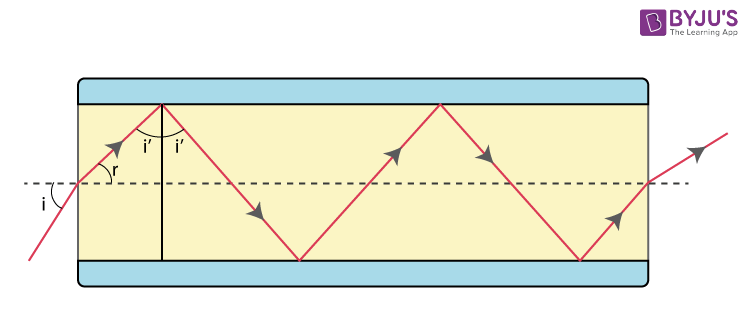
(i) Figure below shows a cross-section of a ‘light pipe’ made of a glass fibre of a refractive
index 1.68. The outer covering of the pipe is made of a material of a refractive index
1.44. What is the range of the angles of the incident rays with the axis of the pipe
for which total reflections inside the pipe take place, as shown in the figure?
(ii) What is the answer if there is no outer covering of the pipe?

NCERT Solutions for Class 12 Physics Chapter 9 Ray Optics and Optical Instruments Question 17

Show solutionHide solution
Worked solution


(i) Refractive index of the glass-fibre,

\(\begin{array}{l}\mu_{2}\end{array} \)

The Refractive index of the outer covering,

\(\begin{array}{l}\mu_{1}\end{array} \)


\(\begin{array}{l}\mu\end{array} \)
\(\begin{array}{l}\mu=\frac{\mu_{2}}{\mu_{1}}=\frac{1}{sin i’}\end{array} \)


\(\begin{array}{l}sin i’=\frac{\mu_{1}}{\mu_{2}}\end{array} \)


\(\begin{array}{l}=\frac{1.44}{1.68}=0.8571\end{array} \)


\(\begin{array}{l}Therefore\;i’=59°\end{array} \)
\(\begin{array}{l}59°\end{array} \)
\(\begin{array}{l}r_{max}=90°-i’=90°-59°=31°\end{array} \)
\(\begin{array}{l}i_{max}\end{array} \)

\(\begin{array}{l}\mu_{1}=1.68\end{array} \)

We know that

\(\begin{array}{l}\mu_{1}=\frac{sin i_{max}}{sin r_{max}}\end{array} \)

Rearranging the equation, we get

sin imax = 1.68 × sin rmax

Substituting the values in the above equation, we get

= 1.68 sin 31°

=

\(\begin{array}{l}1.68\times 0.5150\end{array} \)

Therefore,

\(\begin{array}{l}i_{max}=sin^{-1}0.8652=60°\end{array} \)

Thus, all the rays incident at angles lying in the range 0 < i <

\(\begin{array}{l}60°\end{array} \)

(ii) If the outer covering of the pipe is not present, then
Refractive index of the outer pipe,

\(\begin{array}{l}\mu_{1}\end{array} \)

\(\begin{array}{l}90°\end{array} \)

We can write Snell’s law at the air-pipe interface as

\(\begin{array}{l}\frac{sin i}{sin r}=\mu_{2}=1.68\end{array} \)


\(\begin{array}{l}sin r=\frac{sin 90°}{1.68}=\frac{1}{1.68}\end{array} \)


\(\begin{array}{l}r=sin^{-1}(0.5932)\end{array} \)


\(\begin{array}{l}=36.5°\end{array} \)

Therefore,

\(\begin{array}{l}i’=90°-36.5°=53.5°\end{array} \)

Since i’>r, all incident rays will suffer total internal reflection.

Q18Written answer


Answer the following questions.
(i) You have learnt that plane and convex mirrors produce virtual images of objects.
Can they produce real images under some circumstances? Explain.
(ii) A virtual image, we always say, cannot be caught on a screen.
Yet when we ‘see’ a virtual image, we are obviously bringing it onto the ‘screen’
(i.e., the retina) of our eye. Is there a contradiction?
(iii) A diver underwater looks obliquely at a fisherman standing on the bank of a lake.
Would the fisherman look taller or shorter to the diver than he actually is?
(iv) Does the apparent depth of a tank of water change if viewed obliquely? If so,
does the apparent depth increase or decrease?
(v) The refractive index of a diamond is much greater than that of ordinary glass.
Is this fact of some use to a diamond cutter?

Show solutionHide solution
Worked solution


(i) Yes.

Real images can be obtained from a plane and convex mirrors too. When the light rays converge at a point behind the plane or convex mirror, the object is said to be virtual. The real image of this object is obtained on the screen, which is placed in front of the mirror. This is where the real image is obtained.
(ii) No.

To obtain a virtual image, the light rays must diverge. In the eyes, the convex lens help in converging these divergent rays at the retina. This is an example where the virtual image acts as an object for the lens to produce a real image.

(iii) The diver is in the water while the fisherman is on the land. Air is less dense when compared to water as a medium. It is mentioned that the diver is viewing the fisherman. This explains that the light rays are travelling from the denser medium to the rarer medium. This means that the refracted rays move away from the normal, making fisherman appear taller.

(iv) Yes; Decrease

The reason behind the change in depth of the tank, when viewed obliquely, is that the light rays bend when they travel from one medium to another. This also means that the apparent depth is less than the near-normal viewing.

(v) Yes.

2.42 is the refractive index of the diamond, while 1.5 is the refractive index of ordinary glass. Also, the critical angle of the diamond is less than the glass. The sparkling effect of a diamond is possible because of the large cuts in the angle of incidence. Larger cuts ensure that the light entering the diamond is totally reflected from all the faces.

Q19Written answer


The image of a small electric bulb fixed on the wall of a room is to be obtained on the opposite wall 3 m away by means of a large convex lens. What is the maximum possible focal length of the lens required for the purpose?

Show solutionHide solution
Worked solution


Distance between the object and the image, d = 3 m

Maximum focal length of the convex lens =

\(\begin{array}{l}f_{max}\end{array} \)
\(\begin{array}{l}f_{max}=\frac{d}{4}\end{array} \)

=

\(\begin{array}{l}\frac{3}{4}=0.75m\end{array} \)
Q20Written answer


A screen is placed 90 cm from an object. The image of the object on the screen is
formed by a convex lens at two different locations separated by 20 cm. Determine the
focal length of the lens.

Show solutionHide solution
Worked solution


Distance between the image (screen) and the object, D = 90 cm
Distance between two locations of the convex lens, d = 20 cm
The focal length of the lens = f
The focal length is related to d and D as

\(\begin{array}{l}f=\frac{D^{2}-d^{2}}{4D}\end{array} \)

=

\(\begin{array}{l}\frac{90^{2}-(20^{2})}{4\times90}=\frac{770}{36}=21.39cm\end{array} \)