My Cart
Your Cart 0

    Your cart is empty.

  • Total (Amount) ₹0.00
NCERT · Class 12 · Physics

Chapter 11: Dual Nature of Radiation and Matter

Practice each question, then open the answer or worked solution.

Questions

32 questions
Q11.26Written answer

Ultraviolet light of wavelength 2271 Å from a 100 W mercury source irradiates a photo-cell made of molybdenum metal. If the stopping potential is –1.3 V, estimate the work function of the metal. How would the photo-cell respond to high-intensity (∼105 W m–2) red light of wavelength 6328 Å produced by a He-Ne laser?

Show solutionHide solution
Worked solution

Wavelength of ultraviolet light, λ = 2271 Å = 2271 × 10−10 m

Stopping potential of the metal, V0 = 1.3 V

Planck’s constant, h = 6.6 × 10⁻³⁴ J

Charge on an electron, e = 1.6 × 10⁻¹⁹ C

From the photoelectric effect, we have the photon-electron relation as,

The work function of the metal, Φ0 = hν – eV0

= (hc/λ) – eV0

= 

\(\begin{array}{l}\frac{6.6\times 10^{-34}\times 3\times 10^{^{8}}}{2271\times 10^{-10}}-1.6 \times 10^{-19}\times 1.3\end{array} \)

= 8.72 x 10⁻¹⁹ – 2.08 x 10-19

= 6.64 x 10⁻¹⁹ J

Therefore, the threshold frequency of the metal

Φ0 = hυ0

υ0 = Φ0/h = 6.64 x 10⁻¹⁹ /6.6 x 10-34

= 1.006 x 10¹⁵ Hz

Wavelength of the red light, λr = 6328 x 10-10 m

Frequency of the red light, υr = c/λr = 3 x 10⁸/6328 x 10-10

= 4.74 x 10¹⁴ Hz

υ0>υr

The photocell will not respond to the red light produced by the He-Ne laser.
Q11.27Written answer

Monochromatic radiation of wavelength 640.2 nm (1nm = 10–9 m) from a neon lamp irradiates photosensitive material made of caesium on tungsten. The stopping voltage is measured to be 0.54 V. The source is replaced by an iron source, and its 427.2 nm line irradiates the same photo-cell. Predict the new stopping voltage.

Show solutionHide solution
Worked solution

Wavelength of the monochromatic radiation, λ = 640.2 nm = 640.2 × 10⁻⁹ m

The stopping potential of the neon lamp, V0 = 0.54 V

Charge on an electron, e = 1.6 × 10⁻¹⁹ C

Planck’s constant, h = 6.6 × 10⁻³⁴ Js

From the photoelectric effect, we have the photon-electron relation as eV0 = hν – Φ0

The work function of the metal, Φ0 = hν – eV0

= (hc/λ) – eV0

\(\begin{array}{l}=\frac{6.6\times 10^{-34}\times 3\times 10^{^{8}}}{640.2\times 10^{-9}}-1.6 \times 10^{-19}\times 0.54\end{array} \)

= 3.093 x 10⁻¹⁹ – 0.864 x 10-19

= 2.229 x 10⁻¹⁹ J

The wavelength of the radiation emitted by the iron source, λ’ = 427.2 nm = 427.2 x 10⁻⁹ m

Let V0‘ be the new stopping potential

Therefore, eV0‘ = (hc/λ’) – Φ0

\(\begin{array}{l}=\frac{6.6\times 10^{-34}\times 3\times 10^{^{8}}}{427.2\times 10^{-9}}-2.229 \times 10^{-19}\end{array} \)

= 4.63 x 10⁻¹⁹ – 2.229 x 10-19

= 2.401 x 10⁻¹⁹ J

V0‘ = 2.401 x 10⁻¹⁹ J/ 1.6 x 10⁻¹⁹ J

= 1.5 eV

Therefore, the new stopping potential = 1.50 eV.

Q11.28Written answer

A mercury lamp is a convenient source for studying the frequency dependence of photoelectric emission since it gives a number of spectral lines ranging from the UV to the red end of the visible spectrum. In our experiment with rubidium photo-cell, the following lines from a mercury source were used:
λ1 = 3650 Å,

λ2 = 4047 Å,

λ3 = 4358 Å,

λ4 = 5461 Å,

λ5 = 6907 Å,
The stopping voltages, respectively, were measured to be: V01 = 1.28 V, V02 = 0.95 V, V03 = 0.74 V, V04 = 0.16 V, V05 = 0 V. Determine the value of Planck’s constant h, the threshold frequency and work function for the material.
[Note: You will notice that to get h from the data, you will need to know e (which you can take to be 1.6 × 10⁻¹⁹ C). Experiments of this kind on Na, Li, K, etc. were performed by Millikan, who, using his own value of e (from the oil-drop experiment), confirmed Einstein’s photoelectric equation and, at the same time, gave an independent estimate of the value of h.]

Show solutionHide solution
Worked solution

From the photoelectric effect, we have the photon-electron relation as eV0 = hν – Φ0

The work function of the metal, Φ0 = hν – eV0

Φ0 = (hc/λ) – eV0

\(\begin{array}{l}V_{0} = \frac{h}{e}\nu -\frac{\phi _{0}}{e}\end{array} \)

Here,

V0 = Stopping potential
h = Planck’s constant
e = Charge on an electron
ν = Frequency of radiation
Φ0 = Work function of a material

Stopping proportional is directly proportional to the frequency.
Frequency, ν = Speed of light (c)/Wavelength (λ)

Using this equation, we can find the frequency of various lines

ν1 = c/λ1 = 3 x 10⁸/3650 x 10-10

= 8.219 x 10¹⁴ Hz

ν2 = c/λ2= 3 x 10⁸/4047 x 10-10

= 7.412 x 10¹⁴ Hz

ν3 = c/λ3= 3 x 10⁸/4358 x 10-10

= 6.88 x 10¹⁴ Hz

ν4= c/λ4= 3 x 10⁸/5461 x 10-10

= 5.493 x 10¹⁴ Hz

ν5= c/λ5= 3 x 10⁸/6907 x 10-10

= 4.343 x 10¹⁴ Hz


Frequency 8.219 7.412 6.884 5.493 4.343
Stopping potential 1.28 0.95 0.74 0.16 o


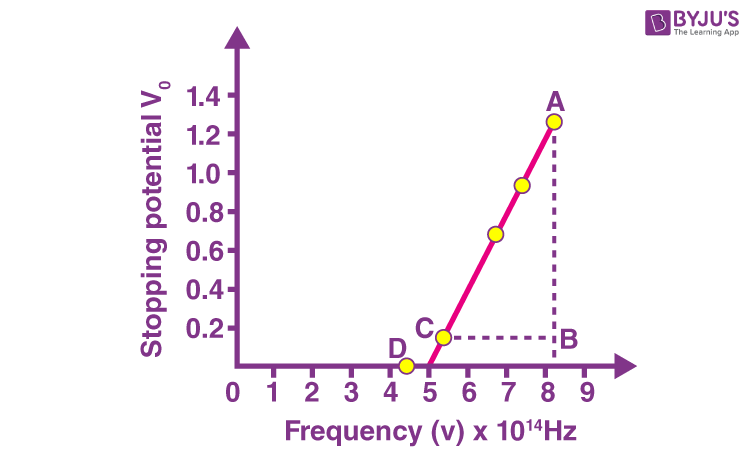
The above values can be plotted in a graph

NCERT solutions Class 12 Physics Chapter 11 Dual Nature of Radiation and Matter Question 28

The graph is a straight line, and it intersects the y-axis at 5 x 10¹⁴ Hz. This is the threshold frequency. Point D is the frequency less than the threshold frequency.

Slope of the straight line = AB/CB = (1.28 – 0.16)/(8.214 – 5.493) x 1014

From equation (1), the slope is written as

h/e = (1.28 – 0.16)/(8.214 – 5.493) x 1014

h = (1.12 x 1.6 x 10-19)/(2.726 x 1014)

= 6.573 x 10⁻³⁴ Js

The work function of the metal is,

Φ0 = hν0

= (6.573 x 10-34 x 5 x 1014)

= 3.286 x 10⁻¹⁹ J

= 3.286 x 10⁻¹⁹ /1.6 x 10-19

Φ0= 2.054 eV.

Q11.29Written answer

The work function for the following metals is given:  Na: 2.75 eV, K: 2.30 eV, Mo: 4.17 eV, Ni: 5.15 eV. Which of these metals will not give photoelectric emission for radiation of wavelength 3300 Å from a He-Cd laser placed 1 m away from the photocell? What happens if the laser is brought nearer and placed 50 cm away?

Show solutionHide solution
Worked solution

Wavelength λ = 3300 Å

Speed of light = 3 x 108 m/s

Planck’s constant = 6.63 x 10-34 Js

The energy of the photon of the incident light

E = hc/λ = (6.63 x 10-34 x 3 x 108)/3300x 10-10

⇒ 6.018 x 10⁻¹⁹ J

⇒  (6.018 x 10⁻¹⁹ J)/1.6 x 10-19

= 3.7 eV

The energy of the incident radiation is greater than the work function of Na and K. It is lesser for Mo and Ni. Therefore, Mo and Ni will not show a photoelectric effect.

If the laser is brought nearer and placed 50 cm away, then the intensity of the radiation will increase. The energy of the radiation will not be affected. Therefore, the result will be the same. However, the photoelectrons from Na and K will increase in proportion to intensity.

Q11.30Written answer

Light of intensity 10–5 W m–2 falls on a sodium photo-cell of a surface area of 2 cm2. Assuming that the top 5 layers of sodium absorb the incident energy, estimate the time required for photoelectric emission in the wave picture of radiation. The work function for the metal is given to be about 2 eV. What is the implication of your answer?

Show solutionHide solution
Worked solution

The intensity of the light = 10–5 W m–2

The surface area of the sodium photocell, A = 2 cm2

Incident power of the light, P = I x A

= 10-5 x 2 x 10-4

= 2 x 10⁻⁹ W

Work function of the metal, Φ0 = 2 eV

= 2 x 1.6 x 10-19 

= 3.2 x 10⁻¹⁹ J

The number of layers of sodium that absorbs the incident energy, n = 5

The atomic area of the sodium atom, Ae, is 10-20 m2

Hence, the number of conduction electrons in n layers is given as:

n’ = n x (A/Ae)

= 5 x [(2 x 10⁻⁴)/10-20] = 1017

The incident power is absorbed by all the electrons continuously. The amount of energy absorbed per electron per second is

E = P/n’

= (2 x 10⁻⁹)/1017

= 2 x 10-26 J/s

The time for photoelectric emission

t = Φ0/E

= (3.2 x 10⁻¹⁹)/(2 x 10-26) = 1.6 x 10⁷ s ≈ 0.507 years

The time required for the photoelectric emission is almost half a year. This is not practical. Therefore, the wave function is in disagreement with the given experiment.

Q11.31Written answer

Crystal diffraction experiments can be performed using X-rays or electrons accelerated through appropriate voltage. Which probe has greater energy? (For quantitative comparison, take the wavelength of the probe equal to 1 Å, which is of the order of interatomic spacing in the lattice) (me =9.11 × 10⁻³¹ kg).

Show solutionHide solution
Worked solution

For electrons, kinetic energy, K.E= (1/2) mev2

= (mev)2/2m

K.E = p2/2me

⇒ 

\(\begin{array}{l}p = \sqrt{2m_{e}K.E}\end{array} \)
\(\begin{array}{l}\lambda = \frac{h}{p}= \frac{h}{\sqrt{2m_{e}K.E}}\end{array} \)
\(\begin{array}{l}\lambda^{2} = \frac{h^{2}}{{2m_{e}K.E}}\end{array} \)
\(\begin{array}{l}K.E= \frac{h^{2}}{{2m_{e}\lambda^{2}}}\end{array} \)
\(\begin{array}{l}K.E= \frac{(6.64 \times 10^{-34})^{2}}{{2\times 9.1 \times 10^{-31}\times (10^{-10})^{2}}}\end{array} \)

K.E = 2.4 x 10⁻¹⁷ J

K.E = 

\(\begin{array}{l}\frac{2.4\times 10^{-17}}{1.6\times 10^{-19}}\end{array} \)

= 149.375 eV

For photon of X-rays, energy, E = hc/λe

= (6.63 x 10-34 x 3 x 108)/ (10-10 x 1.6 x 10-19)

= 12.375 x 103 eV

= 12.375 keV

Hence, the energy of the photons of X-rays is more than the energy of the electron.

Q11.32Written answer

(a) Obtain the de Broglie wavelength of a neutron of kinetic energy 150 eV. As you have seen in question 11.31, an electron beam of this energy is suitable for crystal diffraction experiments. Would a neutron beam of the same energy be equally suitable? Explain. (mn = 1.675 × 10⁻²⁷ kg).

(b) Obtain the de Broglie wavelength associated with thermal neutrons at room temperature (27 °C). Also, explain why a fast neutron beam needs to be thermalised with the environment before it can be used for neutron diffraction experiments.

Show solutionHide solution
Worked solution

(a) Kinetic energy of the neutron = 150 eV

= 150 x 1.6 x 10-19 

= 2.4 x 10⁻¹⁷ J

Mass of the neutron, mn = 1.675 × 10⁻²⁷ kg

The kinetic energy of the neutron is given by the relation

K.E = (1/2) mev2

K.E = p2/2me

⇒ 

\(\begin{array}{l}p = \sqrt{2m_{e}K.E}\end{array} \)
\(\begin{array}{l}\lambda = \frac{h}{p}= \frac{h}{\sqrt{2m_{e}K.E}}\end{array} \)

Wavelength and mass are inversely proportional. Wavelength decreases with an increase in mass and vice versa.

\(\begin{array}{l}\lambda = \frac{(6.63 \times 10^{-34})}{{\sqrt{2.24 \times 10^{-17}\times 1.675\times 10^{-27}}}}\end{array} \)

= 2.327 x 10⁻¹² m

In question 11.31, it is given inter-atomic spacing of the crystal is about 1 Å, i.e., 10-10 m. The interatomic spacing is about 100 times greater. Therefore, a neutron of kinetic energy is 150 eV is not good for a diffraction experiment.

(b) Room temperature = 270 C = 27 +  273 = 300 K

Average kinetic energy of the neutron, E = (3/2) kT

here, k = Boltzmann constant = 1.38 x 10⁻²³ J/mol/K

The wavelength of the neutron is

\(\begin{array}{l}\lambda =\frac{h}{\sqrt{2m_{n}E}}\end{array} \)
\(\begin{array}{l}\lambda =\frac{h}{\sqrt{2m_{n}\frac{3}{2}kT}}\end{array} \)
\(\begin{array}{l}\lambda =\frac{6.6\times 10^{-34}}{\sqrt{3\times 1.675\times 10^{-27}\times 1.38\times 10^{-23}\times 300}}\end{array} \)

= 1.447 x 10⁻¹⁰ m

This wavelength is comparable to the inter-atomic spacing of the crystal. Hence, a fast neutron beam needs to be thermalised with the environment before it can be used for neutron diffraction experiments.

Q11.33Written answer

An electron microscope uses electrons accelerated by a voltage of 50 kV. Determine the de Broglie wavelength associated with the electrons. If other factors (such as numerical aperture, etc.) are taken to be roughly the same, how does the resolving power of an electron microscope compare with that of an optical microscope which uses yellow light?

Show solutionHide solution
Worked solution

Electrons are accelerated by a voltage = 50 kV

Charge on an electron, e = 1.6 x 10⁻¹⁹ C

Mass of the electron, me = 9.11 x 10⁻³¹ kg

Wavelength of the yellow light = 5.9 x 10⁻⁷ m

The kinetic energy of the electron, E = eV

= (1.6 x 10-19) x (50 x 103)

= 8 x 10-15 J

De Broglie wavelength of an electron is given as

\(\begin{array}{l}\lambda =\frac{h}{\sqrt{2m_{e}E}}\end{array} \)
\(\begin{array}{l}\lambda =\frac{6.6\times 10^{-34}}{\sqrt{2\times 9.11\times 10^{-31}\times 8\times 10^{-15}}}\end{array} \)

= 5.467 x 10⁻¹² m

The wavelength is 105 times lesser than the wavelength of yellow light. The resolving power of the microscope and the wavelength of the light used is inversely proportional. Therefore, the resolving power of the electron microscope is 105 times greater than the optical microscope.

Q11.34Written answer

The wavelength of a probe is roughly a measure of the size of a structure that it can probe in some detail. The quark structure of protons and neutrons appears at the minute length scale of 10–15 m or less. This structure was first probed in the early 1970s using high-energy electron beams produced by a linear accelerator at Stanford, USA. Guess what might have been the order of energy of these electron beams. (Rest mass energy of electron = 0.511 MeV.)

Show solutionHide solution
Worked solution

The wavelength of the proton or neutron, λ ≈ 10-15 m

Rest mass-energy of an electron:

m0c2 = 0.511 MeV

= 0.511 x 106 x 1.6 x 10-19

= 0.8176 x 10⁻¹³ J

Planck’s constant, h = 6.6 x 10⁻³⁴ Js

Speed of light, c = 3 x 10⁸ m/s

The momentum  of the proton or a neutron is given as

p = h/λ

=  6.6 x 10⁻³⁴ /10-15

= 6.6 x 10⁻¹⁹ kg m/s

The relativistic relation for energy (E) is given as

E2 = p2c2 + m20C4

= (6.6 x 10-19 x 3 x 108)2 + (0.8176 x 10⁻¹³)2

= 392.04 x 10⁻²² + 0.6685 x 10⁻²⁶

≈ 392.04 x 10⁻²²

⇒ E = 19.8 x 10-11

= 19.8 x 10⁻¹¹/1.6 x 10-19

= 12.375 x 10⁸ eV

Thus, the order of energy of these electron beams is 12.375 x 10⁸ eV.

Q11.35Written answer

Find the typical de Broglie wavelength associated with a He atom in helium gas at room temperature (27 °C) and 1 atm pressure, and compare it with the mean separation between two atoms under these conditions.

Show solutionHide solution
Worked solution

Room temperature, T = 270 C = 27 + 273 = 300 K

Atmospheric pressure, P = 1 atm = 1.01 x 10⁵ Pa

The atomic weight of the He atom = 4

Avogadro’s number, NA = 6.023 x 10²³

Boltzmann’s constant, k = 1.38 x 10⁻²³ J/mol/K

The average energy of a gas at temperature T,

De Broglie wavelength is given as

\(\begin{array}{l}\lambda =\frac{h}{\sqrt{2mE}}\end{array} \)

E = (3/2) kT

m = mass of the He atom

= Atomic weight/NA

= 4/(6.023 x 1023)

= 6.64 x 10⁻²⁴ g

m = 6.64 x 10⁻²⁷ kg

\(\begin{array}{l}\lambda =\frac{h}{\sqrt{3mkT}}\end{array} \)
\(\begin{array}{l}\lambda =\frac{6.6\times 10^{-34}}{\sqrt{3\times 6.64\times 10^{-27}\times 1.38\times 10^{-23}\times 300}}\end{array} \)

= 0.7268 x 10⁻¹⁰ m

We have the ideal gas formula

PV = RT

PV = kNT

V/N = kT/P

Here,

V is the volume of the gas

N is the number of moles of the gas

The mean separation between the two atoms of the gas is given as

\(\begin{array}{l}r = \left [\frac{V}{N}\right ]^{1/3}=\left [ \frac{kT}{P} \right ]^{1/3}\end{array} \)
\(\begin{array}{l}r =\left [ \frac{1.38\times 10^{-23}\times 300}{1.01\times 10^{5}} \right ]^{1/3}\end{array} \)

= 3.35 x 10⁻⁹ m

Therefore, the mean separation between the atom is greater than the de Broglie wavelength.