= 130n
Therefore, n = 5
Hence, the least distance from the central maximum can be obtained by the relation:
x =
Note: The value of d and D are not given in the question.
Question 7:
In a double-slit experiment, 0.2° is found to be the angular width of a fringe on a screen placed 1 m away. The wavelength of light used is 600 nm. What will be the angular width of the fringe if the entire experimental apparatus is immersed in water? Take the refractive index of water to be
Show solutionHide solution
Distance of the screen from the slits, D = 1 m
Wavelength of light used,
Angular width of the fringe in air
Angular width of the fringe in water=
Refractive index of water,
Therefore, 0.15° is the reduction in the angular width of the fringe in water.
Question 8: What is the Brewster angle for air-to-glass transition? (Refractive index of glass = 1.5.)
Refractive index of glass,
Consider Brewster angle =
Following is the relation between the Brewster angle and the refractive index:
Therefore, the Brewster angle for air-to-glass transition is 56.31°
Question 9: Light of wavelength 5000 Armstrong falls on a plane reflecting surface. What are the wavelength and frequency of the reflected light? For what angle of incidence is the reflected ray normal to the incident ray?
Wavelength of incident light,
Speed of light, c =3 x 10⁸ m
Following is the relation for the frequency of incident light:
v =
The wavelength and frequency of incident light are equal to the reflected ray. Therefore, 5000 Armstrong and
From the laws of reflection, we know that the angle of incidence is always equal to the angle of reflection
i.e.
Hence,
Therefore, 45° is the angle of incidence.
Question 10:
Estimate the distance for which ray optics is a good approximation for an aperture of 4 mm and wavelength of 400 nm.
Fresnel’s distance (
Where,
Aperture width, a = 4 mm = 4 × 10⁻³ m
Wavelength of light,
Therefore, 40 m is the distance for which the ray optics is a good approximation.
Question 11: The 6563 Å Hα line emitted by hydrogen in a star is found to be red-shifted by 15 Å. Estimate the speed with which the star is receding from the Earth.
λ = 6563 Å
Δλ = 15 Å
Since the star is receding, the velocity (v) is negative.
Δλ = – vλ/c
v = – cΔλ/λ
= – (3 x 108) x (15 Å/ 6563 Å)
= – 6.86 x 10⁵ m/s
Question 12: Explain how Corpuscular theory predicts the speed of light in a medium, say, water, to be greater than the speed of light in a vacuum. Is the prediction confirmed by experimental determination of the speed of light in water? If not, which alternative picture of light is consistent with the experiment?
According to Newton’s Corpuscular theory, the velocity of light in the denser medium (water) is greater than the velocity of light in the rarer medium (vacuum). This was experimentally wrong.
At the angle of incidence (i) of the light of velocity v, the angle of refraction is r.
Due to the change in the medium, the change in the velocity of light in water is v.
Using Snells law,
c sin i = v sin r ——(1)
The relation between the velocities and the refractive index is
v/c = μ ———(2)
v/c = sin i/sin r = μ ——-(3)
But μ> 1, so v > c is not possible.
Huygens’ wave theory is consistent with the experiment.
Question 13: You have learnt in the text how Huygens’ principle leads to the laws of reflection and refraction. Use the same principle to deduce directly that a point object placed in front of a plane mirror produces a virtual image whose distance from the mirror is equal to the object’s distance from the mirror.
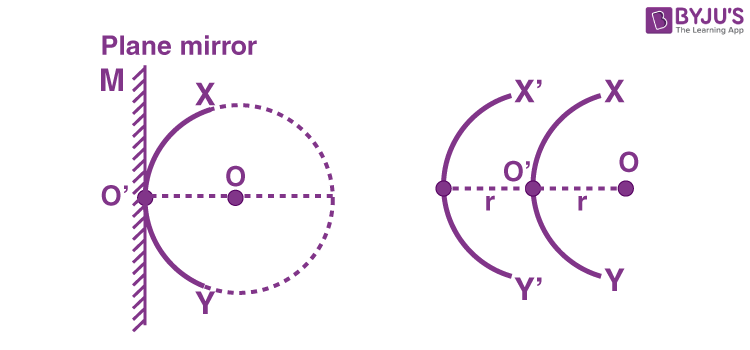
Consider an object O placed in front of the plane mirror MO’ at a distance r. The object is taken as the centre point O, and a circle is drawn such that it just touches the plane mirror at point O’.
According to Huygens’ Principle, XY is the wavefront of the incident light. If the mirror was not present, then a similar wavefront X’Y’ (as XY) would form behind O’ at distance r. X’Y’ can be considered as a virtual reflected ray for the plane mirror. Therefore, a point object placed in front of the plane mirror produces a virtual image whose distance from the mirror is equal to the object distance (r).
Question 14: Let us list some of the factors which could possibly influence the speed of wave propagation:
(i) Nature of the source
(ii) The direction of propagation
(iii) The motion of the source and/or observer
(iv) Wavelength
(v) The intensity of the wave. On which of these factors, if any, does (a) the speed of light in a vacuum (b) the speed of light in a medium (say, glass or water) depend?
(a) The speed of light in the vacuum does not depend on any of the factors listed.
(b) The speed of light in the medium depends on the wavelength of the light in that medium.
Question 15: For sound waves, the Doppler formula for frequency shift differs slightly between the two situations: (i) source at rest; observer moving, and (ii) source moving; observer at rest. The exact Doppler formulas for the case of light waves in a vacuum are, however, strictly identical for these situations. Explain why this should be so. Would you expect the formulas to be strictly identical for the two situations in the case of light travelling in a medium?
The Doppler formula differs slightly between the two situations because sound waves can travel only through a medium. The motion of the observer relative to the medium is different in both cases. Hence, the doppler formula is different.
Light waves can propagate in a vacuum. In a vacuum, the speed of light does not depend on the motion of the observer and the source.
When light travels in the medium, the doppler formula for the two cases will be different.
Question 16: In a double-slit experiment using the light of wavelength 600 nm, the angular width of a fringe formed on a distant screen is 0.1°. What is the spacing between the two slits?
The wavelength of the light, λ = 600 nm
The angular width of the fringe formed, θ = 0.10 = 0.1 π/180
Spacing between the slits, d = λ/θ = (600 x 10-9 x 180)/(0.1 x 3.14)
= 108000 x 10-9/0.314
d =3.44 x 10⁻⁴ m
Question 17: Answer the following questions:
(a) In a single slit diffraction experiment, the width of the slit is made double the original width. How does this affect the size and intensity of the central diffraction band?
(b) In what way is diffraction from each slit related to the interference pattern in a double-slit experiment?
(c) When a tiny circular obstacle is placed in the path of light from a distant source, a bright spot is seen at the centre of the shadow of the obstacle. Explain why?
(d) Two students are separated by a 7 m partition wall in a room 10 m high. If both light and sound waves can bend around obstacles, how is it that the students are unable to see each other even though they can converse easily?
(e) Ray optics is based on the assumption that light travels in a straight line. Diffraction effects (observed when light propagates through small apertures/slits or around small obstacles) disprove this assumption. Yet the ray optics assumption is so commonly used in understanding location and several other properties of images in optical instruments. What is the justification?
(a) In a single slit diffraction experiment, if the width of the slit is made double the original width, the size of the central diffraction band reduces to half, and the intensity of the band increases four times.
(b) If the width of each slit is comparable to the wavelength of light used, the interference pattern thus obtained in the double-slit experiment is modified by diffraction from each of the two slits.
(c) When a tiny circular obstacle is placed in the path of light from a distant source, a bright spot is seen at the centre of the shadow of the obstacle. The bright spot is formed due to the constructive interference of the light waves that get diffracted from the edges of the circular obstacle.
(d) The obstacle bends the waves by a large angle if the wavelength of the wave is comparable with the size of the obstacle. The wavelength of the light wave is much smaller than the size of the wall. Therefore, the diffraction angle is also very small. As a result, the students will not be able to see each other. On the other hand, the size of the wall and the wavelength of the sound wave is comparable. Hence, the diffraction angle is large. Therefore, students can hear each other.
(e) The size of the aperture in the optical instruments is much larger than the wavelength of light. Therefore, the diffraction effect of light is negligible in these instruments. Thus, the assumption of light travelling in a straight line can be used in these instruments.
Question 18: Two towers on top of two hills are 40 km apart. The line joining them passes 50 m above a hill halfway between the towers. What is the longest wavelength of radio waves which can be sent between the towers without appreciable diffraction effects?
Distance between the towers = 40 km
Height of the line joining the hills, d = 50 m
The radial spread of the radio waves must not exceed 50 m
Aperture a = d = 50 m
The hill is located halfway between the towers. Therefore, Fresnel’s distance is Zp = 20 km
Fresnel’s distance can be given by the equation, Zp = a2/λ
λ = a2/Zp
= (50)2/(20 x 103)
= 250/20 = 12.5 x 10⁻³ m = 12.5 cm
Question 19: A parallel beam of light of wavelength 500 nm falls on a narrow slit, and the resulting diffraction pattern is observed on a screen 1 m away. It is observed that the first minimum is at a distance of 2.5 mm from the centre of the screen. Find the width of the slit.
The wavelength of the beam of light, λ = 500 nm
Distance between the slit and the screen, D= 1 m
Distance of the first minimum from the centre of the screen, x = 2.5 mm = 2.5 x 10⁻³ m
First minima, n = 1
Consider the equation, nλ = xd/D
⇒ d = nλD/x = ( 1 x 500 x 10-9 x 1) /( 2.5 x 10⁻³ )
= 200 x 10-6 m
Question 20: Answer the following questions:
(a) When a low-flying aircraft passes overhead, we sometimes notice a slight shaking of the picture on our TV screen. Suggest a possible explanation.
(b) As you have learnt in the text, the principle of linear superposition of wave displacement is basic to understanding intensity distributions in diffraction and interference patterns. What is the justification for this principle?
(a) The weak radar signals from the aircraft interfere with the TV signal received by the antenna.
(b) This is because superposition follows from the linear character of a differential equation that governs wave motion.
Question 21: In deriving the single slit diffraction pattern, it was stated that the intensity is zero at angles of nλ/a. Justify this by suitably dividing the slit to bring out the cancellation.
Let “a” be the width of a single slit. The single slit is further divided into n smaller slits of width a’.
a’ = a/n
Each of the smaller slits should produce zero intensity for the single slit to produce zero intensity.
For this to happen, the angle of diffraction, θ = λ/a’
⇒ θ = λ/(a/n)
or, θ = nλ/a
Therefore, in deriving the single slit diffraction pattern, it was stated that the intensity is zero at angles of nλ/a.