My Cart
Your Cart 0

    Your cart is empty.

  • Total (Amount) ₹0.00
NCERT · Class 12 · Physics

Chapter 1: Electric Charges and Fields

Practice each question, then open the answer or worked solution.

Questions

24 questions
Q1.11Written answer

A polythene piece rubbed with wool is found to have a negative charge of

\(\begin{array}{l}3 \times 10^{-7}\; C\end{array} \)
.

(i) Estimate the number of electrons transferred (from which to which?).

(ii) Is there a transfer of mass from wool to polythene?


Show solutionHide solution
Worked solution

Soln.:

(i) Since the wool is positively charged and the polythene is negatively charged, we can say that few amounts of electrons are transferred from wool to polythene.

Charge on the polythene, q =

\(\begin{array}{l}3 \times 10^{-7}\; C\end{array} \)

Amount of charge on an electron,

\(\begin{array}{l}e = -1.6 \times 10^{-19}\; C\end{array} \)

Let the number of electrons transferred from wool to polythene be n

So, by using the given equation, we can calculate the value of n,

q = ne

\(\begin{array}{l}\Rightarrow n = \frac{q}{e} = \frac{-3 \times 10 ^{-7}}{-1.6 \times 10 ^{-19}} = 1.87 \times 10 ^{12}\end{array} \)

Therefore, the number of electrons transferred from wool to polythene is

\(\begin{array}{l}1.87 \times 10 ^{12}\end{array} \)


(ii) Yes,

Mass is also transferred as an electron is transferred from wool to polythene and an electron particle has some mass.

Mass of an electron,

\(\begin{array}{l}m_{e} = 9.1 \times 10 ^{-31} kg\end{array} \)

Total mass transferred , m =

\(\begin{array}{l}m_{e} \times n \\ \\ = 9.1 \times 10 ^{-31} \times 1.87 \times 10^{12} \\ \\ = 1.701 \times 10^{-18} \; kg\end{array} \)

Here, the mass transferred is too low that it can be neglected.
 

Q1.12Written answer

(i) Two insulated charged copper spheres, A and B, have their centres separated by a distance of 50 cm. What is the mutual force of electrostatic repulsion if the charge on each is

\(\begin{array}{l}6.5 \times 10^{-7} \; C\end{array} \)
each? The radii of A and B are negligible compared to the distance of separation.

(ii) What is the force of repulsion if each sphere is charged double the above amount, and the distance between them is halved?

Show solutionHide solution
Worked solution

Soln.:

(i) Charge on sphere A,

\(\begin{array}{l}q_{A} = 6.5 \times 10^{-7} \; C\end{array} \)

Charge on sphere B,

\(\begin{array}{l}q_{B} = 6.5 \times 10^{-7} \; C\end{array} \)

Distance between the spheres, r = 50 cm = 0.5 m

Force of repulsion between the two spheres,

\(\begin{array}{l}F = \frac{1}{4 \pi \epsilon _{0}}. \frac{q _{A} q_{B}}{r ^{2}}\end{array} \)

Where

\(\begin{array}{l}\epsilon _{0}\end{array} \)
\(\begin{array}{l}\frac{1}{ 4 \pi \epsilon _{0}} = 9 \times 10^{9} \; Nm^{2} C^{2}\end{array} \)

Therefore,

\(\begin{array}{l}F = \frac{9 \times 10 ^{9} \times \left ( 6.5 \times 10^{-7} \right )^{2}}{\left ( 0.5 \right )^{2}}\\ \\ = 1.52 \times 10^{-2}\; N\end{array} \)

Therefore, the force between the two spheres is

\(\begin{array}{l}1.52 \times 10^{-2}\; N\end{array} \)


(ii) After doubling the charge,

Charge on sphere A,

\(\begin{array}{l}q_{A} = 1.3 \times 10^{-6} \; C\end{array} \)

Charge on sphere B,

\(\begin{array}{l}q_{B} = 1.3 \times 10^{-6} \; C\end{array} \)

The distance between the spheres is halved.

\(\begin{array}{l}∴ r = \frac {0.5}{2} = 0.25 \; m\end{array} \)

Force of repulsion between the two spheres,

\(\begin{array}{l}F = \frac{1}{4 \pi \epsilon _{0}}. \frac{q _{A} q_{B}}{r ^{2}} = \frac{9 \times 10 ^{9} \times 1.3 \times 10^{-6} \times 1.3 \times 10^{-6} }{\left ( 0.25 \right )^{2}}\\ \\ = 16 \times 1.52 \times 10^{-2} \\ \\ = 0.243 \; N\end{array} \)

Therefore, the force between the two spheres is 0.243 N.


Q1.13Written answer

Suppose the spheres A and B in Exercise 12 have identical sizes. A third sphere of the same size but uncharged is brought in contact with the first, then brought in contact with the second, and finally removed from both. What is the new force of repulsion between A and B?

Show solutionHide solution
Worked solution

 Soln.:

Distance between the spheres, A and B, r = 0.5 m

Initially, the charge on each sphere

\(\begin{array}{l}q = 6.5\times 10^{-7} \; C\end{array} \)

When sphere A is touched with an uncharged sphere C, then half of the charge will be transferred to sphere C. Hence the charge on both spheres A and C will be q/2.

After that, when sphere C with charge q/2 is brought in touch with sphere B with charge q, then the charge on each of the spheres will be divided into two equal parts, is:

\(\begin{array}{l}\frac{1}{2}\left ( q + \frac{q}{2} \right ) = \frac{3q}{4}\end{array} \)

Hence, the charge on each of the spheres, C and B, is

\(\begin{array}{l} \frac{3q}{4}\end{array} \)

The Force of repulsion between spheres A and B is:

\(\begin{array}{l} F = \frac{1}{4 \pi \epsilon _{0}}. \frac{q _{A} q_{B}}{r ^{2}} = \frac{1}{4 \pi \epsilon _{0}}. \frac{\frac{q}{2} \times \frac{3q}{4}}{r^{2}} \\ \\ = \frac{1}{4 \pi \epsilon _{0}}. \frac{3q^{2}}{8r^{2}} \\ \\ = \frac{9 \times 10^{9} \times 3 \times \left ( 6.5 \times 10^{-7} \right )^{2}}{8 \times \left ( 0.5 \right )^{2}} = 5.703 \times 10^{-3} \; N\end{array} \)

Therefore, the force of attraction between the two spheres is

\(\begin{array}{l}5.703 \times 10^{-3} \; N\end{array} \)


Q1.14Written answer

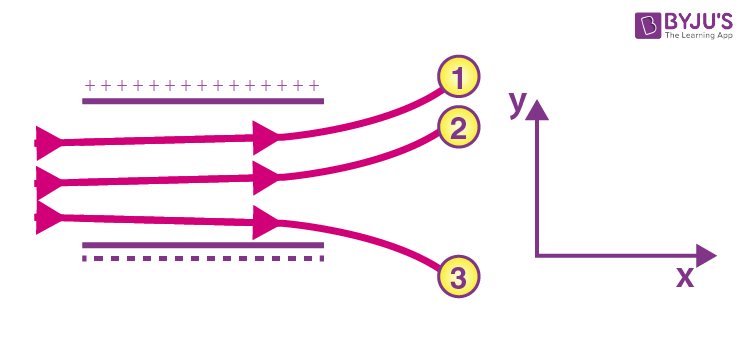
The figure below shows tracks of three charged particles in a uniform electrostatic field. Give the signs of the three charges. Which particle has the highest charge-to-mass ratio?

NCERT Solutions for Class 12 Physics Chapter 1 Electric Charges and Fields Question 14

Show solutionHide solution
Worked solution

Soln.:

We can see here that particles 1 and 2 are moving in the direction of the positive charge, and we know that the opposite charge attracts each other and the same charge repels each other. So, here we can say that the charged particles 1 and 2, which are going towards the charged particle, are negatively charged. And particle 3 is being attracted towards the negative charge. So, particle 3 will be the positively charged particle.

The EMF or charge-to-mass ratio is directly proportional to the amount of depletion or depletion at a given velocity. Here, we can see that particle 3 is depleting more as compared to the other two. Therefore, it will have a higher charge-to-mass ratio.


Q1.15Written answer

Consider a uniform electric field E = 3 × 10 3 î N/C.

(a) What is the flux of this field through a square of 10 cm on a side whose plane is parallel to the y z – plane?

(b) What is the flux through the same square if the normal to its plane makes a 60 ° angle with the x-axis?

Show solutionHide solution
Worked solution

Soln. :

(a) Electric field intensity, E = 3 × 10 3 î  N / C

Magnitude of electric field intensity, | E | = 3 × 10 3 N / C

Side of the square,  s = 10 cm = 0.1 m

Area of the square, A = s 2 = 0.01 m 2

The plane of the square is parallel to the y – z plane. Hence, the angle between the unit vector normal to the plane and electric field, θ = 0 °

Flux ( φ ) through the plane is given by the relation,

φ = | E |A cos θ

φ  = 3 × 10 3 × 0.01 × cos 0 °

φ = 30 N m 2 /C

(b) Plane makes an angle of 60 ° with the x-axis.

Hence, θ = 60°

Flux, φ = | E |A cos θ

Flux, φ  = 3 × 10 3 × 0.01 × cos 60°

Flux, φ  = 30 x 0.5

Flux, φ  = 15 N m 2 /C


Q1.16Written answer

What is the net flux of the uniform electric field of Exercise 1.15 through a cube of side 20 cm oriented so that its faces are parallel to the coordinate planes?

Show solutionHide solution
Worked solution

Soln.:

All the faces of a cube are parallel to the coordinate axes. Therefore, the number of field lines entering the cube is equal to the number of field lines piercing out of the cube. As a result, the net flux through the cube is zero.


Q1.17Written answer

Careful measurement of the electric field at the surface of a black box indicates that the net outward flux through the surface of the box is 8.0 × 10 3 N m 2 /C.

(a) What is the net charge inside the box?

(b) If the net outward flux through the surface of the box were zero, could you conclude that there were no charges inside the box? Why or Why not?

Show solutionHide solution
Worked solution

Soln.:

(a) Net outward flux through the surface of the box, φ = 8.0 × 10 3 N m 2 /C

For a body containing net charge q, flux is given by the relation,

\(\begin{array}{l}\phi = \frac{ q }{ \varepsilon _{ 0 }}\end{array} \)


\(\begin{array}{l}\varepsilon _{ 0 } = permitivity of free space\end{array} \)


\(\begin{array}{l}\varepsilon _{ 0 } = 8.854 \times 10 ^{ – 12 } N^{ – 1 } C ^{ 2 } m ^{ – 2 }\end{array} \)


\(\begin{array}{l}q = \varepsilon _{ 0 } \phi\end{array} \)

= 8.854 x 10 – 12 x 8.0 x 10 3 C = 7.08 x 10 – 8 C = 0.07

\(\begin{array}{l}\mu C\end{array} \)

Thus, the total charge inside the box is 0.07

\(\begin{array}{l}\mu C\end{array} \)

(b) No

Net flux piercing out through a body depends on the net charge contained in the body. If the net flux is zero, then it can be inferred that the net charge inside the body is zero. The body may have an equal amount of positive and negative charges.


Q1.18Written answer

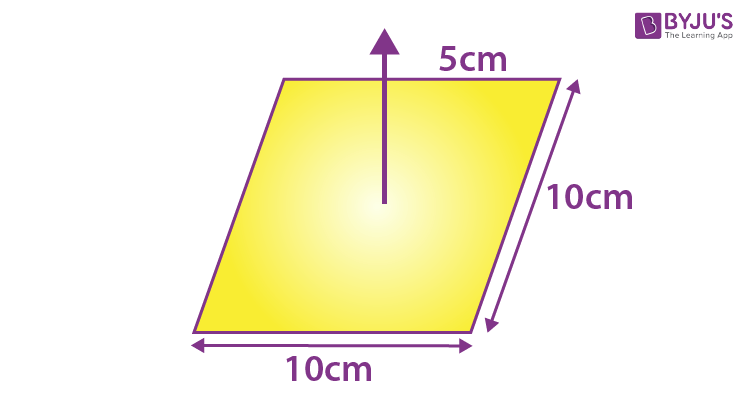
A point charge + 10 μC is at a distance 5 cm directly above the centre of a square of side 10 cm, as shown in Fig. 1.34. What is the magnitude of the electric flux through the square?

(Hint: Think of the square as one face of a cube with an edge 10 cm)

NCERT Solutions for Class 12 Physics Chapter 1 Electric Charges and Fields Question 18

Show solutionHide solution
Worked solution

 Soln.:

The square can be considered as one face of a cube of edge 10 cm with a centre where charge q is placed. According to Gauss’s theorem for a cube, total electric flux is through all its six faces.

\(\begin{array}{l}\phi _{ Total } = \frac{ q }{ \epsilon _{0}}\end{array} \)

Hence, electric flux through one face of the cube, i.e. through the square, is

\(\begin{array}{l}\phi = \frac{\phi _{ Total}}{6} = \frac{ 1 }{ 6 }. \frac{ q }{ \epsilon _{ 0 }}\end{array} \)

Here,

\(\begin{array}{l}{ \epsilon _{ 0 }}\end{array} \)
– 12– 12– 2
\(\begin{array}{l}q = 10 \mu C = 10 \times 10 ^{ – 6 } C\end{array} \)

Therefore,

\(\begin{array}{l}\phi = \frac{ 1 }{ 6 } . \frac{ 10 \times 10 ^{ – 6 }}{ 8.854 \times 10 ^{ – 12 }}\end{array} \)
\(\begin{array}{l}\phi\end{array} \)
52– 1

Therefore, electric flux through the square is 1.88 × 10 5 N m 2 C – 1


Q1.19Written answer

A point charge of 2.0 μC is at the centre of a cubic Gaussian surface 9.0 cm on edge. What is the net electric flux through the surface?

Show solutionHide solution
Worked solution

Soln.:

Net electric flux ( φ Net ) through the cubic surface is given by

\(\begin{array}{l}\phi _{ net } = \frac{ q }{ \epsilon _{ 0 }}\end{array} \)

Here,

\(\begin{array}{l}{ \epsilon _{ 0 }}\end{array} \)
– 12– 12– 2
\(\begin{array}{l}q = total \;charge\; contained \;in \;the\; cube\; given \;= \;2.0 \mu\; C \;=\; 2 \times 10 ^{ – 6 } C\end{array} \)

Therefore,

\(\begin{array}{l}\phi _{ net } = \frac{ 2 \times 10 ^{ – 6 }}{ 8.854 \times 10 ^{ – 12 }}\end{array} \)


\(\begin{array}{l}\phi _{ net } = 2.26 \times 10 ^{ 5 } N m ^{ 2 } C ^{ – 1}\end{array} \)

The total electric flux through the surface of the cube given is,

\(\begin{array}{l}\phi _{ net } = 2.26 \times 10 ^{ 5 } N m ^{ 2 } C ^{ – 1}\end{array} \)


Q1.20Written answer

A point charge causes an electric flux of – 1.0 × 10 3 N m 2 /C to pass through a spherical Gaussian surface of a 10.0 cm radius centred on the charge.

(a) If the radius of the Gaussian surface were doubled, how much flux would pass through the surface?

(b) What is the value of the point charge?

Show solutionHide solution
Worked solution

Soln. :

(a) Electric flux, Φ = – 1.0 × 10 3 N m 2 /C

The radius of the Gaussian surface, r = 10.0 cm

Electric flux penetrating through a surface depends on the net charge enclosed inside the body. It does not depend on the size of the body. If the radius of the Gaussian surface is doubled, then the flux passing through the surface remains the same, i.e., – 10 3 N m 2 /C.

(b) Electric flux is given by the relation

\(\begin{array}{l}\phi _{ Total } = \frac{ q }{ \epsilon _{0}}\end{array} \)

Here,

\(\begin{array}{l}{ \epsilon _{ 0 }}\end{array} \)
– 12– 12– 2

q = total charge contained enclosed by the spherical surface = φ ε 0

q = – 1.0 x 10 3 x 8.854 x 10 – 12

q = – 8.854 x 10 – 9 C

q = – 8.854 n C

Therefore, the value of the point charge is – 8.854 n C.