My Cart
Your Cart 0

    Your cart is empty.

  • Total (Amount) ₹0.00
NCERT · Class 12 · Physics

Chapter 1: Electric Charges and Fields

Practice each question, then open the answer or worked solution.

Questions

24 questions
Q1.1Written answer

What is the force between two small charged spheres having charges of 2 × 10⁻⁷C and 3 × 10⁻⁷ C placed 30 cm apart in the air?

Show solutionHide solution
Worked solution

Soln: Given,

The charge on the 1st sphere and 2nd sphere is q1 = 2 x 10⁻⁷ C and q2 = 3 x 10⁻⁷ C

The distance between two charges is given by r = 30cm = 0.3m

The electrostatic force between the spheres is given by the relation:

F =

\(\begin{array}{l} \frac{1}{4\pi \epsilon _{o}}.\frac{q_{1}q_{2}}{r^{2}} \end{array} \)

Here,

\(\begin{array}{l} \epsilon _{o} \end{array} \)
\(\begin{array}{l} \frac{1}{4\pi \epsilon _{o}} \end{array} \)
92-2

Force, F =

\(\begin{array}{l} \frac{9 \times 10^{9} \times 2 \times 10^{-7} \times 3 \times 10^{-7}}{(0.3)^{2}} \end{array} \)
‑3

The force between the charges will be repulsive as they have the same nature.


Q1.2Written answer

The electrostatic force on a small sphere of charge is 0.4 µC due to another small sphere of charge –0.8 µC in the air is 0.2 N.

(a) What is the distance between the two spheres?

(b) What is the force on the second sphere due to the first?

Show solutionHide solution
Worked solution

(a) Given,

The charge on the 1st sphere (q1 ) and the 2nd sphere (q2) is 0.4 µC or 0.4 × 10-6 C and -0.8 × 10-6C, respectively.

The electrostatic force on the 1st sphere is given by F = 0.2N.

The electrostatic force between the spheres is given by the relation:

F =

\(\begin{array}{l} \frac{1}{4\pi \epsilon _{o}}.\frac{q_{1}q_{2}}{r^{2}} \end{array} \)

Here,

\(\begin{array}{l} \epsilon _{o} \end{array} \)
\(\begin{array}{l} \frac{1}{4\pi \epsilon _{o}} \end{array} \)
92-2

r2 =

\(\begin{array}{l} \frac{1}{4\pi \epsilon _{o}}.\frac{q_{1}q_{2}}{F} \end{array} \)

=

\(\begin{array}{l} \frac{0.4 \times 10^{-6} \times 8 \times 10^{-6} \times 9 \times 10^{9}}{0.2} \end{array} \)
-4

r =

\(\begin{array}{l} \sqrt{144 \times 10^{-4}} \end{array} \)
-2

Therefore, the distance between the two spheres = 0.12 m

(b) Since the spheres have opposite charges, the force on the second sphere due to the first sphere will also be equal to 0.2N.


Q1.3Written answer

Check that the ratio ke2/G memp is dimensionless. Look up a Table of Physical Constants and determine the value of this ratio. What does the ratio signify?

Show solutionHide solution
Worked solution

Soln.:

The ratio to be determined is given as follows :

\(\begin{array}{l} \frac{ke^{2}}{Gm_{e}m_{p}} \end{array} \)

where G is the gravitational constant in N m2 kg-2

me and mp are the mass of electron and proton in kg.

e is the electric charge (unit – C)

k =

\(\begin{array}{l} \frac{1}{4\pi \epsilon _{o}} \end{array} \)
2-2

Therefore, the unit of the given ratio,

\(\begin{array}{l} \frac{ke^{2}}{Gm_{e}m_{p}} \end{array} \)
\(\begin{array}{l} \frac{[Nm^{2}C^{-2}][C^{-2}]}{[Nm^{2}kg^{-2}][kg][kg]} \end{array} \)
000

So, the given ratio is dimensionless.

Given,

e = 1.6 x 10⁻¹⁹ C

G = 6.67 x 10⁻¹¹ N m2 kg-2

me = 9.1 x 10⁻³¹ kg

mp = 1.66 x 10⁻²⁷ kg

Putting the above values in the given ratio, we get

\(\begin{array}{l} \frac{ke^{2}}{Gm_{e}m_{p}} \end{array} \)
\(\begin{array}{l} \frac{9 \times 10^{9} \times (1.6 \times 10^{-19})^{2}}{6.67 \times 10^{-11} \times 9.1 \times 10^{-31} \times 1.67 \times 10^{-27}} \end{array} \)
39

So, the above ratio is the ratio of the electric force to the gravitational force between a proton and an electron when the distance between them is constant.


Q1.4Written answer

(i) Explain the meaning of the statement ‘electric charge of a body is quantised’.
(ii) Why can one ignore the quantisation of electric charge when dealing with macroscopic, i.e. large-scale charges?

Show solutionHide solution
Worked solution

Soln.:

(i) The ‘electric charge of a body is quantized’ means that only integral (1, 2, …n) numbers of electrons can be transferred from one body to another.

Charges cannot get transferred in fractions. Hence, the total charge possessed by a body is only in integral multiples of electric charge.

(ii) In the case of large-scale or macroscopic charges, the charge which is used over there is comparatively too huge to the magnitude of the electric charge. Hence, on a macroscopic level, the quantisation of charge is of no use. Therefore, it is ignored, and the electric charge is considered to be continuous.

Q1.5Written answer

When a glass rod is rubbed with a silk cloth, charges appear on both. A similar phenomenon is observed with many other pairs of bodies. Explain how this observation is consistent with the law of conservation of charge.

Show solutionHide solution
Worked solution

Soln.:

When two bodies are rubbed against each other,  a charge is developed on both bodies. These charges are equal but opposite in nature. And this phenomenon of inducing a charge is known as charging by friction. The net charge on both of the bodies is 0, and the reason behind it is that an equal amount of charge repels it. When we rub a glass rod with a silk cloth, a charge with the opposite magnitude is generated over there. This phenomenon is in consistence with the law of conservation of energy. A similar phenomenon is observed with many other pairs of bodies.


Q1.6Written answer

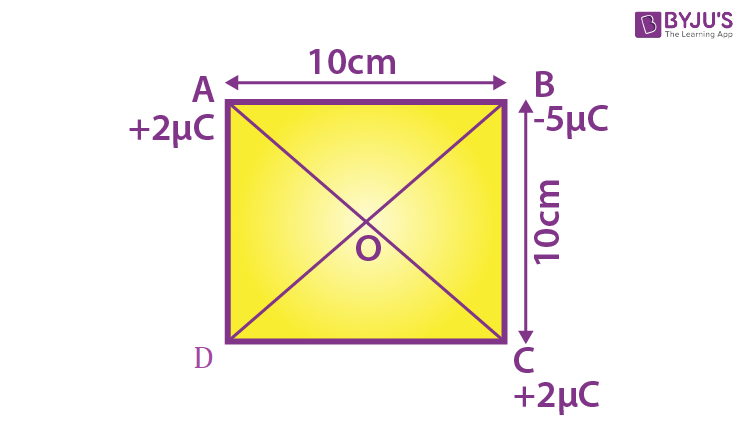
Four point charges

\(\begin{array}{l}q_{A} = 2 \mu C, \; q_{B} = -5 \mu C, \; q_{C} = 2 \mu C, \; and q_{D} = -5 \mu C\end{array} \)
are located at the corners of a square ABCD of side 10 cm. What is the force on a charge of 1 µC placed at the centre of the square?

Show solutionHide solution
Worked solution

Soln.:

NCERT Solutions for Class 12 Physics Chapter 1 Electric Charges and Fields Question 6

In the above picture, we have shown the square mentioned in the question. Its side is 10 cm, four charges are placed at the corners of the squares, and O is the centre of the square.

Where,

(Sides) AB = BC = CD = DA = 10 cm

(Diagonals) AC = BD =

\(\begin{array}{l}10 \sqrt{2} \; cm\end{array} \)

AO = OC = DO = OB =

\(\begin{array}{l}5 \sqrt{2} \; cm\end{array} \)

At the centre point ‘O’, we have placed a charge of

\(\begin{array}{l}1 \; \mu C\end{array} \)

In the above case, the repulsive force between corner A and centre O is the same in magnitude with the repulsive force by corner C to centre O, but these forces are opposite in direction. Hence, these forces will cancel each other, and from A and C, no forces are applied on the centre O. Similarly, from corner C, the attractive force is applying on to the centre O, and another force with the same magnitude is applying on the centre O; also these two forces are opposite in direction hence they are also opposing each other.

Therefore, the net force applying to the centre is zero because all the forces here are being cancelled by each other.


Q1.7Written answer

(i) An electrostatic field line is a continuous curve. That is, a field line cannot have sudden breaks. Why not?

(ii) Explain why two field lines never cross each other at any point.

Show solutionHide solution
Worked solution

Soln.:

(i) When a charge is placed in an electrostatic field, then it experiences a continuous force. Therefore, an electrostatic field line is a continuous curve. And a charge moves continuously and does not jump from one point to the other. So, the field line cannot have a sudden break.

(ii) If two field lines cross each other at any point, then at that point, the field intensity will start showing in two directions at the same point, which is impossible. Therefore, two field lines can never cross each other.

Q1.8Written answer

Two point charges qA = 3 µC and qB= –3 µC are located 20 cm apart in a vacuum.

(i) What is the electric field at the midpoint O of the line AB joining the two charges?

(ii) If a negative test charge of magnitude 1.5 × 10⁻⁹ C is placed at this point, what is the force experienced by the test charge?

Show solutionHide solution
Worked solution

Soln.:

(i) The figure given below shows the situation given to us, in which AB is a line and O is the midpoint.
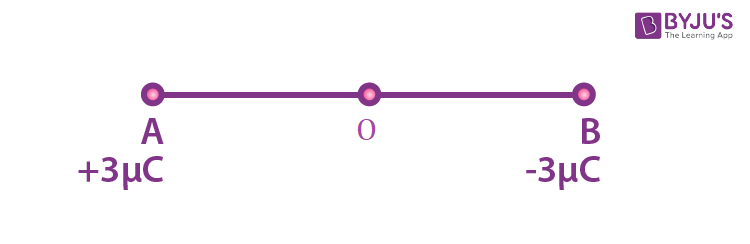
NCERT Solutions for Class 12 Physics Chapter 1 Electric Charges and Fields Question 8

Distance between two charges, AB = 20 cm

Therefore, AO = OB = 10 cm

The total electric field at the centre is (Point O) = E

Electric field at point O caused by

\(\begin{array}{l}+ 3 \; \mu C\end{array} \)
\(\begin{array}{l}E _{1} = \frac {1}{4 \pi \epsilon _{0}}. \frac{3 \times 10 ^{-6}}{\left ( OA \right )^{2}} = \frac {1}{4 \pi \epsilon _{0}}. \frac{3 \times 10 ^{-6}}{\left ( 10 \times 10 ^{-2} \right )^{2}} NC ^{-1}\end{array} \)

Where

\(\begin{array}{l}\epsilon _{0}\end{array} \)
\(\begin{array}{l}\frac{1}{ 4 \pi \epsilon _{0}} = 9 \times 10^{9} \; Nm^{2} C^{-2}\end{array} \)

Therefore,

The electric field at point O caused by

\(\begin{array}{l}- 3 \; \mu C\end{array} \)
\(\begin{array}{l}E _{2} = \left | \frac {1}{4 \pi \epsilon _{0}}. \frac{- 3 \times 10 ^{-6}}{\left ( OB \right )^{2}} \right | = \frac {1}{4 \pi \epsilon _{0}}. \frac{3 \times 10 ^{-6}}{\left ( 10 \times 10 ^{-2} \right )^{2}} NC ^{-1}\end{array} \)
\(\begin{array}{l}∴ E _{1} + E _{2} = 2 \times \frac {1}{4 \pi \epsilon _{0}}. \frac{3 \times 10 ^{-6}}{\left ( 10 \times 10 ^{-2} \right )^{2}} \; NC ^{-1}\end{array} \)
\(\begin{array}{l}E _{1} \; and \; E _{2}\end{array} \)


\(\begin{array}{l}∴ E = 2 \times 9 \times 10 ^{9} \times \frac{3 \times 10^{-6}}{\left (10 \times 10^{-2} \right ) ^{2}} \; NC ^{-1} \\ \\ = 5.4 \times 10^{6} NC ^{-1}\end{array} \)

Therefore, the electric field at midpoint O is  

\(\begin{array}{l}5.4 \times 10^{6} NC ^{-1}\end{array} \)


(ii) A test charge with a charge potential of

\(\begin{array}{l}1.5 \times 10 ^{-9} \; C\end{array} \)
\(\begin{array}{l}q = 1.5 \times 10 ^{-9} \; C\end{array} \)

Let the force experienced by the test charge be  F

Therefore, F = qE

=

\(\begin{array}{l}1.5 \times 10 ^{-9} \times 5.4 \times 10 ^{6} \\ \\ = 8.1 \times 10 ^{-3} \; N\end{array} \)

The force is directed along line OA because the negative test charge is attracted towards point A and is repelled by the charge placed at point B. As a result, the force experienced by the test charge is

\(\begin{array}{l}q = 8.1 \times 10 ^{-3} \; N\end{array} \)
 

Q1.9Written answer

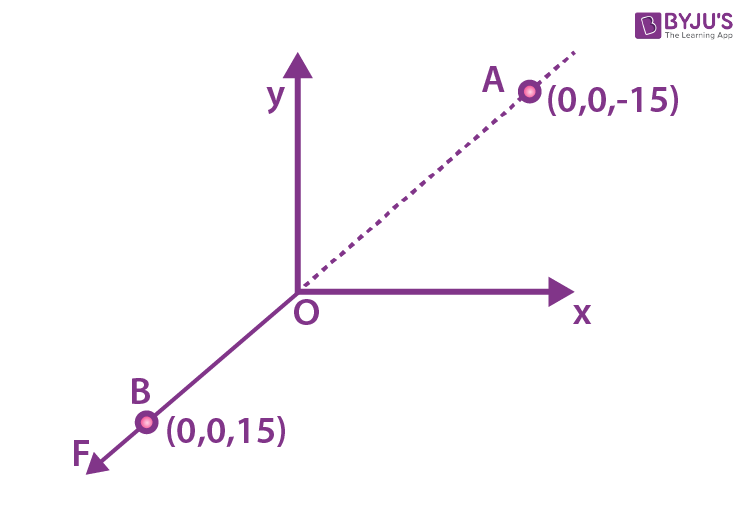
A system has two charges

\(\begin{array}{l}q _{A} = 2.5 \times 10 ^{-7} \;C \; and \; q _{B} = -2.5 \times 10 ^{-7}\;C\end{array} \)
located at points A: (0, 0, -15 cm) and B (0, 0, + 15 cm), respectively. What are the total charge and electric dipole moment of the system?

Show solutionHide solution
Worked solution

Soln.:

The charges which are located at the given points are shown in the coordinate system as:

NCERT Solutions for Class 12 Physics Chapter 1 Electric Charges and Fields Question 9

At point A, the total charge amount,

\(\begin{array}{l}q _{A} = 2.5 \times 10 ^{-7} \;C\end{array} \)

At point B, the total charge amount,

\(\begin{array}{l}q _{B} =  – 2.5 \times 10 ^{-7} \;C\end{array} \)

The total charge of the system is,

\(\begin{array}{l}q _{A} + q_{B}= 2.5 \times 10 ^{-7} \;C – 2.5 \times 10 ^{-7} \;C = 0\end{array} \)

Distance between two charges at points A and B,

d = 15 + 15 = 30 cm = 0.3 m

The electric dipole moment of the system is given by,

\(\begin{array}{l}p = q _{A} \times d = q_{B} \times d = 2.5 \times 10 ^{-7} \times 0.3\\ \\ = 7.5 \times 10 ^{-8} \; C\end{array} \)

Therefore, the electric dipole moment of the system is 

\(\begin{array}{l}7.5 \times 10 ^{-8} \; C\end{array} \)


Q1.10Written answer

An electric dipole with dipole moment

\(\begin{array}{l}4 \times 10^{-9}\;  C\, m\end{array} \)
is aligned at 30° with the direction of a uniform electric field of magnitude
\(\begin{array}{l}5 \times 10^{4}\; N C^{-1}\end{array} \)
. Calculate the magnitude of the torque acting on the dipole.

Show solutionHide solution
Worked solution

Soln.:

Electric dipole moment,

\(\begin{array}{l}p = 4 \times 10^{-9}\;C\,m\end{array} \)

Angle made by p with a uniform electric field,

\(\begin{array}{l}\theta = 30^{\circ}\end{array} \)

Electric field,

\(\begin{array}{l}E = 5 \times 10^{4}\; NC^{-1}\end{array} \)

The torque acting on the dipole is given by the relation,

\(\begin{array}{l}\tau = pE \sin \theta\\ \\ = 4 \times 10^{-9} \times 5 \times 10^{4} \times \sin 30 = 20 \times 10 ^{-5} \times \frac {1}{2} = 10^{-4}\;Nm\end{array} \)

Therefore, the magnitude of the torque acting on the dipole is

\(\begin{array}{l}10^{-4}\; Nm\end{array} \)