My Cart
Your Cart 0

    Your cart is empty.

  • Total (Amount) ₹0.00
NCERT · Class 12 · Physics

Chapter 1: Electric Charges and Fields

Practice each question, then open the answer or worked solution.

Questions

24 questions
Q1.21Written answer

A conducting sphere of radius 10 cm has an unknown charge. If the electric field 20 cm from the centre of the sphere is 1.5 × 10 3 N/C and points radially inward, what is the net charge on the sphere?

Show solutionHide solution
Worked solution

 Soln. :

Electric field intensity (E) at a distance (d) from the centre of a sphere containing net charge q is given by the relation,

\(\begin{array}{l}E = \frac{ 1 }{ 4\pi \epsilon _{ 0 }} . \frac{ q }{ d ^{ 2 }}\end{array} \)

Where, q = Net charge = 1.5 × 10 3 N/C

d = Distance from the centre = 20 cm = 0.2 m

ε 0 = Permittivity of free space and

\(\begin{array}{l}\frac{ 1 }{ 4 \pi \epsilon _{ 0 }} = 9 \times 10 ^{ 9 } N m ^{ 2 } C ^{ – 2 }\end{array} \)

Therefore, the net charge on the sphere is 6.67 n C.
 

Q1.22Written answer

A uniformly charged conducting sphere of 2.4 m diameter has a surface charge density of 80.0 μC /m 2

(a) Find the charge on the sphere.

(b) What is the total electric flux leaving the surface of the sphere?

Show solutionHide solution
Worked solution

Soln. :

(a) The diameter of the sphere, d = 2.4 m

The radius of the sphere, r = 1.2 m

Surface charge density, σ = 80.0 μC /m 2 = 80 × 10 – 6 C/m 2

The total charge on the surface of the sphere can be calculated as follows,

Q = Charge density × Surface area

= σ × 4πr 2

= 80 × 10 – 6 × 4 × 3.14 × ( 1.2 ) 2

= 1.447 × 10 – 3 C

Therefore, the charge on the sphere is 1.447 × 10 – 3 C.

(b) Total electric flux ( φ Total  ) leaving out the surface of a sphere containing net charge Q is given by the relation,

\(\begin{array}{l}\phi _{ Total } = \frac{ Q }{ \epsilon _{0}}\end{array} \)

Here,

\(\begin{array}{l}{ \epsilon _{ 0 }}\end{array} \)
– 12– 12– 2

Electric flux = 1.63 x 10 8 N C – 1 m 2

Therefore, the total electric flux leaving the surface of the sphere is 1.63 × 10 8 N C – 1 m 2


Q1.23Written answer

An infinite line charge produces a field of 9 × 10 4 N/C at a distance of 2 cm. Calculate the linear charge density.

Show solutionHide solution
Worked solution

Soln. :

The electric field produced by the infinite line charges at a distance d having linear charge density λ is given by the relation,

\(\begin{array}{l}E = \frac{ \lambda }{ 2 \pi \epsilon _{ 0 } d }\end{array} \)
\(\begin{array}{l}\lambda = 2 \pi \epsilon _{ 0 } d E\end{array} \)

Here,

d = 2 cm = 0.02 m

E = 9 x 10 4 N / C

ε 0 = Permittivity of free space and

\(\begin{array}{l}\frac{ 1 }{ 4 \pi \epsilon _{ 0 }} = 9 \times 10 ^{ 9 } N m ^{ 2 } C ^{ – 2 }\end{array} \)
\(\begin{array}{l}\\ \lambda = \frac{0.02\times 9\times 10^{4} }{2\times 9\times 10^{9} } \\ \lambda = 10 \mu C/m\end{array} \)
Q1.24Written answer

Two large, thin metal plates are parallel and close to each other. On their inner faces, the plates have surface charge densities of opposite signs and magnitude 17.0 × 10 – 22 C /m 2

What is E:

 (a) In the outer region of the first plate?

(b) In the outer region of the second plate and (c) between the plates?

Show solutionHide solution
Worked solution

Soln. :

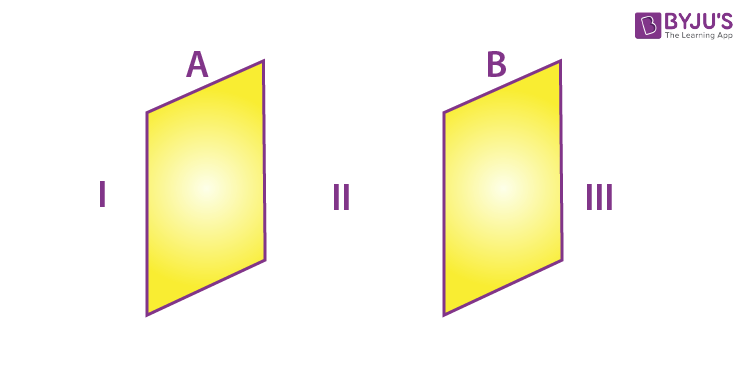
The situation given in the question can be depicted in the following figure.

NCERT Solutions for Class 12 Physics Chapter 1 Electric Charges and Fields Question 24

Parallel plates A and B are placed close to each other, as shown in the figure. The region between plates A and B is labelled as II, the outer region of plate A is labelled as I, and the outer region of plate B is labelled as III.

(a) The charge density of plate A can be calculated as,

σ = 17.0 × 10 – 22 C/m 2

(b) Similarly, the charge density of plate B can be calculated as,

σ = – 17.0 × 10 – 22 C/m 2

(c) In regions I and III, electric field E is zero. This is because the charge is not enclosed by the respective plates.

Electric field E in region II is given by the relation,

\(\begin{array}{l}E = \frac{\sigma }{ \epsilon _{ 0 }}\end{array} \)

here,

ε 0 = Permittivity of free space = 8.854 × 10 – 12 N – 1C 2 m – 2

\(\begin{array}{l}E = \frac{ 17.0 \times 10 ^{ – 22 }}{ 8.854 \times 10 ^{ – 12 }}\end{array} \)
– 10