My Cart
Your Cart 0

    Your cart is empty.

  • Total (Amount) ₹0.00
NCERT · Class 12 · Economics

Chapter 3: Production and Costs

Practice each question, then open the answer or worked solution.

Questions

30 questions
Q21Written answer

What do the long run marginal cost and the average cost curves look like?
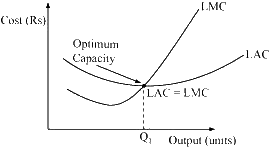
NCERT Microeconomics Solutions for Class 12 Chapter 3 -3

Show solutionHide solution
Worked solution

The Long Run Marginal Cost (LMC) and Long Run Average Cost (LAC) are U-shaped, and the reason behind this is the law of returns to scale. As per this law, a company or a firm undergoes three stages in production which are IRS (Increasing Return to Scale), CRS (Constant Return to Scale) and DRS (Diminishing Return to Scale). The curve becomes U-Shaped due to the falling of LAC due to economies of scale (IRS); it attains constant output at the CRS level, and finally, if the firm experiences diseconomies of scale and if it is continuing production after this stage, it will see a rise or DRS.
Q22Written answer

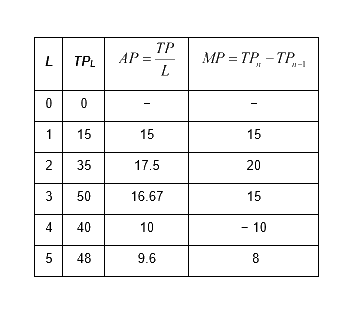
The following table gives the total product schedule of labour. Find the corresponding average product and marginal product schedules of labour.

L TPL
0 0
1 15
2 35
3 50
4 40
5 48

The solution to this question is as follows:

NCERT Microeconomics Solutions for Class 12 Chapter 3 - 4

Show solutionHide solution
Worked solution

Solution coming soon.

Q23Written answer

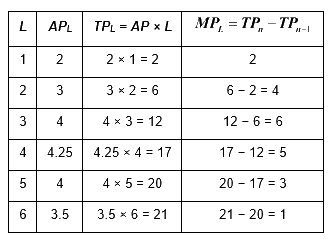
The following table gives the average product schedule of labour. Find the total product and marginal product schedules. It is given that the total product is zero at zero level of labour employment.

L APL
1 2
2 3
3 4
4 4.25
5 4
6 3.5
Show solutionHide solution
Worked solution

The solution to this question is as follows:

NCERT Microeconomics Solutions for Class 12 Chapter 3 - 5

Q24Written answer

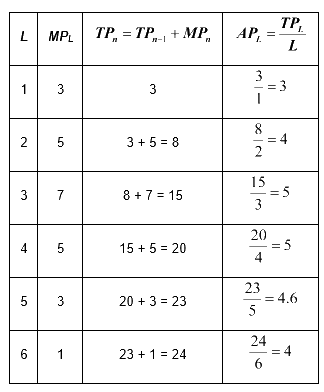
The following table gives the marginal product schedule of labour. It is also given that the total product of labour is zero at zero level of employment. Calculate the total and average product schedules of labour.

L MPL
1 3
2 5
3 7
4 5
5 3
6 1
Show solutionHide solution
Worked solution

The solution to this question is as follows:

NCERT Microeconomics Solutions for Class 12 Chapter 3 - 6

Q25Written answer

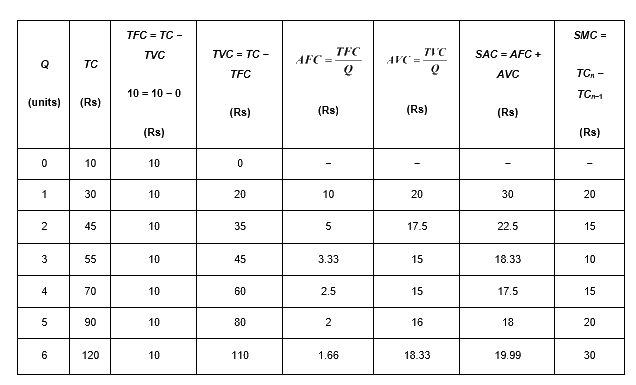
The following table shows the total cost schedule of a firm. What is the total fixed cost schedule of this firm?

Calculate the TVC, AFC, AVC, SAC and SMC schedules of the firm.

L TPL
0 10
1 30
2 45
3 55
4 70
5 90
6 120
Show solutionHide solution
Worked solution

The solution to this question can be as follows:

NCERT Microeconomics Solutions for Class 12 Chapter 3 - 7

Q26Written answer

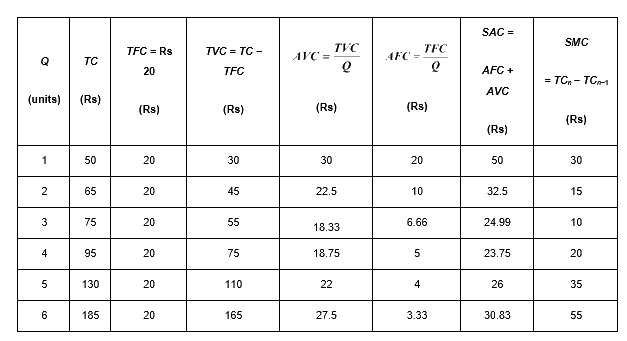
The following table gives the total cost schedule of a firm. It is also given that the average fixed cost at 4 units of output is Rs 5/-. Find the TVC, TFC, AVC, AFC, SAC and SMC schedules of the firm for the corresponding values of output.

L TPL
1 50
2 65
3 75
4 95
5 130
6 185
Show solutionHide solution
Worked solution

The solution to this question is as follows:

NCERT Microeconomics Solutions for Class 12 Chapter 3- 8

Q27Written answer

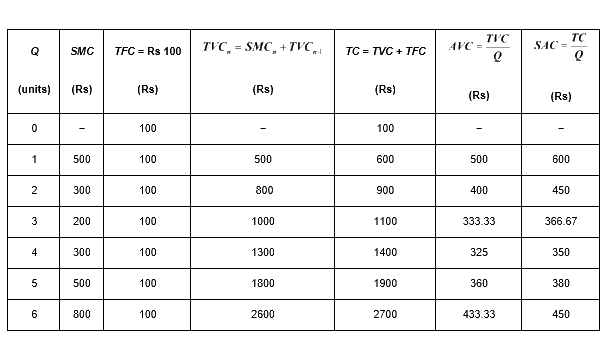
A firm’s SMC schedule is shown in the following table. The total fixed cost of the firm is Rs 100. Find the TVC, TC, AVC and SAC schedules of the firm.

L TPL
0 −
1 500
2 300
3 200
4 300
5 500
6 800
Show solutionHide solution
Worked solution

The solution to this question is as follows:

NCERT Microeconomics Solutions for Class 12 Chapter 3 - 9

Q28Written answer

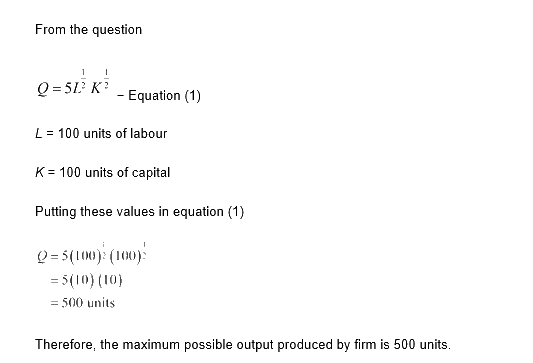
Let the production function of a firm beNCERT Microeconomics Solutions for Class 12 Chapter 3 - 10.

Find out the maximum possible output that the firm can produce with 100 units of L and 100 units of K.

Show solutionHide solution
Worked solution

The solution is as follows:

NCERT Microeconomics Solutions for Class 12 Chapter 3 -11

Q29Written answer

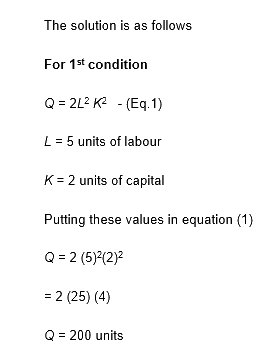
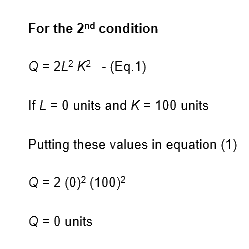
Let the production function of a firm be Q = 2L2 K2.

Find out the maximum possible output that the firm can produce with 5 units of L and 2 units of K. What is the maximum possible output that the firm can produce with zero unit of L and 10 units of K?

NCERT Microeconomics Solutions for Class 12 Chapter 3 - 12

NCERT Microeconomics Solutions for Class 12 Chapter 3 - 13

Show solutionHide solution
Worked solution

Solution coming soon.

Q30Written answer

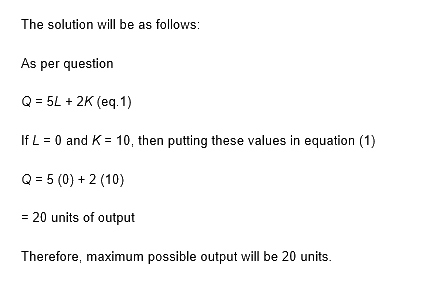
Find out the maximum possible output for a firm with zero unit of L and 10 units of K when its production function is Q = 5L = 2K.

NCERT Microeconomics Solutions for Class 12 Chapter 3 - 14

Show solutionHide solution
Worked solution

NCERT Solution for Class 12 Economics Chapter 3 – Production and Costs gives a summary of the related concepts. This can be termed the ‘Theory of production – Cost Theory’ as well. In the Cost Theory, there are 2 types of costs analogous to production: Fixed Cost and Variable Cost.

  • Fixed Cost – Fixed costs are costs that do not differ with different degrees of production, and fixed costs survive even if the output is zero.
  • Variable Cost – Variable Costs are costs that differ with the degree of output.

Conclusion