My Cart
Your Cart 0

    Your cart is empty.

  • Total (Amount) ₹0.00
NCERT · Class 12 · Economics

Chapter 3: Production and Costs

Practice each question, then open the answer or worked solution.

Questions

30 questions
Q11Written answer

When does a production function satisfy decreasing returns to scale? 

Show solutionHide solution
Worked solution

Decreasing returns to scale is when the change in the factors of production results in a decrease in the changes in the total output. This is an indication that the changes have proved to be detrimental to productivity instead of increasing productivity
Q12Written answer

Briefly explain the concept of the cost function. 

Show solutionHide solution
Worked solution

The relationship between the cost of production and the total output is known as the cost function.

Q13Written answer

What are the total fixed cost, total variable cost and total cost of a firm? How are they related? 

Show solutionHide solution
Worked solution

A fixed cost is a cost that does not change in relation to the total number of goods and services produced by the company. On the other hand, a variable cost is a cost that changes in relation to the total number of goods and services produced by the company.

Total Fixed Cost: The cost incurred by a company in acquiring fixed production factors like buildings, cost of machinery and depreciation.

Total Variable Cost: Cost incurred by a company on variable production factors like wages and fuel charges.

Total Cost: The total cost of the firm is the total fixed cost and total variable cost put together. It is the actual cost incurred by the company when producing a given amount of output.

Q14Written answer

What are the average fixed cost, average variable cost and average cost of a firm? How are they related?

Show solutionHide solution
Worked solution

The average fixed cost is the fixed cost per unit of output produced.

The average variable cost is the variable cost per unit of output produced.

The average cost of a firm is the average fixed cost and average variable cost put together.

Q15Written answer

Can there be some fixed cost in the long run? If not, why? 

Show solutionHide solution
Worked solution

The fixed cost cannot be set in the long run. Fixed costs can only be set for the short run. Since all factors of production and inputs can change in the long run, a fixed cost cannot be determined for the output.

Q16Written answer

What does the average fixed cost curve look like? Why does it look so?

Show solutionHide solution
Worked solution

The average fixed cost resembles a rectangular hyperbola. This is because of the constantly increasing output and the fixed cost, which remains the same at every point.

Q17Written answer

What do the short run marginal cost, average variable cost and short run average cost curves look like?

Show solutionHide solution
Worked solution

The curves of the short run marginal cost, the average variable cost and the short run average cost are all U-shaped.

Q18Written answer

Why does the SMC curve cut the AVC curve at the minimum point of the AVC curve?

Show solutionHide solution
Worked solution

It can be explained by the following points:

1. When AVC (Average Variable Cost) falls, SMC (Short Marginal Curve) is lesser than AVC.

2. When AVC rises, SMC becomes more than AVC

3. When AVC is constant and is minimum, SMC is equal to AVC.

Therefore, the SMC curve cuts the AVC curve at the minimum point.

Q19Written answer

At which point does the SMC curve intersect SAC curve? Give reasons in support of your answer.

Show solutionHide solution
Worked solution

This can be explained with the following points:

1. When SAC falls, SMC is below the SAC.

2. When SAC rises, SMC is above SAC.

Therefore, the SMC curve cuts the SAC curve at its minimum point because at that point, SMC = SAC

Q20Written answer

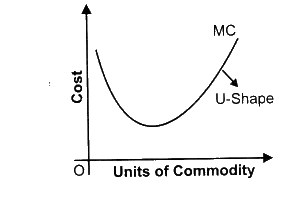
Why is the short run marginal cost curve ‘U’-shaped?

NCERT Microeconomics Solutions for Class 12 Chapter 3 - 2

Show solutionHide solution
Worked solution

The Marginal Curve (MC) is U-shaped as per the Law of Variable Proportion.

This can be explained as follows:

1. Shape of the Marginal Cost Curve (MC) depends on the Total Variable Cost (TVC).

2. As TVC increases at a diminishing rate, the total product increases at an increasing rate, which creates a gap in the curve leading to the fall of MC.

3. Now, as TVC increases at an increasing rate and the total product increases at a diminishing rate, making the marginal cost increase and rise upward.

4. The increasing returns and then constant returns, along with the rise in decreasing returns, make it appear like the letter U from the English alphabet; hence, it is named so.