My Cart
Your Cart 0

    Your cart is empty.

  • Total (Amount) ₹0.00
NCERT · Class 12 · Economics

Chapter 3: Production and Costs

Practice each question, then open the answer or worked solution.

Questions

30 questions
Q1Written answer

Explain the concept of a production function. 

Show solutionHide solution
Worked solution

The production function is defined as the relationship between physical inputs used in production and the corresponding physical output. This shows how many units of inputs produce the maximum output. It can be represented as

Qx = f (L, K)

Where Qx = Total Physical Output

L= Total physical labour employed

K= Total capital employed
Q2Written answer

What is the total product of input? 

Show solutionHide solution
Worked solution

It refers to the total volume of goods and services that are produced in a firm with the provided input during a specific time period.

Q3Written answer

What is the average product of input? 

Show solutionHide solution
Worked solution

The Average Product of an input is the Total Product divided by the total amount of the variable input used to produce it.

Q4Written answer

What is the marginal product of input? 

Show solutionHide solution
Worked solution

The marginal product of an input is the improvement in output that is achieved by using an additional unit of input.

Q5Written answer

Explain the relationship between the marginal products and the total product of an input.

Show solutionHide solution
Worked solution

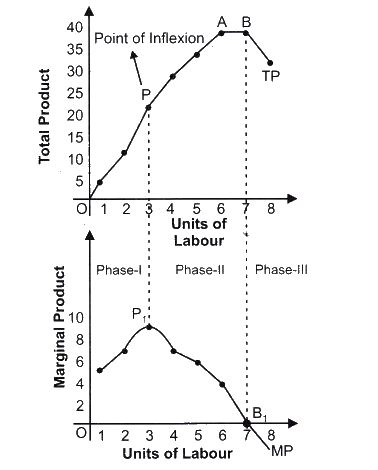
 This can be explained with the help of the law of variable proportions. As per this law, when only one variable factor input is allowed to increase with all other inputs kept constant, the following changes are observed:

1. With an increase in Marginal Product (MP), there is a corresponding increase in Total Product (TP). A convex curve is obtained with the effect till the MP curve is at its maximum.

2. When MP declines but is positive, then TP increases with a decline in rate, giving the total product a concave shape.

3. When MP is at zero, the TP is at maximum

4. When MP becomes negative, the TP falls.

NCERT Microeconomics Solutions for Class 12 Chapter 3 - 1

Q6Written answer

Explain the concepts of the short run and the long run. 

Show solutionHide solution
Worked solution

The long run is a period of time in which the producer can change all the variables involved in the production, like building, machine etc. The short-run is a period of time in which the producer can only make limited changes in the production process. It is the period in which at least one factor of production is fixed while others can be changed or improved. The examples of short run can be farmer having a fixed piece of land.

Q7Written answer

What is the law of diminishing marginal product? 

Show solutionHide solution
Worked solution

According to the law of diminishing marginal product, there will initially be an increase in the total amount of production when one of the factors is increased while keeping the others constant.

Eventually, this strategy would not keep increasing production. For example, think of a factory where the machinery is a factor of production. Increasing the number of machines would initially increase production. But if the company keeps increasing the number of machines without correspondingly hiring new workers to operate them, the productivity will decrease.

Q8Written answer

What is the law of variable proportions? 

Show solutionHide solution
Worked solution

The Law of Variable Proportions is also called the Law of Diminishing Returns.

According to the law, when one of the inputs involved in the production is changed while keeping the other inputs constant, there will be a point after which the output per unit of that input will start to decrease. This law is theorised under certain assumptions.

i) The technology should remain the same.

ii) The possibility that the factors of production can be changed within a short period of time.

iii) Some inputs should be kept constant

Q9Written answer

When does a production function satisfy constant returns to scale? 

Show solutionHide solution
Worked solution

Constant returns to scale is achieved when the change in the factors of production matches with the changes in the total output. This means that the efforts of the producer to improve production yield appropriate and equivalent returns.

Q10Written answer

When does a production function satisfy increasing returns to scale? 

Show solutionHide solution
Worked solution

Increasing returns to scale is achieved when the change in the factors of production yields more than the proportionate changes in the total output. This means that the company has improved its productivity.