My Cart
Your Cart 0

    Your cart is empty.

  • Total (Amount) ₹0.00
NCERT · Class 12 · Chemistry

Chapter 8: Aldehydes, Ketones, and Carboxylic Acids

Practice each question, then open the answer or worked solution.

Questions

20 questions
Q12.11Written answer

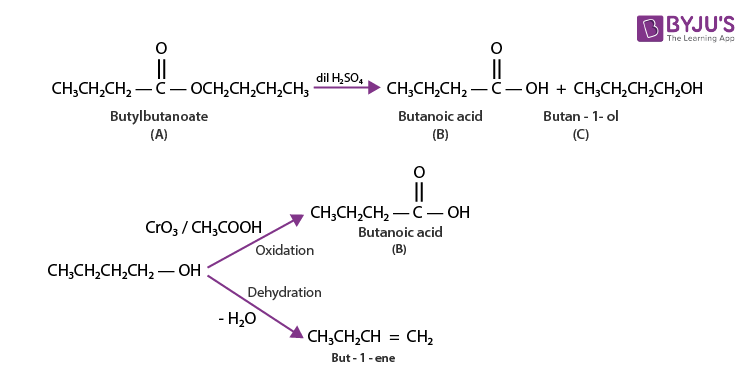
NCERT Solutions for Class 12 Chemistry Chapter 12 Aldehydes, Ketones and Carboxylic Acids Question 10 image 2
An organic compound (A) (molecular formula C8H16O2) was hydrolysed with
dilute sulphuric acid to give carboxylic acid (B) and alcohol (C). Oxidation of (C) with chromic acid produced (B). (C) on dehydration gives but-1-ene. Write equations for the reactions involved.

Show solutionHide solution
Worked solution

A is an organic compound with the molecular formula C8H16O2. This gives carboxylic acid (B) and alcohol (C) on hydrolysis with dilute sulphuric acid. Thus, compound A must be an ester.

Further, the oxidation of alcohol (C) with chromic acid gives acid B. Thus, B and C must contain an equal number of carbon atoms.

A total of 8 carbon atoms are present in compound A, and each of B and C contain 4 carbon atoms.

Again, alcohol C gives but-1-ene on dehydration. Therefore, C is of straight-chain, and hence, it is butan-1-ol.

On oxidation, Butan-1-ol gives butanoic acid. Hence, acid B is butanoic acid.

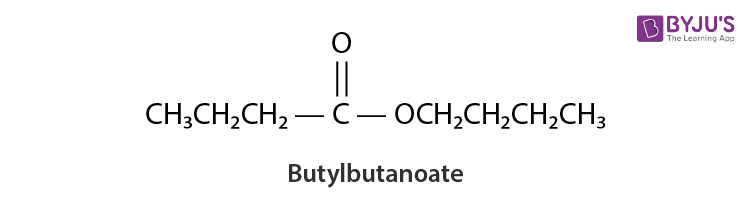
Hence, the ester with the molecular formula C8H16O2 is butylbutanoate.

NCERT Solutions for Class 12 Chemistry Chapter 12 Aldehydes, Ketones and Carboxylic Acids Question 11 image 1
All the given reactions can be explained by the following equations.

Q12.12Written answer

NCERT Solutions for Class 12 Chemistry Chapter 12 Aldehydes, Ketones and Carboxylic Acids Question 11 image 2
Arrange the following compounds in increasing order of their property as indicated:

(i) Acetaldehyde, Acetone, Di-tert-butyl ketone, Methyl tert-butyl ketone (reactivity towards HCN)

(ii) CH3CH2CH(Br)COOH, CH3CH(Br)CH2COOH, (CH3)2CHCOOH, CH3CH2CH2COOH (acid strength)

(iii) Benzoic acid, 4-Nitrobenzoic acid, 3,4-Dinitrobenzoic acid, 4-Methoxybenzoic acid (acid strength)

Show solutionHide solution
Worked solution

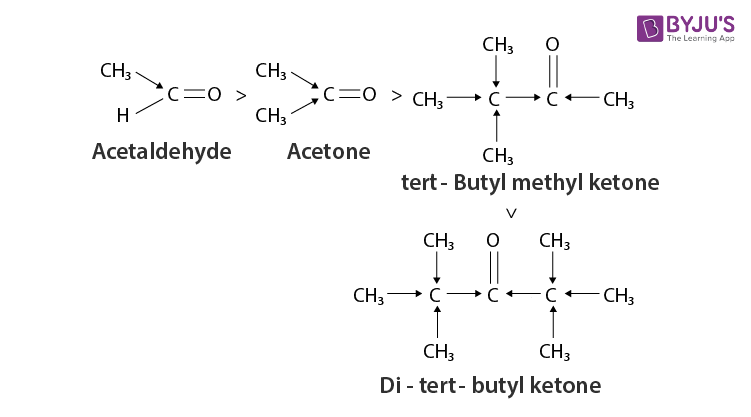
(i) When HCN reacts with a compound, the attacking species is a nucleophile, CN–. Therefore, the reactivity with HCN decreases when the negative charge on the compound increases. The +I effect increases in the given compound. Steric hindrance also increases in the same.

Hence, the given compounds can be arranged according to their increasing reactivities toward HCN as follows:

NCERT Solutions for Class 12 Chemistry Chapter 12 Aldehydes, Ketones and Carboxylic Acids Question 12 image 1
Di-tert-butyl ketone < Methyl tert-butyl ketone < Acetone < Acetaldehyde

(ii) After losing a proton, carboxylic acids gain a negative charge, as shown below:

NCERT Solutions for Class 12 Chemistry Chapter 12 Aldehydes, Ketones and Carboxylic Acids Question 12 image 2
Now, the stability of the carboxyl ion increases by any group that helps to stabilise the negative charge, which will increase the strength of the acid. Thus, groups having the −I effect will increase the strength of the acids and groups having the +I effect will decrease the strength of the acids. In the given compounds, Br-group has a −I effect, and the −CH3 group has a +I effect. Thus, acids containing Br− are stronger.

Now, the +I effect of the isopropyl group is more than that of the n-propyl group. Hence, CH3CH2CH2COOH is a stronger acid than (CH3)2CHCOOH.

Also, as the distance increases, the +I effect grows weaker. Hence, CH3CH2CH(Br)COOH is a stronger acid than CH3CH(Br)CH2COOH.

Hence, the strengths of the given acids increase as:

(CH3)2CHCOOH < CH3CH2CH2COOH < CH3CH(Br)CH2COOH < CH3CH2CH(Br)COOH

(iii) As we have seen in the previous case, the strength of acids is decreased by the electron-donating group, while the strength of acids increases by electron-withdrawing groups. As the methoxy group is an electron-donating group, benzoic acid is a stronger acid than 4-methoxybenzoic acid. The Nitro group is an electron-withdrawing group and will increase the strength of acids. As 3,4-dinitrobenzoic acid contains two nitro groups, it is a slightly stronger acid than 4-nitrobenzoic acid. Hence, the strengths of the given acids increase as:

4-Methoxybenzoic acid < Benzoic acid < 4-Nitrobenzoic acid < 3, 4-Dinitrobenzoic acid

Q12.13Written answer

Give simple chemical tests to distinguish between the following pairs of compounds.
(i) Propanal and propanone

(ii) Acetophenone and benzophenone

(iii) Phenol and benzoic acid

(iv) Benzoic acid and ethyl benzoate

(v) Pentan-2-one and pentan-3-one

(vi) Benzaldehyde and acetophenone

(vii) Ethanal and propanal

Show solutionHide solution
Worked solution

(i) Propanal and propanone can be distinguished by the following tests.

(a) Tollen’s test

Tollen’s reagent is reduced by propanal as it is an aldehyde. But, Tollen’s reagent is not reduced as propanone is a ketone.

NCERT Solutions for Class 12 Chemistry Chapter 12 Aldehydes, Ketones and Carboxylic Acids Question 13ia
(b) Fehling’s test

Aldehydes respond to Fehling’s test, but ketones do not.

Propanone being a ketone, does not reduce Fehling’s solution to a red-brown precipitate of Cu2O, but Propanal being an aldehyde, does the reaction.

NCERT Solutions for Class 12 Chemistry Chapter 12 Aldehydes, Ketones and Carboxylic Acids Question 13ib
(c) Iodoform test:

At least one methyl group should be present in aldehydes and ketones linked to the carbonyl carbon atom to respond to the iodoform test. They are oxidised by sodium hypoiodite (NaOI) to give iodoforms. Propanone being a methyl ketone, responds to this test, but propanal does not.

NCERT Solutions for Class 12 Chemistry Chapter 12 Aldehydes, Ketones and Carboxylic Acids Question 13ic
(ii) Acetophenone and Benzophenone can be distinguished using the iodoform test.

Iodoform test:

yellow ppt. of iodoform is produced when methyl ketones are oxidised by sodium hypoiodite.

Acetophenone being a methyl ketone, responds to this test, but benzophenone does not.
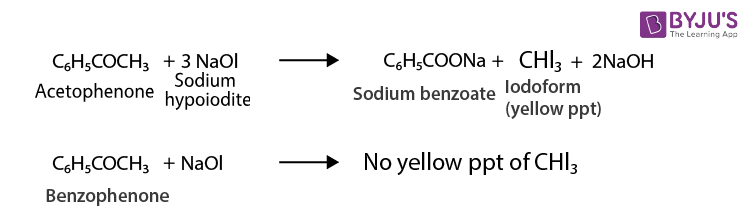
NCERT Solutions for Class 12 Chemistry Chapter 12 Aldehydes, Ketones and Carboxylic Acids Question 13ii
(iii) Phenol and benzoic acid can be distinguished by the ferric chloride test.

Ferric chloride test:

Phenol reacts with neutral FeCl3 to form an iron-phenol complex giving violet colouration.
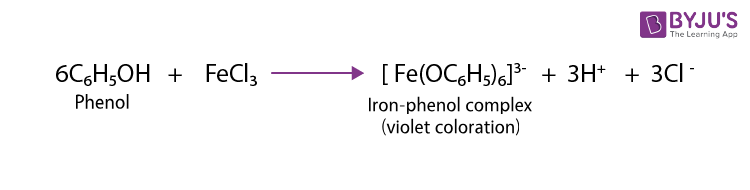
NCERT Solutions for Class 12 Chemistry Chapter 12 Aldehydes, Ketones and Carboxylic Acids Question 13iiia
A buff-coloured ppt of ferric benzoate is produced when benzoic acid reacts with neutral FeCl3.

NCERT Solutions for Class 12 Chemistry Chapter 12 Aldehydes, Ketones and Carboxylic Acids Question 13iiib
(iv) Benzoic acid and ethyl benzoate can be distinguished by the sodium bicarbonate test.

Sodium bicarbonate test:

Brisk effervescence is produced when acids react with NaHCO3 due to the evolution of CO2 gas.

Benzoic acid, being an acid, responds to this test, but ethyl benzoate does not.
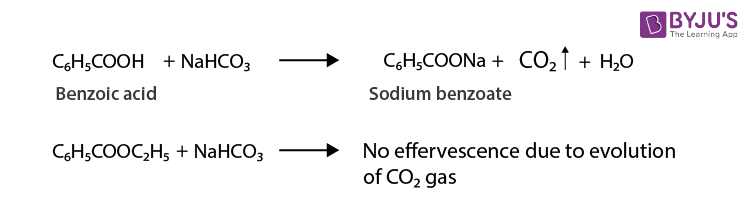
NCERT Solutions for Class 12 Chemistry Chapter 12 Aldehydes, Ketones and Carboxylic Acids Question 13iv
(v) Pentan-2-one and pentan-3-one can be distinguished by the iodoform test.

Iodoform test:

Pentan-2-one responds to this test as it is a methyl ketone. But pentan-3-one, not being a methyl ketone, does not respond to this test.
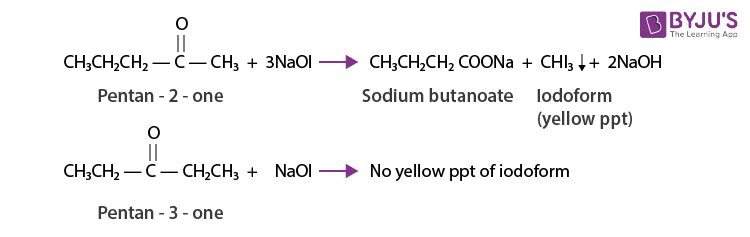
NCERT Solutions for Class 12 Chemistry Chapter 12 Aldehydes, Ketones and Carboxylic Acids Question 13v
(vi) Benzaldehyde and acetophenone can be distinguished by the following tests.

(a) Tollen’s Test

Aldehydes respond to Tollen’s test. The red-brown precipitate of Cu2O is produced by Benzaldehyde reduces Tollen’s reagent, but acetophenone being a ketone, does not.

NCERT Solutions for Class 12 Chemistry Chapter 12 Aldehydes, Ketones and Carboxylic Acids Question 13via
(b) Iodoform test

A yellow precipitate of iodoform is given by acetophenone (a methyl ketone) when it undergoes oxidation by sodium hypoiodite (NaOI). But benzaldehyde does not respond to this test.

NCERT Solutions for Class 12 Chemistry Chapter 12 Aldehydes, Ketones and Carboxylic Acids Question 13vib
(vii) Ethanal and propanal can be distinguished by the iodoform test.

Iodoform test

Carbonyl carbon atom having at least one methyl group in aldehydes and ketones responds to the iodoform test. Also, Ethanal having one methyl group linked to the carbonyl carbon atom, responds to this test. But, there are no methyl groups linked to the carbonyl carbon atom in propanal, and thus, it does not respond to this state.
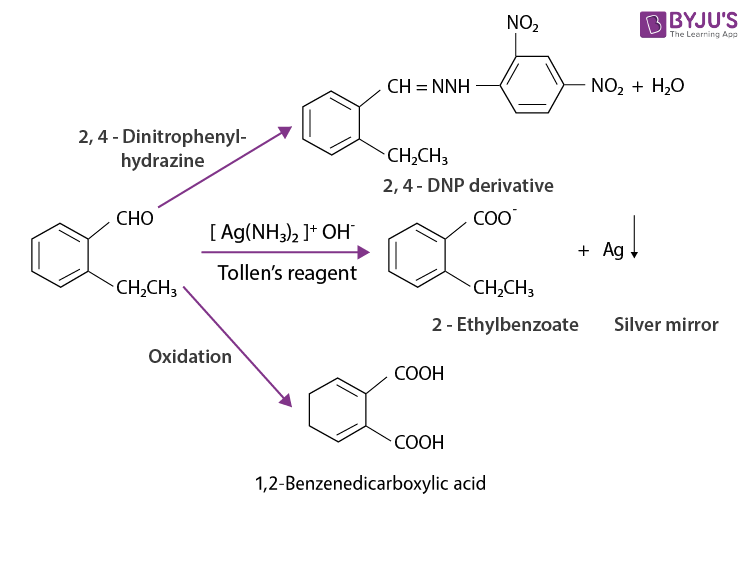
Q12.14Written answer

NCERT Solutions for Class 12 Chemistry Chapter 12 Aldehydes, Ketones and Carboxylic Acids Question 13vii
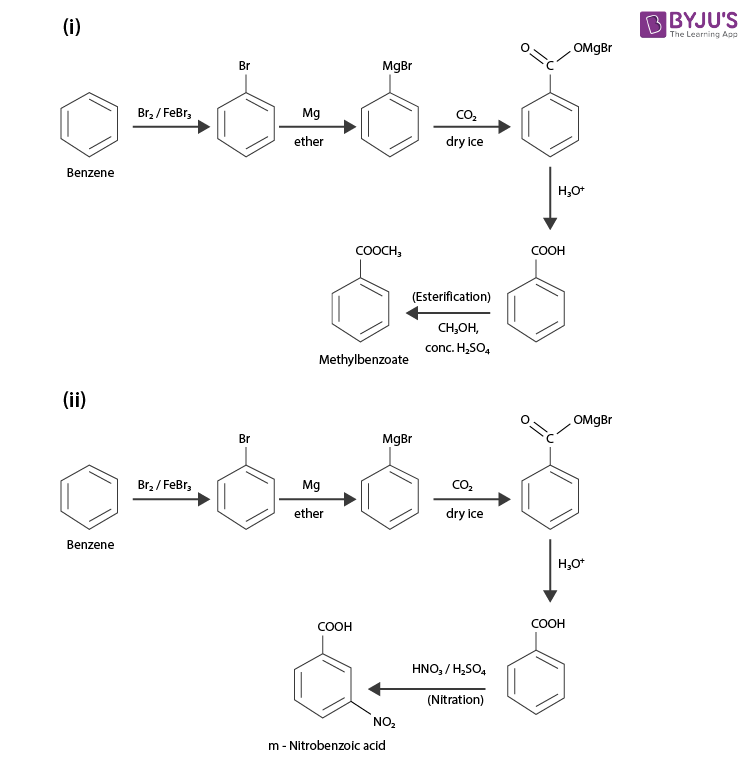
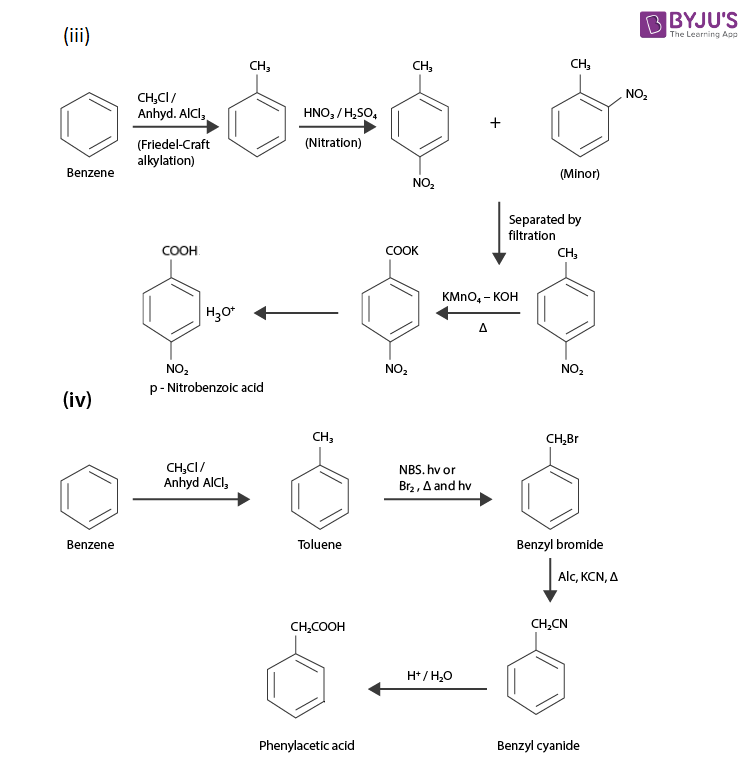
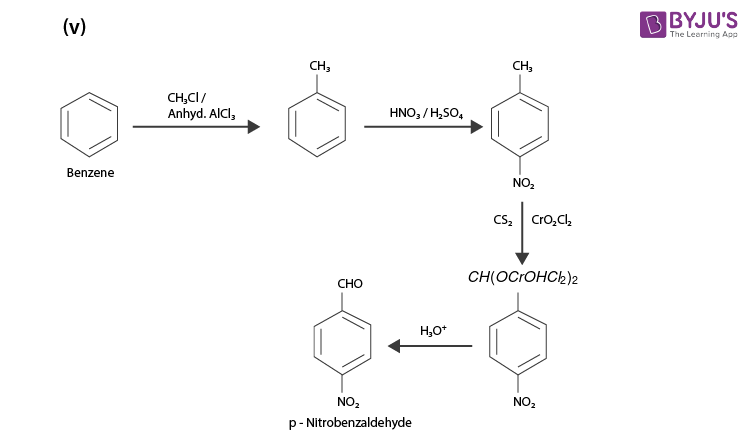
How will you prepare the following compounds from benzene? You may use
any inorganic reagent and any organic reagent having not more than one carbon atom
(i) Methyl benzoate

 (ii) m-Nitrobenzoic acid

(iii) p-Nitrobenzoic acid

 (iv) Phenylacetic acid

(v) p-Nitrobenzaldehyde

Show solutionHide solution
Worked solution

Solution coming soon.

Q12.15Written answer

NCERT Solutions for Class 12 Chemistry Chapter 12 Aldehydes, Ketones and Carboxylic Acids Question 14 image 1
NCERT Solutions for Class 12 Chemistry Chapter 12 Aldehydes, Ketones and Carboxylic Acids Question 14 image 2
NCERT Solutions for Class 12 Chemistry Chapter 12 Aldehydes, Ketones and Carboxylic Acids Question 14 image 3
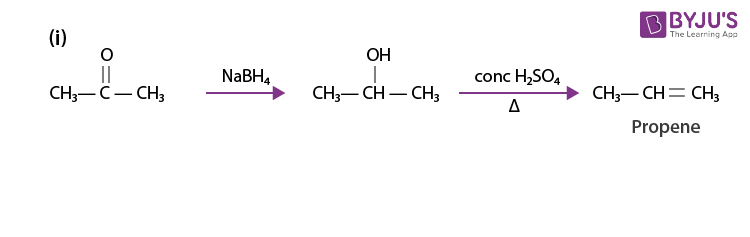
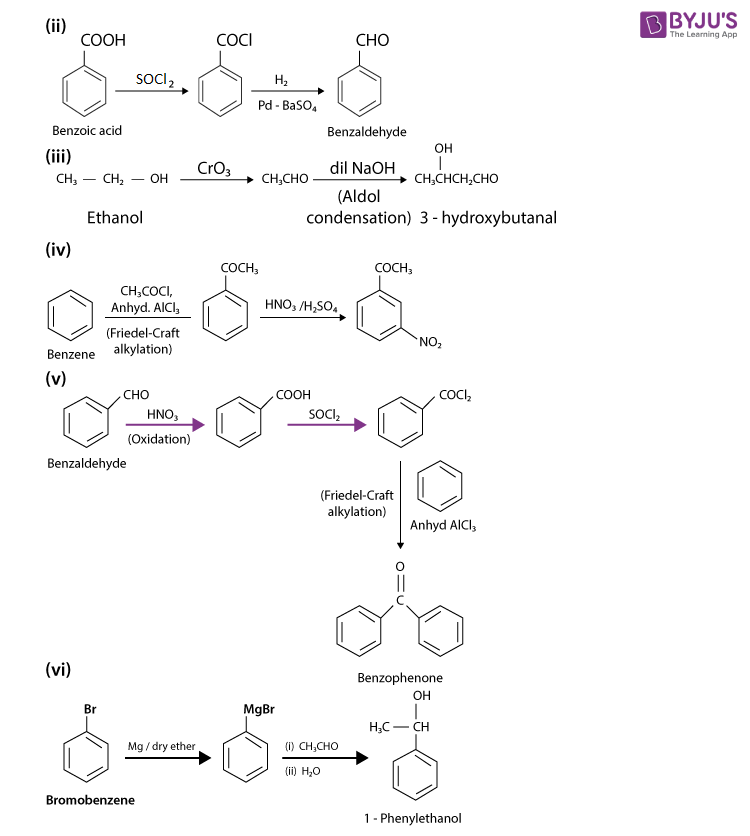
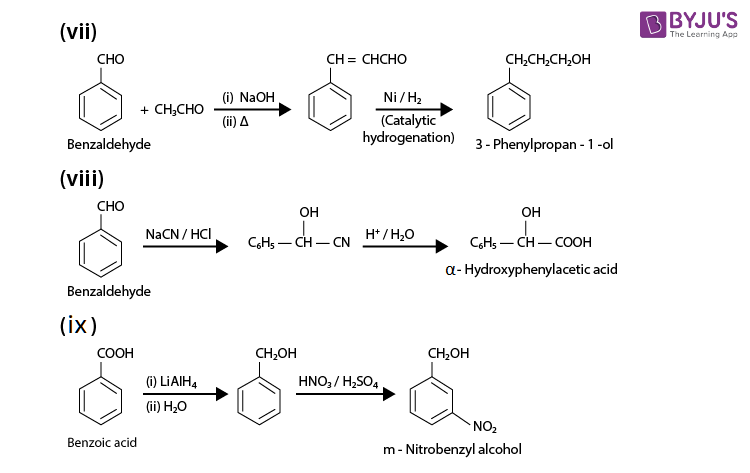
How will you bring about the following conversions in not more than two steps?

(i) Propanone to propene

(ii) Benzoic acid to benzaldehyde

(iii) Ethanol to 3-hydroxybutanal

(iv) Benzene to m-nitroacetophenone

(v) Benzaldehyde to benzophenone

(vi) Bromobenzene to 1-phenylethanol

(vii) Benzaldehyde to 3-phenylpropan-1-ol

(viii) Benazaldehyde to α-hydroxyphenylacetic acid

(ix) Benzoic acid to m-nitrobenzyl alcohol

Show solutionHide solution
Worked solution

Solution coming soon.

Q12.16Written answer

NCERT Solutions for Class 12 Chemistry Chapter 12 Aldehydes, Ketones and Carboxylic Acids Question 15 image 1
NCERT Solutions for Class 12 Chemistry Chapter 12 Aldehydes, Ketones and Carboxylic Acids Question 15 image 2
NCERT Solutions for Class 12 Chemistry Chapter 12 Aldehydes, Ketones and Carboxylic Acids Question 15 image 3
Describe the following:

(i) Acetylation

(ii) Cannizzaro reaction

(iii) Cross aldol condensation

(iv) Decarboxylation

Show solutionHide solution
Worked solution

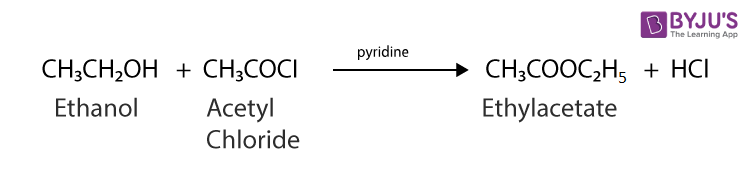
(i) Acetylation

When an organic compound is introduced with an acetyl function group, it is known as acetylation. Bases such as pyridine, dimethylaniline, etc., are present when this process is carried out. An acetyl group is substituted with an active hydrogen atom in this process. Acetylating agents such as acetyl chloride and acetic anhydride are commonly used in the process.

For example, the acetylation of ethanol produces ethyl acetate.

NCERT Solutions for Class 12 Chemistry Chapter 12 Aldehydes, Ketones and Carboxylic Acids Question 16 image 1
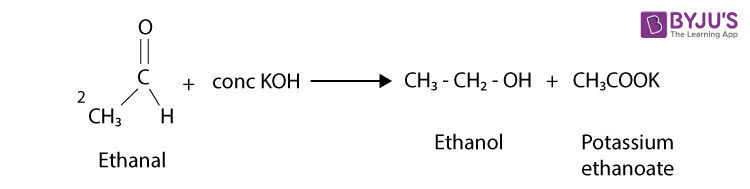
(ii) Cannizzaro reaction:

Cannizzaro reaction is the self-disproportionation (oxidation-reduction) reaction of aldehydes with no α-hydrogens on treatment with concentrated alkalis.

One molecule of aldehyde is reduced to an alcohol, and the other is oxidised to carboxylic acid in this reaction.

For example, ethanol and potassium ethanoate are produced when ethanol is treated with concentrated potassium hydroxide.

NCERT Solutions for Class 12 Chemistry Chapter 12 Aldehydes, Ketones and Carboxylic Acids Question 16 image 2
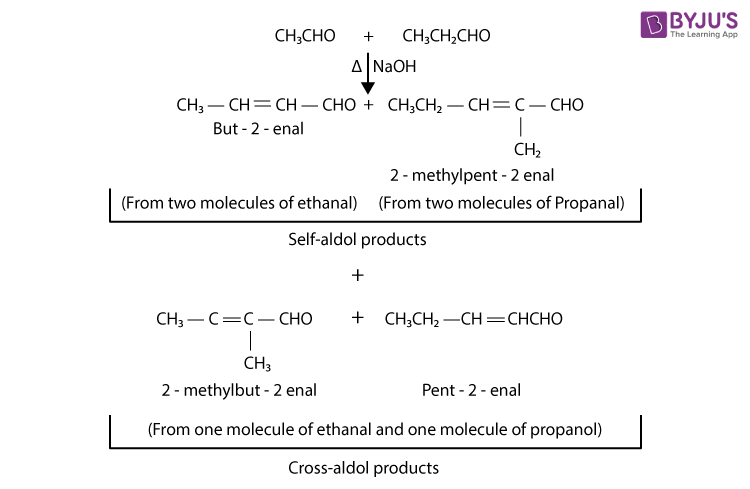
(iii) Cross-aldol condensation:

Cross-aldol condensation is carried out between two different aldehydes or two different ketones, or an aldehyde and a ketone. Four compounds are obtained as products if both the reactants contain α-hydrogens.

For example, the reaction of ethanal and propanal gives four products.

NCERT Solutions for Class 12 Chemistry Chapter 12 Aldehydes, Ketones and Carboxylic Acids Question 16 image 3
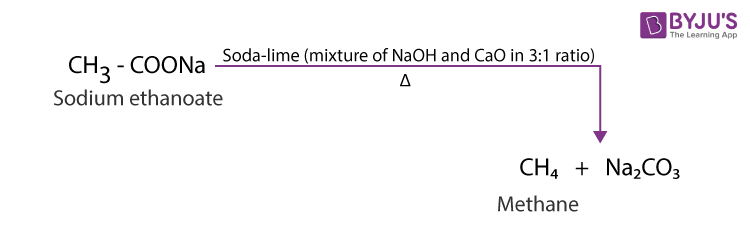
(iv) Decarboxylation:

The reaction in which carboxylic acids lose carbon dioxide to form hydrocarbons when their sodium salts are heated with soda-lime is called decarboxylation.

When aqueous solutions of alkali metal salts of carboxylic acids are electrolyzed also results in decarboxylation. This electrolytic process is known as Kolbe’s electrolysis.

Q12.17Written answer

NCERT Solutions for Class 12 Chemistry Chapter 12 Aldehydes, Ketones and Carboxylic Acids Question 16 image 4
Complete each synthesis by giving the missing starting material, reagent or products

Show solutionHide solution
Worked solution

Solution coming soon.

Q12.18Written answer

NCERT Solutions for Class 12 Chemistry Chapter 12 Aldehydes, Ketones and Carboxylic Acids Question 17 Solution image 1
NCERT Solutions for Class 12 Chemistry Chapter 12 Aldehydes, Ketones and Carboxylic Acids Question 17 Solution image 2
NCERT Solutions for Class 12 Chemistry Chapter 12 Aldehydes, Ketones and Carboxylic Acids Question 17 Solution image 3
Give a plausible explanation for each of the following:

(i) Cyclohexanone forms cyanohydrin in good yield, but 2,2,6-trimethylcyclohexanone does not.

(ii) There are two −NH2 groups in semicarbazide. However, only one is involved in the formation of semicarbazones.

(iii) During the preparation of esters from a carboxylic acid and an alcohol in the presence of an acid catalyst, the water or the ester should be removed as soon as it is formed.

Show solutionHide solution
Worked solution

(i) Cyanohydrins are formed by cyclohexanones according to the following equation.

NCERT Solutions for Class 12 Chemistry Chapter 12 Aldehydes, Ketones and Carboxylic Acids Question 18 image 1
In this case, there will not be any steric hindrance; hence the nucleophile CN– can easily attack. However, in the case of 2,2,6-trimethylcyclohexanone, methyl groups at α-positions offer steric hindrances, and as a result, CN− cannot attack effectively.

NCERT Solutions for Class 12 Chemistry Chapter 12 Aldehydes, Ketones and Carboxylic Acids Question 18 image 2
For this reason, it does not form a cyanohydrin.

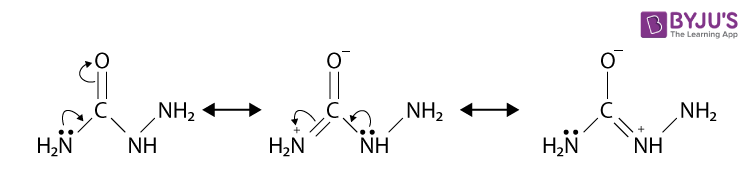
(ii) Semicarbazide undergoes resonance involving only one of the two −NH2 groups, which is attached directly to the carbonyl-carbon atom.

NCERT Solutions for Class 12 Chemistry Chapter 12 Aldehydes, Ketones and Carboxylic Acids Question 18 image 3
Therefore, the electron density on the −NH2 group involved in the resonance also decreases.

As a result, it cannot act as a nucleophile. Since the other −NH2 group is not involved in resonance, it can act as a nucleophile and attack carbonyl-carbon atoms of aldehydes and ketones to produce semicarbazones.

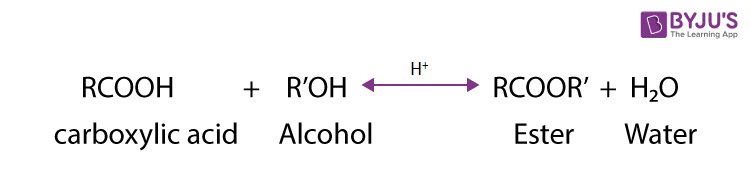
(iii) Ester, along with water, is formed reversibly from a carboxylic acid and an alcohol in the presence of an acid.

NCERT Solutions for Class 12 Chemistry Chapter 12 Aldehydes, Ketones and Carboxylic Acids Question 18 image 4
If either water or ester is not removed as soon as it is formed, then it reacts to give back the reactants as the reaction is reversible. Therefore, to shift the equilibrium in the forward direction, i.e., to produce more ester, either of the two should be removed.

Q12.19Written answer

An organic compound contains 69.77% carbon, 11.63% hydrogen and the rest oxygen. The molecular mass of the compound is 86. It does not reduce Tollens’ reagent but forms an addition compound with sodium hydrogensulphite and gives a positive iodoform test. On vigorous oxidation, it gives ethanoic and propanoic acid. Write the possible structure of the compound.

Show solutionHide solution
Worked solution

% of carbon = 69.77 %

% of hydrogen = 11.63 %

% of oxygen = {100 − (69.77 + 11.63)}%

= 18.6 %

Thus, the ratio of the number of carbon, hydrogen, and oxygen atoms in the organic compound can be given as:

\(\begin{array}{l}C:H:O=\frac{69.77}{12}:\frac{11.63}{1}:\frac{18.6}{16}\end{array} \)

= 5.81:11.63:1.16

= 5:10:1

Therefore, the empirical formula of the compound is C5H10O. Now, the empirical formula mass of the compound can be given as:

= 5 x 12 + 10 x 1 + 1 x 16

= 86

The molecular mass of the compound = 86

Therefore, the molecular formula of the compound is given by C5H10O.

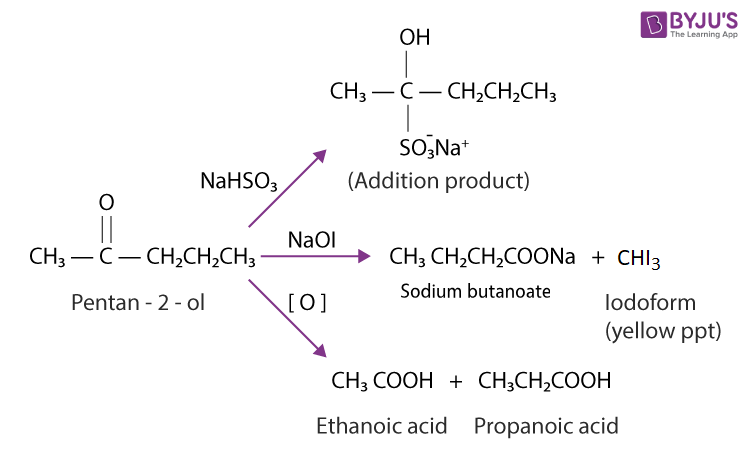
Tollen’s reagent is not reduced by the given compound; hence it is not an aldehyde. A positive iodoform test is given by the compound and also forms sodium hydrogen sulphate addition products. Since the compound is not an aldehyde, it must be a methyl ketone.

The given compound also gives a mixture of ethanoic acid and propanoic acid.

Hence, the given compound is pentan-2-ol.

NCERT Solutions for Class 12 Chemistry Chapter 12 Aldehydes, Ketones and Carboxylic Acids Question 19 image 1
The given reactions can be explained by the following equations:

Q12.20Written answer

NCERT Solutions for Class 12 Chemistry Chapter 12 Aldehydes, Ketones and Carboxylic Acids Question 19 image 2
Although phenoxide ion has more number of resonating structures than
carboxylate ion, the carboxylic acid, is a stronger acid than phenol. Why?

Show solutionHide solution
Worked solution

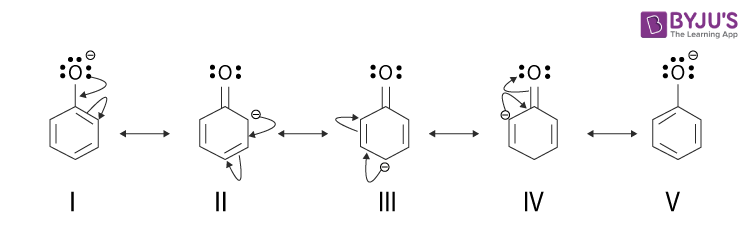
Resonance structures of phenoxide ion are:

NCERT Solutions for Class 12 Chemistry Chapter 12 Aldehydes, Ketones and Carboxylic Acids Question 20 image 1
In II, III and IV, less electronegative carbon atoms carry a negative charge which is observed from the resonance structures of phenoxide ion. Therefore, the resonance stability of the phenoxide ion gets a negligible contribution from these three structures.

Hence, these structures can be eliminated. The more electronegative oxygen atom contains a negative charge by the structures I and V.

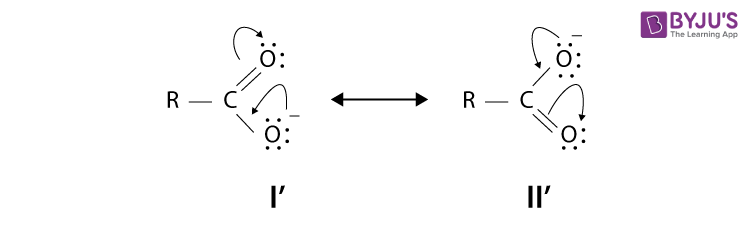
Resonance structures of carboxylate ion are as shown below:

NCERT Solutions for Class 12 Chemistry Chapter 12 Aldehydes, Ketones and Carboxylic Acids Question 20 image 2
In the case of carboxylate ion, resonating structures I′ and II′ contain a charge carried by a more electronegative oxygen atom.

Also, the negative charge is delocalised over two oxygen atoms in resonating structures I′ and II′. But in resonating structures I and V of the phenoxide ion, the negative charge is localised on the same oxygen atom. Therefore, its stability is determined more by the resonating structures of carboxylate ion than those of phenoxide ion. As a result, phenoxide ion is less resonance-stabilised than carboxylate ion. Hence, the carboxylic acid is a stronger acid than phenol.

The Central Board of Secondary Education (CBSE) is responsible for conducting the examinations of Classes 10 and 12. Schools affiliated with CBSE follow the curriculum and textbooks designed by the NCERT.  The