My Cart
Your Cart 0

    Your cart is empty.

  • Total (Amount) ₹0.00
NCERT · Class 12 · Chemistry

Chapter 7: Alcohols, Phenols, and Ethers

Practice each question, then open the answer or worked solution.

Questions

32 questions
Q11.21Written answer

Name the reagents used in the following reactions:
(i) Oxidation of primary alcohol to a carboxylic acid.
(ii) Oxidation of primary alcohol to aldehyde.
(iii) Bromination of phenol to 2,4,6-tribromophenol.
(iv) Benzyl alcohol to benzoic acid.
(v) Dehydration of propan-2-ol to propene.
(vi) Butan-2-one to butan-2-ol.

Show solutionHide solution
Worked solution

(i) NaBH4 or LiAlH4 to acidified KMnO4

(ii) Pyridinium chlorochromate (PCC)

(iii) Bromine water

(iv) Acidified potassium permanganate

(v) Concentrated H2SO4 or H3PO4

(vi) Catalytic hydrogenation or sodium borohydride (NaBH4) or lithium aluminium hydride (LiAlH4)


Q11.22Written answer

Give a reason for the higher boiling point of ethanol in comparison to methoxymethane.

Show solutionHide solution
Worked solution

Ethanol experiences intermolecular H – bonding because of the presence of – OH group, which results in the association of molecules. additional energy is necessary to break these hydrogen bonds. Conversely, methoxymethane does not experience H – bonding. Therefore, ethanol has a higher boiling point when compared to methoxymethane

NCERT Solutions for Class 12 Chemistry Chapter 11 Alcohols, Phenols and Ethers Q 11.22


Q11.23Written answer

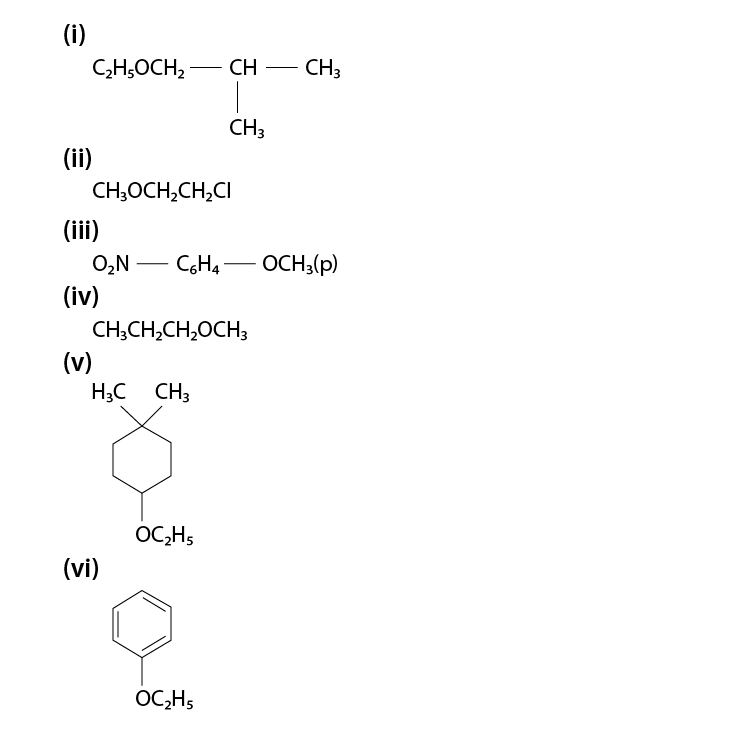
Give IUPAC names of the following ethers:

NCERT Solutions for Class 12 Chemistry Chapter 11 Alcohols, Phenols and Ethers Q 11.23

Show solutionHide solution
Worked solution

(i) 1 – Ethoxy – 2 – methylpropane

(ii) 2 – Chloro – 1 – methoxyethane

(iii) 4 – Nitroanisole

(iv) 1 – Methoxypropane

(v) 1 – Ethoxy – 4, 4 – dimethylcyclohexane

(vi) Ethoxybenzene


Q11.24Written answer

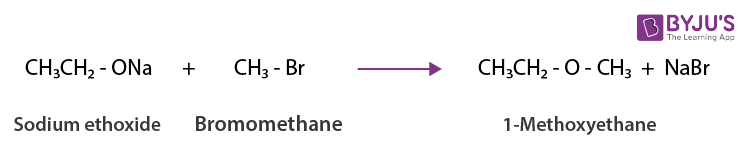
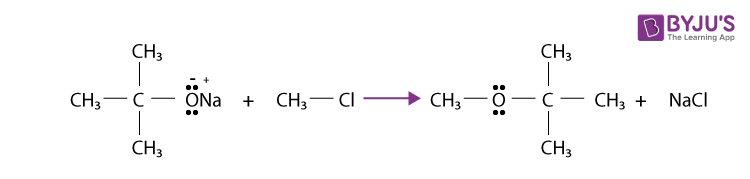
Write the names of reagents and equations for the preparation of the following
ethers by Williamson’s synthesis:
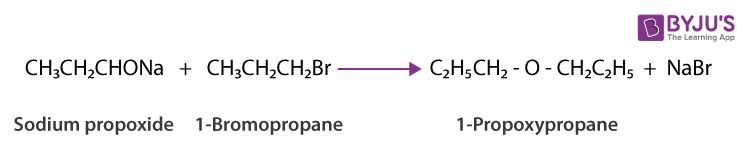
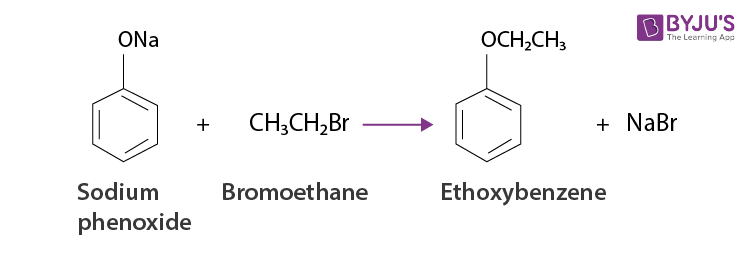
(i) 1-Propoxypropane (ii) Ethoxybenzene
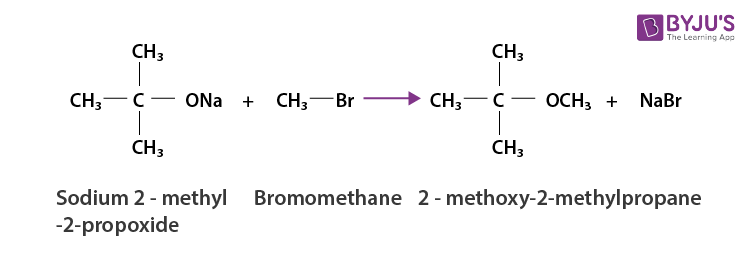
(iii) 2-Methoxy-2-methylpropane (iv) 1-Methoxyethane

Show solutionHide solution
Worked solution

(i)NCERT Solutions for Class 12 Chemistry Chapter 11 Alcohols, Phenols and Ethers Q 11.24(i)

(ii)NCERT Solutions for Class 12 Chemistry Chapter 11 Alcohols, Phenols and Ethers Q 11.24(ii)

(iii)NCERT Solutions for Class 12 Chemistry Chapter 11 Alcohols, Phenols and Ethers Q 11.24(iii)

(iv)NCERT Solutions for Class 12 Chemistry Chapter 11 Alcohols, Phenols and Ethers Q 11.24(iv)


Q11.25Written answer

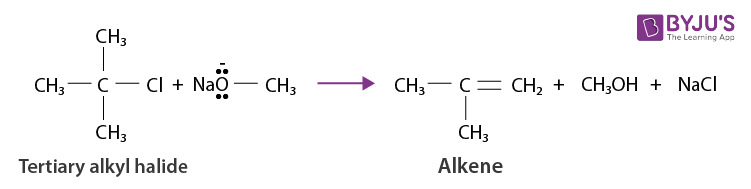
Illustrate with examples the limitations of Williamson synthesis for the preparation of certain types of ethers.

Show solutionHide solution
Worked solution

The reaction of Williamson synthesis includes SN2 attack of an alkoxide ion on a primary alkyl halide.

NCERT Solutions for Class 12 Chemistry Chapter 11 Alcohols, Phenols and Ethers Q 11.25-1

while, tertiary alkyl halides or secondary alkyl halides were to be substituted in place of primary alkyl halides, in that case elimination would contend over substitution. This results in the formation of alkenes. This happens because alkoxides are nucleophiles as well as strong bases. Therefore, they react with alkyl halides, which results in an elimination reaction.

NCERT Solutions for Class 12 Chemistry Chapter 11 Alcohols, Phenols and Ethers Q 11.25-2


Q11.26Written answer

How is 1-propoxypropane synthesised from propan-1-ol? Write the mechanism of this reaction.

Show solutionHide solution
Worked solution

1 – propoxypropane can be synthesized from propan – 1 – ol by dehydration.

Propan – 1 – ol undergoes dehydration in the presence of protic acids (such as H 2 SO 4, H 3 PO 4 ) to give 1 – propoxypropane.

NCERT Solutions for Class 12 Chemistry Chapter 11 Alcohols, Phenols and Ethers Q 11.26-1

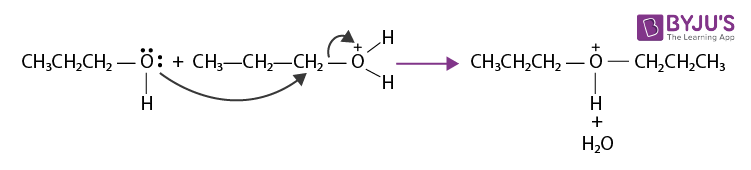
The mechanism of this reaction involves the following three steps :

Step 1 : Protonation

NCERT Solutions for Class 12 Chemistry Chapter 11 Alcohols, Phenols and Ethers Q 11.26 Step1

Step 2 : Nucleophilic attack

NCERT Solutions for Class 12 Chemistry Chapter 11 Alcohols, Phenols and Ethers Q 11.26 Step2

Step 3 : Deprotonation

NCERT Solutions for Class 12 Chemistry Chapter 11 Alcohols, Phenols and Ethers Q 11.26 Step3


Q11.27Written answer

Preparation of ethers by acid dehydration of secondary or tertiary alcohols is not a suitable method. Give reason.

Show solutionHide solution
Worked solution

The synthesis of ethers with dehydration of alcohol is a bimolecular reaction (SN 2) which involves the attack of an alcohol molecule on a protonated alcohol molecule. In the method, the alkyl group should be unhindered. In the case of secondary or tertiary alcohols, the alkyl group is hindered. As a result, elimination of dominates substitution. Hence, in place of ethers, alkenes are formed.


Q11.28Written answer

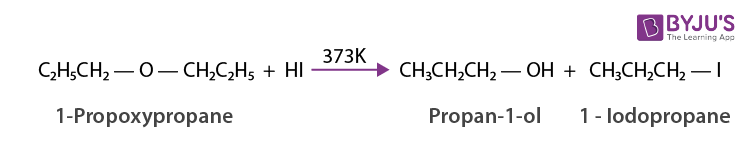
Write the equation of the reaction of hydrogen iodide with:
(i) 1-propoxypropane (ii) methoxybenzene and (iii) benzyl ethyl ether

Show solutionHide solution
Worked solution

(i)NCERT Solutions for Class 12 Chemistry Chapter 11 Alcohols, Phenols and Ethers Q 11.28(i)

(ii)NCERT Solutions for Class 12 Chemistry Chapter 11 Alcohols, Phenols and Ethers Q 11.28(ii)

(iii)NCERT Solutions for Class 12 Chemistry Chapter 11 Alcohols, Phenols and Ethers Q 11.28(iii)


Q11.29Written answer

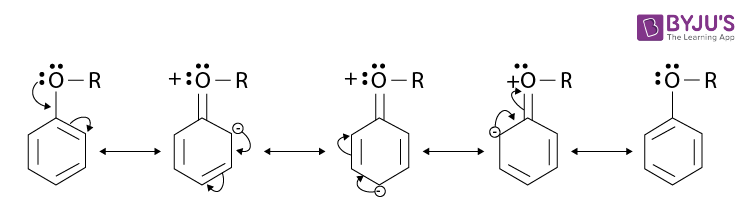
Explain the fact that in aryl alkyl ethers

(i) the alkoxy group activates the benzene ring towards electrophilic substitution 

(ii) it directs the incoming substituents to ortho and para positions in the benzene ring

Show solutionHide solution
Worked solution

(i)NCERT Solutions for Class 12 Chemistry Chapter 11 Alcohols, Phenols and Ethers Q 11.29(i)-1

The electron density in the benzene ring boosts up because of the existence of + R effect of the alkoxy group in aryl alkyl ethers, which is given in the resonance configuration below :

NCERT Solutions for Class 12 Chemistry Chapter 11 Alcohols, Phenols and Ethers Q 11.29(i)-2


Therefore, a benzene ring is activated by the alkoxy group towards electrophilic substitution.

(ii) The above resonance configuration, we infer that the electron density is higher at the para and ortho positions compared to meta position. Consequently, the substituent which is incoming is directed to the para and ortho positions in the benzene ring.


Q11.30Written answer

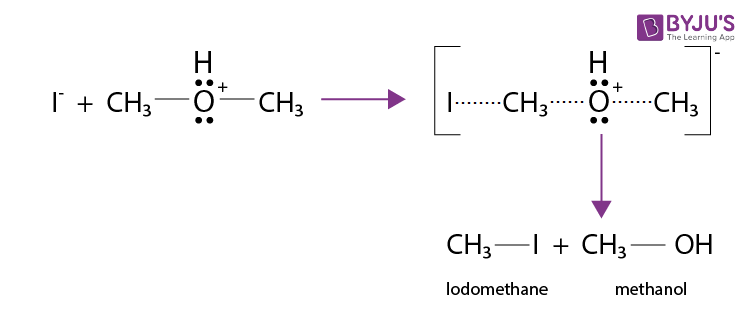
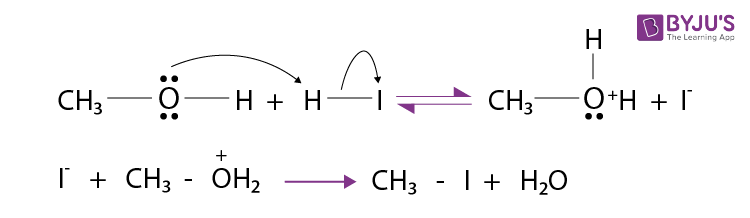
Write the mechanism of the reaction of HI with methoxymethane.

Show solutionHide solution
Worked solution

The steps of the reaction of methoxymethane with HI are given below :

Step 1 : Protonation of methoxymethane :

NCERT Solutions for Class 12 Chemistry Chapter 11 Alcohols, Phenols and Ethers Q 11.30 Step1

Step 2 : Nucleophilic attack of I – :

NCERT Solutions for Class 12 Chemistry Chapter 11 Alcohols, Phenols and Ethers Q 11.30 Step2

Step 3 : The methanol synthesized in the above step is made to react with another HI molecule which then converts to methyl iodide. This is done at a high temperature & HI is present in excess.NCERT Solutions for Class 12 Chemistry Chapter 11 Alcohols, Phenols and Ethers Q 11.30 Step3


Q 11.31:

Write equations of the following reactions:
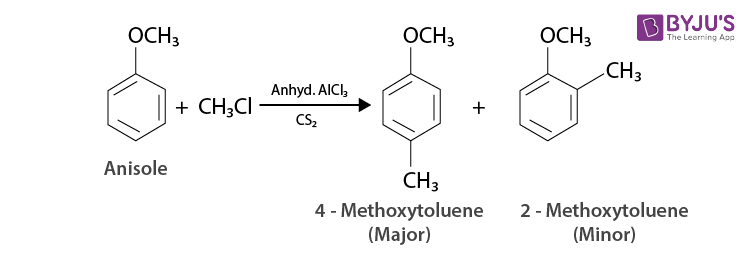
(i) Friedel-Crafts reaction – alkylation of anisole.
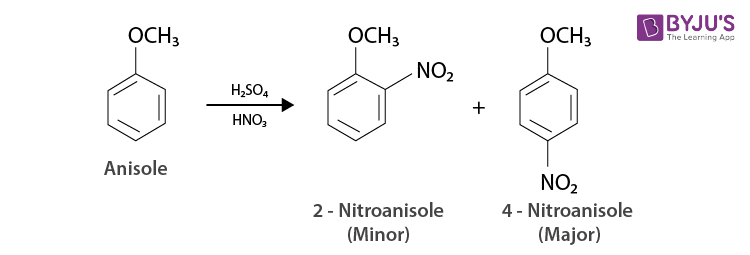
(ii) Nitration of anisole.
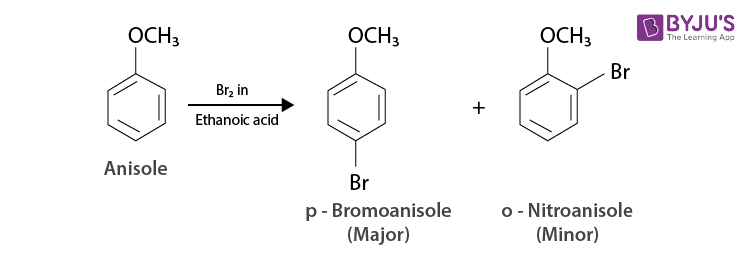
(iii) Bromination of anisole in ethanoic acid medium.
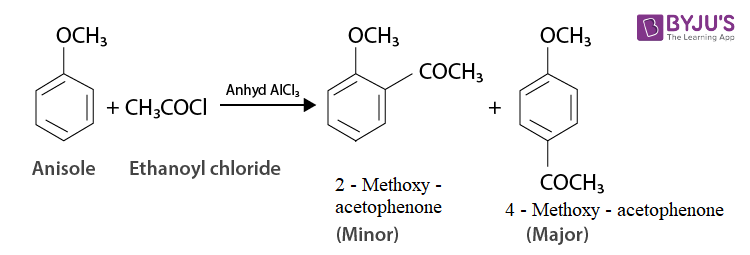
(iv) Friedel-Craft’s acetylation of anisole.

(i)NCERT Solutions for Class 12 Chemistry Chapter 11 Alcohols, Phenols and Ethers Q 11.31(i)

(ii)NCERT Solutions for Class 12 Chemistry Chapter 11 Alcohols, Phenols and Ethers Q 11.31(ii)

(iii)NCERT Solutions for Class 12 Chemistry Chapter 11 Alcohols, Phenols and Ethers Q 11.31(iii)

(iv)NCERT Solutions for Class 12 Chemistry Chapter 11 Alcohols, Phenols and Ethers Q 11.31(iv)