My Cart
Your Cart 0

    Your cart is empty.

  • Total (Amount) ₹0.00
NCERT · Class 12 · Chemistry

Chapter 7: Alcohols, Phenols, and Ethers

Practice each question, then open the answer or worked solution.

Questions

32 questions
Q11.11Written answer

Write a chemical reaction for the preparation of phenol from chlorobenzene.

Show solutionHide solution
Worked solution

Chlorobenzene is combined with NaOH ( at 623 K & 320 atm pressure ) to prepare sodium phenoxide, resulting in phenol on acidification.

NCERT Solutions for Class 12 Chemistry Chapter 11 Alcohols, Phenols and Ethers Q 11.11

Q11.12Written answer

You are given benzene, conc. H2SO4 and NaOH. Write the equations for the preparation of phenol using these reagents.

Show solutionHide solution
Worked solution

Solution coming soon.

Q11.13Written answer

Show how will you synthesise:
(i) 1-phenylethanol from a suitable alkene.
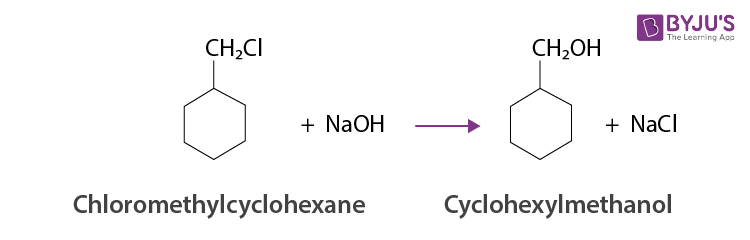
(ii) cyclohexylmethanol using an alkyl halide by an SN2 reaction.
(iii) pentan-1-ol using a suitable alkyl halide?

Show solutionHide solution
Worked solution

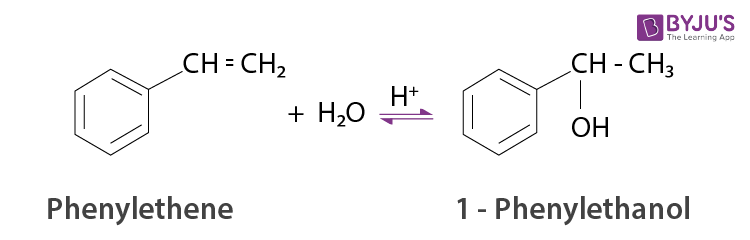
(i) By acid-catalyzed hydration of ethylbenzene ( styrene ), 1 – phenylethanol can be synthesized.

NCERT Solutions for Class 12 Chemistry Chapter 11 Alcohols, Phenols and Ethers Q 11.13-1

(ii) When chloromethyl cyclohexane is treated with sodium hydroxide, cyclohexyl methanol is obtained.

NCERT Solutions for Class 12 Chemistry Chapter 11 Alcohols, Phenols and Ethers Q 11.13-2

(iii) When 1 – chloropentane is treated with NaOH, pentan – 1 – ol is produced.

NCERT Solutions for Class 12 Chemistry Chapter 11 Alcohols, Phenols and Ethers Q 11.13-3


Q11.14Written answer

Give two reactions that show the acidic nature of phenol. Compare acidity of phenol with that of ethanol.

Show solutionHide solution
Worked solution

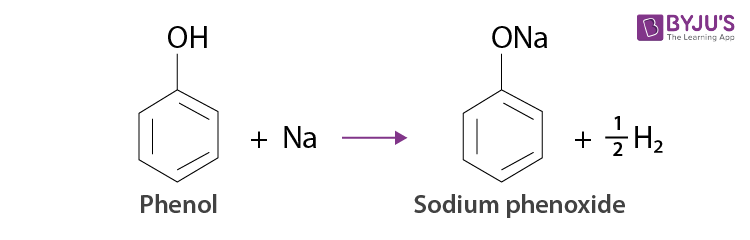
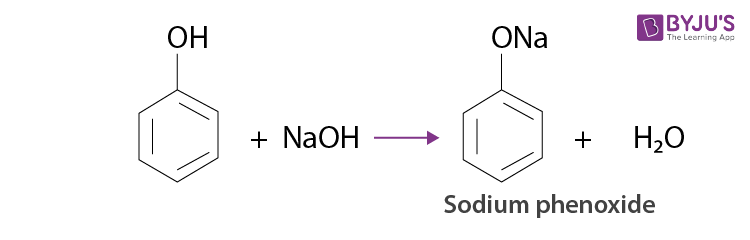
The acidic nature of phenol can be proven with the two reactions given below :

(i) Phenol reacts with sodium to give sodium phenoxide, liberating H2.

NCERT Solutions for Class 12 Chemistry Chapter 11 Alcohols, Phenols and Ethers Q 11.14-1

(ii) Phenol reacts with sodium hydroxide to give sodium phenoxide & water as by-products.

NCERT Solutions for Class 12 Chemistry Chapter 11 Alcohols, Phenols and Ethers Q 11.14-2

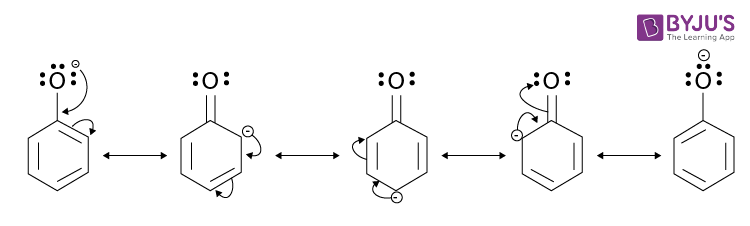
The acidity of phenol is more than that of ethanol. This is because after losing a proton, the phenoxide ion undergoes resonance and gets stabilized whereas ethoxide ion does not.

NCERT Solutions for Class 12 Chemistry Chapter 11 Alcohols, Phenols and Ethers Q 11.14-3


Q11.15Written answer

Explain why ortho nitrophenol is more acidic than ortho methoxyphenol.

Show solutionHide solution
Worked solution

The nitro – group is an electron-withdrawing group. The existence of this group in the ortho position decreases the electron density in the O – H bond. Consequently, it is easier to give away a proton. Furthermore, the o -nitrophenoxide ion formed after the loss of protons is stabilized by resonance. Therefore, ortho nitrophenol is a stronger acid. In contrast, a methoxy group is an electron – releasing group. Hence, it increases the electron density in the O – H bond and thus, losing proton is not possible easily. Therefore, ortho – nitrophenol is more acidic than ortho – methoxyphenol.


Q11.16Written answer

Explain how the –OH group attached to a carbon of benzene ring activates it towards electrophilic substitution.

Show solutionHide solution
Worked solution

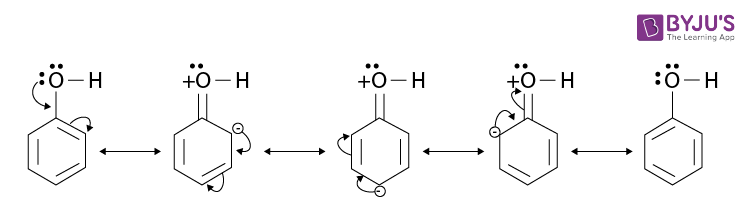
The density of the electron increases in the benzene ring as the – OH group acts as an electron-donating group. This is clearly shown in the resonance structure of phenol given here.

NCERT Solutions for Class 12 Chemistry Chapter 11 Alcohols, Phenols and Ethers Q 11.16

As a result, the benzene ring is activated towards electrophilic substitution.


Q11.17Written answer

Give equations of the following reactions:
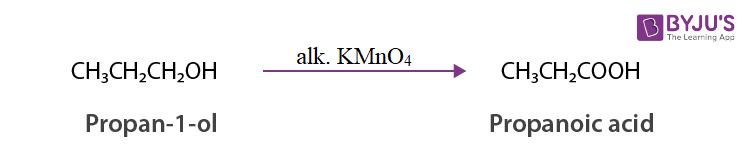
(i) Oxidation of propan-1-ol with alkaline KMnO4 solution.
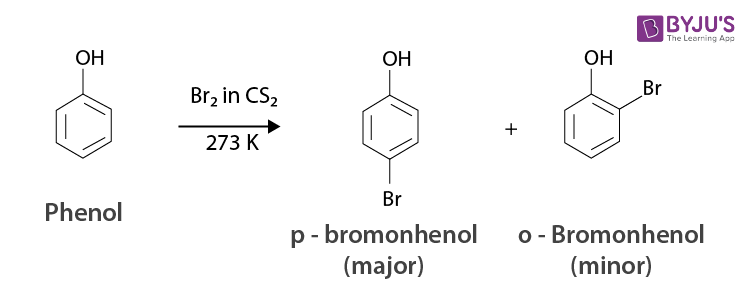
(ii) Bromine in CS2 with phenol.
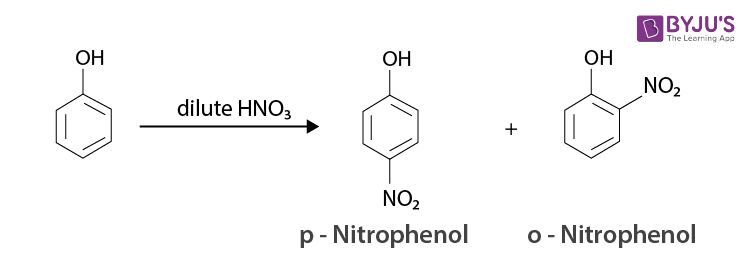
(iii) Dilute HNO3 with phenol.
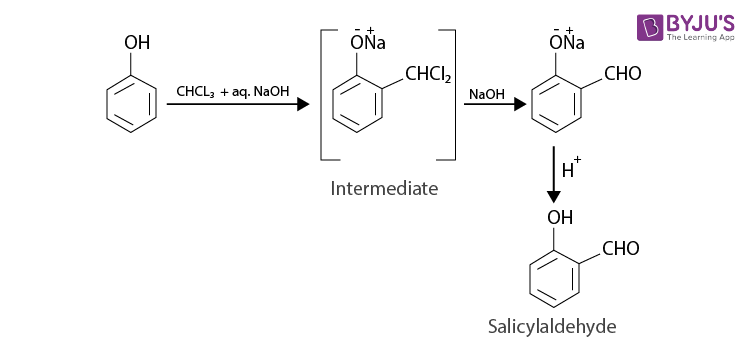
(iv) Treating phenol with chloroform in the presence of aqueous NaOH.

Show solutionHide solution
Worked solution

(i)NCERT Solutions for Class 12 Chemistry Chapter 11 Alcohols, Phenols and Ethers Q 11.17-1

(ii)NCERT Solutions for Class 12 Chemistry Chapter 11 Alcohols, Phenols and Ethers Q 11.17-2

(iii)NCERT Solutions for Class 12 Chemistry Chapter 11 Alcohols, Phenols and Ethers Q 11.17-3

(iv)NCERT Solutions for Class 12 Chemistry Chapter 11 Alcohols, Phenols and Ethers Q 11.17-4


Q11.18Written answer

Explain the following with an example.
(i) Kolbe’s reaction.
(ii) Reimer-Tiemann reaction.
(iii) Williamson ether synthesis.
(iv) Unsymmetrical ether.

Show solutionHide solution
Worked solution

(i) Kolbe’s reaction:

Sodium phenoxide is formed when phenol is treated with sodium hydroxide. Ortho – hydroxybenzoic acid as the main product when sodium phenoxide is treated with carbon dioxide, followed by acidification, it undergoes electrophilic substitution. This reaction is known as Kolbe’s reaction.
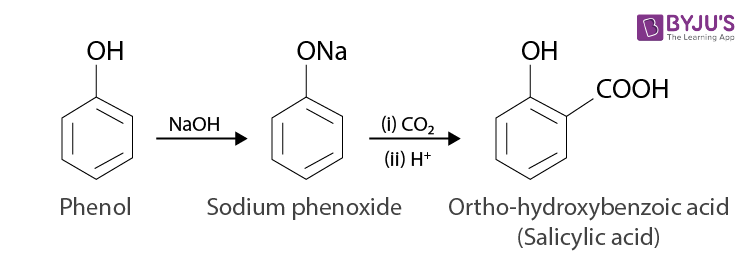
NCERT Solutions for Class 12 Chemistry Chapter 11 Alcohols, Phenols and Ethers Q 11.18(i) Kolbes reaction

(ii) Reimer – Tiemann reaction:

A -CHO group is introduced at the ortho position of the benzene ring when phenol is treated with chloroform ( CHCl 3 ) in the presence of sodium hydroxide.
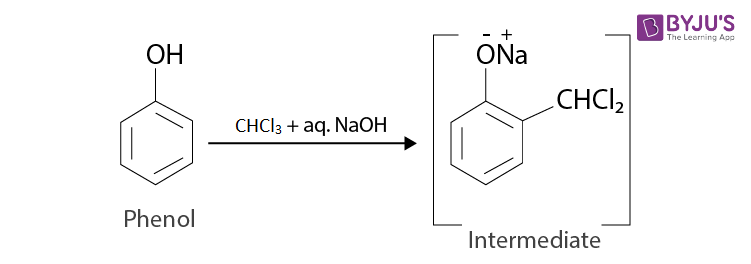
NCERT Solutions for Class 12 Chemistry Chapter 11 Alcohols, Phenols and Ethers Q 11.18(ii) Reimer Tiemann reaction

This reaction is known as the Reimer – Tiemann reaction.

Salicylaldehyde is produced when the intermediate is hydrolyzed in the presence of alkalis.
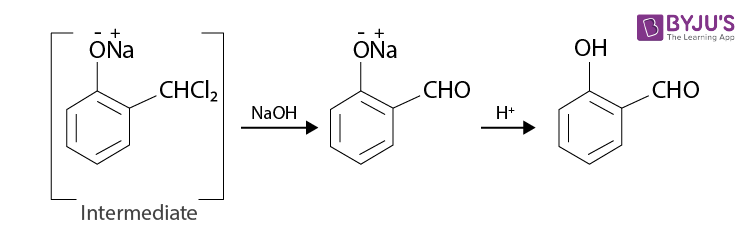
NCERT Solutions for Class 12 Chemistry Chapter 11 Alcohols, Phenols and Ethers Q 11.18(ii)-1

(iii) Williamson ether synthesis:

A chemical method to synthesize symmetrical & unsymmetrical ethers by making alkyl halides to react with sodium alkoxides is called Williamson ether synthesis.

NCERT Solutions for Class 12 Chemistry Chapter 11 Alcohols, Phenols and Ethers Q 11.18(iii) Williamson ether synthesis

The above reaction includes Sn 2 attack of the alkoxide ion on the alkyl halide. In the case of primary alkyl halides, better results are obtained.

NCERT Solutions for Class 12 Chemistry Chapter 11 Alcohols, Phenols and Ethers Q 11.18(iii)-1

Only If the alkyl halide is tertiary or secondary, in that case, elimination competes over substitution.

(iv) Unsymmetrical ether:

When an oxygen atom has two groups on two of its side, it is called Unsymmetrical ether. ( i.e., the number of carbon atoms is unequal ). For eg: ethyl methyl ether ( CH 3 – O − CH 2 CH 3 ).

 

Q11.19Written answer

Write the mechanism of acid dehydration of ethanol to yield ethene.

Show solutionHide solution
Worked solution

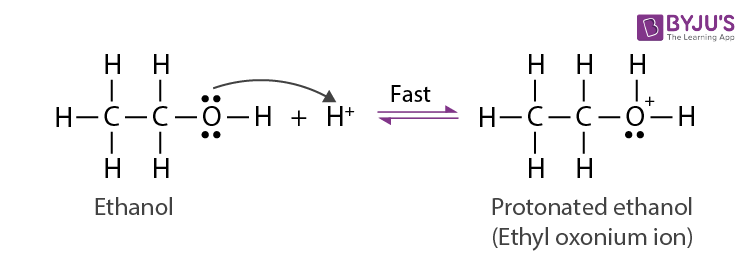
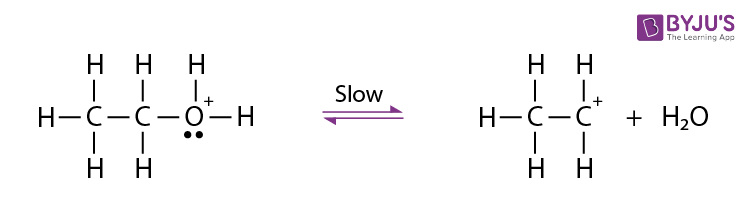
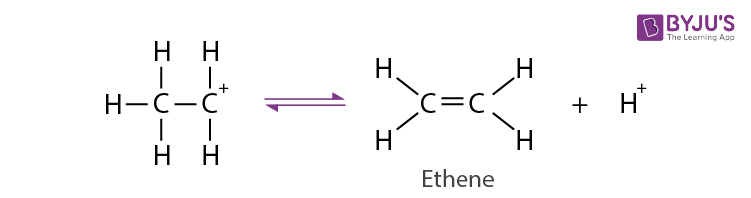
The mechanism of acid dehydration of ethanol to yield ethene involves the following three steps :

Step 1 :

Formation of ethyl oxonium by protonation of ethanol :

NCERT Solutions for Class 12 Chemistry Chapter 11 Alcohols, Phenols and Ethers Q 11.19 Step1

Step 2 :

A carbocation is formed ( rate-determining step ) :

NCERT Solutions for Class 12 Chemistry Chapter 11 Alcohols, Phenols and Ethers Q 11.19 Step2

Step 3 :

Ethane is formed by elimination of proton:

NCERT Solutions for Class 12 Chemistry Chapter 11 Alcohols, Phenols and Ethers Q 11.19 Step3

The acid is released in Step 3 which was being consumed in Step 1. It is removed to shift the equilibrium in a forward direction, after ethene is formed.


Q11.20Written answer

How are the following conversions carried out?
(i) Propene → Propan-2-ol.
(ii) Benzyl chloride → Benzyl alcohol.
(iii) Ethyl magnesium chloride → Propan-1-ol.
(iv) Methyl magnesium bromide → 2-Methylpropan-2-ol.

Show solutionHide solution
Worked solution

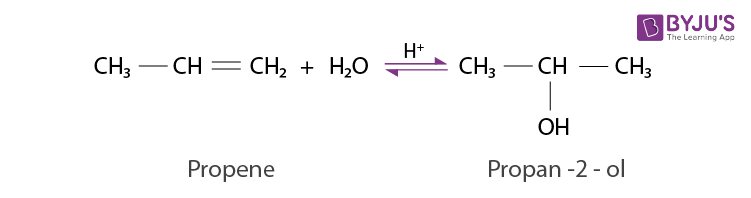
(i) When propene is reacted with water in the presence of an acid as a catalyst, as a result, we obtain propan – 2 – ol.

NCERT Solutions for Class 12 Chemistry Chapter 11 Alcohols, Phenols and Ethers Q 11.20(i)

(ii) If then benzyl alcohol is obtained when benzyl chloride is reacted with NaOH which is then followed by acidification.

NCERT Solutions for Class 12 Chemistry Chapter 11 Alcohols, Phenols and Ethers Q 11.20(ii)

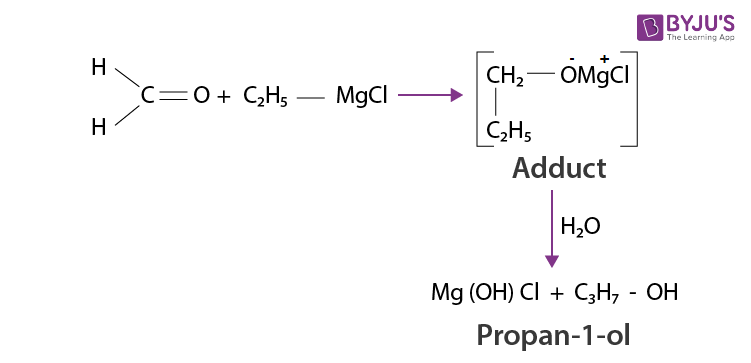
(iii) An adduct is obtained when ethyl magnesium chloride is reacted with methanal, as a result, propan – 1 – ol on hydrolysis is obtained.

NCERT Solutions for Class 12 Chemistry Chapter 11 Alcohols, Phenols and Ethers Q 11.20(iii)

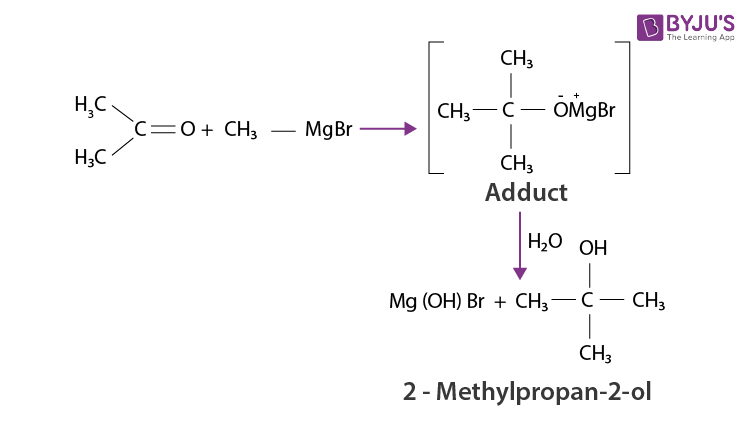
(iv) On treating methyl magnesium bromide with propane, an adduct is obtained which results in 2 – methylpropane – 2 – ol on hydrolysis.

NCERT Solutions for Class 12 Chemistry Chapter 11 Alcohols, Phenols and Ethers Q 11.20(iv)