My Cart
Your Cart 0

    Your cart is empty.

  • Total (Amount) ₹0.00
NCERT · Class 12 · Chemistry

Chapter 4: The d & f Block Elements

Practice each question, then open the answer or worked solution.

Questions

37 questions
Q8.1Written answer

Write down the electronic configuration of

(i) Cr3+ (ii) Pm3+ (iii) Cu+ (iv) Ce4+ (v) Co2+ (vi) Lu2+ (vii) Mn2+  (viii) Th4+

Show solutionHide solution
Worked solution

(i) Cr3+: 1s2 2s2 2p6 3s2 3p6 3d3

Or, [Ar]18 3d3

(ii) Pm3+: 1s2 2s2 2p6 3s2 3p6 3d10 4s2 4p6 4d10 5s2 5p6 4f4

Or, [Xe]54 4f4

(iii) Cu+: 1s2 2s2 2p6 3s2 3p6 3d10

Or, [Ar]18 3d10

(iv) Ce4+: 1s2 2s2 2p6 3s2 3p6 3d10 4s2 4p6 4d10 5s2 5p6

Or, [Xe]54

(v) Co2+: 1s2 2s2 2p6 3s2 3p6 3d7

Or, [Ar]18 3d7

(vi) Lu2+: 1s2 2s2 2p6 3s2 3p6 3d10 4s2 4p6 4d10 5s2 5p6 4f14 5d1

Or, [Xe]54 4f14 5d1

(vii) Mn2+: 1s2 2s2 2p6 3s2 3p6 3d5

Or, [Ar]18 3d5

(viii) Th4+: 1s2 2s2 2p6 3s2 3p6 3d10 4s2 4p6 4d10 4f14 5s2 5p6 5d10 6s2 6p6

Or, [Rn]86
Q8.2Written answer

Why are Mn2+ compounds more stable than Fe towards oxidation to their +3 state?

Show solutionHide solution
Worked solution

Electronic configuration:               Fe2+ is [Ar]18 3d6.

Mn2+ is [Ar]18 3d5.

We know that half and completely-filled orbitals are more stable. Hence, Mn with (+2) state has a stable d5 configuration, which is why Mn2+ shows resistance to oxidation to Mn3+. We know that Fe2+ has 3d6 configuration, and by losing one electron, its configuration changes to a more stable 3d5 configuration. Therefore, Fe2+ easily gets oxidized to the Fe+3 oxidation state.

Q8.3Written answer

Explain briefly how +2 state becomes more and more stable in the first half of the first-row transition elements with increasing atomic number.

Show solutionHide solution
Worked solution

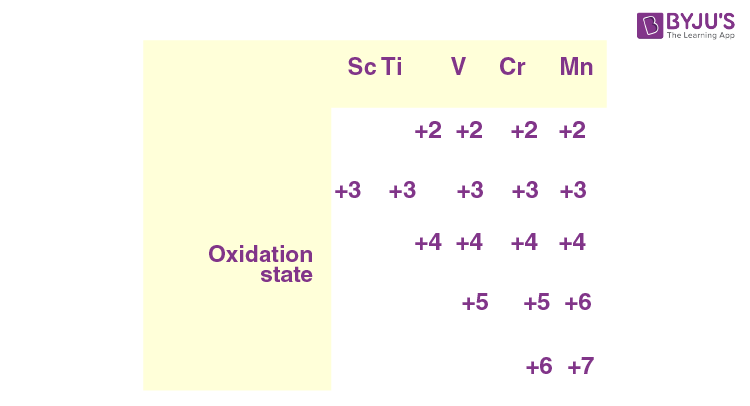
In the table below, the oxidation states of the first half of the first row of transition metals are displayed.

NCERT Solutions for Class 12 Chemistry Chapter 8 D and F Block Elements Q 8.3

We can see that, except Sc, all other metals have a +2 oxidation state. As moving in the increasing order of atomic number from 21 to 25, that is, from Sc to Mn, the number of electrons in 3d orbitals increases from 1 to 5.

Sc (+2) = d1

Ti (+2) = d2

V (+2) = d3

Cr (+2) = d4

Mn (+2) = d5

+2 oxidation state is attained by the loss of the two 4s electrons by these metals. Since the number of d electrons in (+2) state also increases from Ti(+2) to Mn(+ 2), the stability of +2 state increases (as the d-orbital is becoming more and more half-filled). Mn (+2) has d5 electrons (that is, a half-filled d shell, which is highly stable).

Q8.4Written answer

To what extent do the electronic configurations decide the stability of oxidation states in the first series of transition elements? Illustrate your answer with examples.

Show solutionHide solution
Worked solution

The oxidation states with the maximum number (+2 to +7) are exhibited by the elements of Mn oxidation states that are in the first half of the transition series. Ti  With the increase in atomic number, the stability of the +2 oxidation state increases. Once more electrons are filled in the d-orbital, this happens to a great extent.  The +2 oxidation state is not shown by the Sc. Its electronic configuration is 4s2 3d1. It loses all three electrons to form Sc3+, +3 oxidation state of Sc is very stable as by losing all three electrons, it attains stable noble gas configuration, [Ar], Ti (+ 4) and V(+5) are very stable for the same reason. For Mn, the +2 oxidation state is very stable as after losing two electrons, its d-orbital is exactly half-filled, [Ar] 3d5

Q8.5Written answer

What may be the stable oxidation state of the transition element with the following d electron configurations in the ground state of their atoms: 3d3, 3d5, 3d8 and 3d4?

Show solutionHide solution
Worked solution
Electronic configuration in the ground state Stable oxidation states
(i) 3d3 (Vanadium) +2, +3, +4 and +5
(ii) 3d5 (Chromium) +3, +4, +6
(iii) 3d5 (Manganese) +2, +4, +6, +7
(iv) 3d8(Cobalt) +2, +3
(v) 3d4 There is no 3d4 configuration in the ground state.
Q8.6Written answer

Name the oxometal anions of the first series of transition metals in which the metal exhibits the oxidation state equal to its group number.

Show solutionHide solution
Worked solution

(i) Chromate,

\(\begin{array}{l}CrO^{2-}_{4}\end{array} \)

Oxidation state of Cr is + 6.

(ii) Permanganate,

\(\begin{array}{l}MnO^{-}_{4}\end{array} \)

Oxidation state of Mn is + 7.

(iii) Vanadate, 

\(\begin{array}{l}VO^-_3\end{array} \)

Oxidation state of V is + 5.

Q8.7Written answer

What is lanthanoid contraction? What are the consequences of lanthanoid contraction?

Show solutionHide solution
Worked solution

On moving along the lanthanoid series, the atomic number gradually increases by one. With the increase in atomic number, the number of protons and electrons present in the atom also increases by one. The effective nuclear charge increases as electrons are being added to the same shell. Owing to the proton addition being pronounced more above the interelectronic repulsions resulting from electron addition, a nuclear attraction increase happens. Also, with the increase in the atomic number, the number of electrons in the 4f orbital also increases. The 4f electrons have a poor shielding effect. Therefore, the effective nuclear charge experienced by the outer electrons increases. Consequently, the attraction of the nucleus for the outermost electrons increases. This results in a steady decrease in the size of lanthanoids with an increase in the atomic number. This is termed lanthanoid contraction.

Consequences of lanthanoid contraction

(i) It is due to lanthanide contraction that there is variation in the basic strength of lanthanide hydroxides. (Basic strength decreases from La(OH)3 to Lu(OH)3.)

(ii) There is a similarity in the properties of the second and third transition series.

(iii) Separation of lanthanoids is possible due to lanthanide contraction.

Q8.8Written answer

What are the characteristics of the transition elements, and why are they called transition elements? Which of the d-block elements may not be regarded as transition elements?

Show solutionHide solution
Worked solution

Transition elements are those elements in which the atoms or ions (in a stable oxidation state) contain partially filled d-orbital. These elements are found in the d-block and show a transition of properties between the s-block and the p-block. Hence, these are called transition elements.

Elements such as Cd, Hg and Zn cannot be called transition elements because they have completely filled the d-sub shell.

Q8.9Written answer

In what way is the electronic configuration of the transition elements different from that of the non-transition elements?

Show solutionHide solution
Worked solution

Transition metals have a partially filled d−orbital. Hence, the electronic configuration of transition elements is (n − 1)d1-10 ns0-2.

The non-transition elements either do not have a d−orbital or have a fully filled d−orbital.

Therefore, the electronic configuration of non-transition elements is ns1-2 or ns2 np1-6.

Q8.10Written answer

What are the different oxidation states exhibited by lanthanoids?

Show solutionHide solution
Worked solution

In the case of lanthanoids, the +3 oxidation state is the most common.

That is, Ln(III) compounds are predominant.

However, +2 and +4 oxidation states can also be found in the solution or in solid compounds.