My Cart
Your Cart 0

    Your cart is empty.

  • Total (Amount) ₹0.00
NCERT · Class 12 · Chemistry

Chapter 2: Electrochemistry

Practice each question, then open the answer or worked solution.

Questions

18 questions
Q3.11Written answer

The conductivity of 0.00241 M acetic acid is 7.896 × 10⁻⁵ S cm–1. Calculate its molar conductivity. If 0 Λ m for acetic acid is 390.5 S cm2 mol–1, what is its dissociation constant?

Show solutionHide solution
Worked solution

Given, κ = 7.896 × 10⁻⁵ S m−1 c

= 0.00241 mol L−1

Then, molar conductivity,

\(\begin{array}{l}\Lambda_m = \frac{k}{c}\end{array} \)

=

\(\begin{array}{l}\frac{7.896 \times 10^{-5} S cm^{-1}}{0.00241 \; mol \; L^{-1}}\times \frac{1000 cm^3}{L}\end{array} \)

= 32.76S cm2 mol−1

\(\begin{array}{l}\Lambda^0_m =\end{array} \)
2−1

Again,

\(\begin{array}{l}\alpha =\frac{\Lambda_m }{\Lambda^0_m }\end{array} \)

=

\(\begin{array}{l}= \frac{32.76 \; S\; cm^2 \; mol^{-1} }{390.5 \; S\; cm^2 \; mol^{-1} }\end{array} \)

Now,

= 0.084

Dissociation constant,

\(\begin{array}{l}K_a = \frac{c\alpha^2}{(1-\alpha)}\end{array} \)

=

\(\begin{array}{l}\frac{ ( 0.00241 \; mol \; L^{-1} )( 0.084 )^2}{ ( 1 – 0.084 ) }\end{array} \)

= 1.86 × 10⁻⁵ mol L−1

Q3.12Written answer

How much charge is required for the following reductions?
(i) 1 mol of Al3+ to Al
(ii) 1 mol of Cu2+ to Cu
(iii) 1 mol of MnO4– to Mn2+

Show solutionHide solution
Worked solution

(i)

\(\begin{array}{l}Al^{3+} + 3e^- \rightarrow Al\end{array} \)

Required charge = 3 F

= 3 × 96487 C

= 289461 C

(ii)

\(\begin{array}{l}Cu^{2+} + 2e^- \rightarrow Cu\end{array} \)

Required charge = 2 F

= 2 × 96487 C

= 192974 C

(iii)

\(\begin{array}{l}MnO^-_4 \rightarrow Mn^{2+}\end{array} \)

i.e

\(\begin{array}{l}Mn^{7+} + 5e^-\rightarrow Mn^{2+}\end{array} \)

Required charge = 5 F

= 5 × 96487 C

= 482435 C

Q3.13Written answer

How much electricity in terms of Faraday is required to produce
(i) 20.0 g of Ca from molten CaCl2?
(ii) 40.0 g of Al from molten Al2O3?

Show solutionHide solution
Worked solution

(i)  From the given data,

\(\begin{array}{l}Ca^{2+} + 2e^- \rightarrow Ca\end{array} \)

Electricity required to produce 40 g of calcium = 2 F

Therefore, electricity required to produce 20 g of calcium = (2 x 20 )/ 40 F

= 1 F

(ii) From the given data,

\(\begin{array}{l}Al^{3+} + 3e^- \rightarrow Al\end{array} \)

Electricity required to produce 27 g of Al = 3 F

Therefore, electricity required to produce 40 g of Al = ( 3 x 40 )/27 F

= 4.44 F

Q3.14Written answer

How much electricity is required in coulomb for the oxidation of
(i) 1 mol of H2O to O2?
(ii) 1 mol of FeO to Fe2O3?

Show solutionHide solution
Worked solution

(i) From the given data,

\(\begin{array}{l}H_2O\rightarrow H_2 + \frac{1}{2}O_2\end{array} \)

We can say that

\(\begin{array}{l}O^{2-}\rightarrow \frac{1}{2}O_2 + 2e^-\end{array} \)

Electricity required for the oxidation of 1 mol of H2O to O2 = 2 F

= 2 × 96487 C

= 192974 C

(ii) From the given data,

\(\begin{array}{l}Fe^{2+}\rightarrow Fe^{3+} + e^-\end{array} \)

Electricity required for the oxidation of 1 mol of FeO to Fe2O3 = 1 F

= 96487 C

Q3.15Written answer

A solution of Ni(NO3)2 is electrolysed between platinum electrodes using a current of 5 amperes for 20 minutes. What mass of Ni is deposited at the cathode?

Show solutionHide solution
Worked solution

Given,

Current = 5A

Time = 20 × 60 = 1200 s

Charge = current × time

= 5 × 1200

= 6000 C

According to the reaction,

\(\begin{array}{l}Ni^{2+} + 2e^-\rightarrow Ni_{ (s) } + e^-\end{array} \)

Nickel deposited by 2 × 96487 C = 58.71 g

Therefore, nickel deposited by 6000 C =

\(\begin{array}{l}\frac{58.71 \times 6000}{2 \times 96487}g\end{array} \)

= 1.825 g

Hence, 1.825 g of nickel will be deposited at the cathode.

Q3.16Written answer

Three electrolytic cells, A, B, and C, containing solutions of ZnSO4, AgNO3 and CuSO4, respectively, are connected in series. A steady current of 1.5 amperes was passed through them until 1.45 g of silver was deposited at the cathode of cell B. How long did the current flow? What mass of copper and zinc were deposited?

Show solutionHide solution
Worked solution

According to the reaction,

\(\begin{array}{l}Ag^+_{(aq)} +e^- \rightarrow Ag_{(s)}\end{array} \)

i.e., 108 g of Ag is deposited by 96487 C.

Therefore, 1.45 g of Ag is deposited by =

\(\begin{array}{l}\frac{96487\times 1.45}{107}C\end{array} \)

= 1295.43 C

Given,

Current = 1.5 A

Time = 1295.43/ 1.5 s

= 863.6 s

= 864 s

= 14.40 min

Again,

\(\begin{array}{l}Cu^{2+}_{(aq)} +2e^-\rightarrow Cu_{(s)}\end{array} \)

i.e., 2 × 96487 C of charge deposit = 63.5 g of Cu

Therefore, 1295.43 C of charge will deposit

\(\begin{array}{l}\frac{63.5 \times 1295.43}{2 \times 96487}\end{array} \)

= 0.426 g of Cu

\(\begin{array}{l}Zn^{2+}_{(aq)} +2e^-\rightarrow Zn_{(s)}\end{array} \)

i.e., 2 × 96487 C of charge deposit = 65.4 g of Zn

Therefore, 1295.43 C of charge will deposit

\(\begin{array}{l}\frac{65.4 \times 1295.43}{2 \times 96487}\end{array} \)

= 0.439 g of Zn

Q3.17Written answer

Using the standard electrode potentials given in Table 3.1, predict if the reaction between the following is feasible.
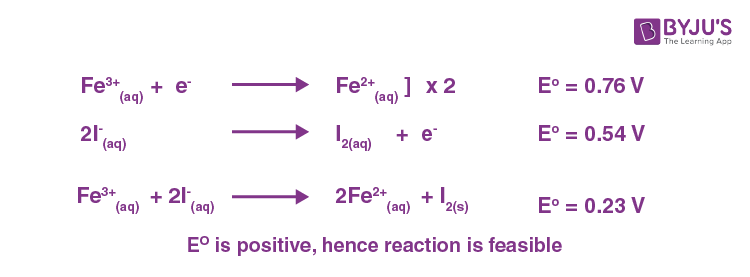
(i) Fe3+(aq) and I–(aq)
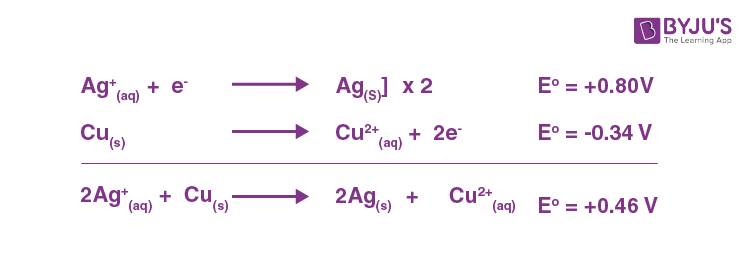
(ii) Ag+ (aq) and Cu(s)
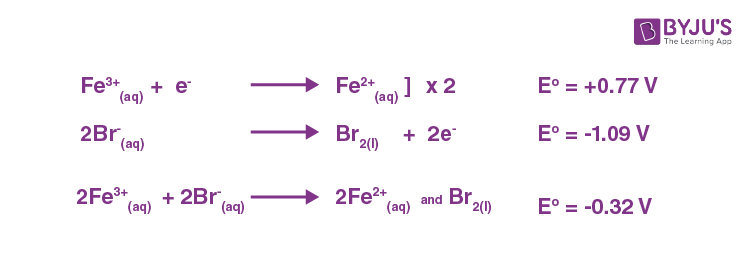
(iii) Fe3+ (aq) and Br– (aq)
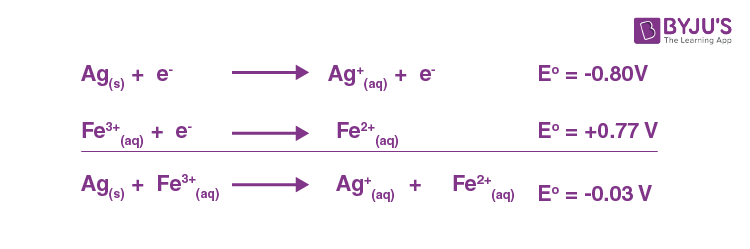
(iv) Ag(s) and Fe 3+ (aq)
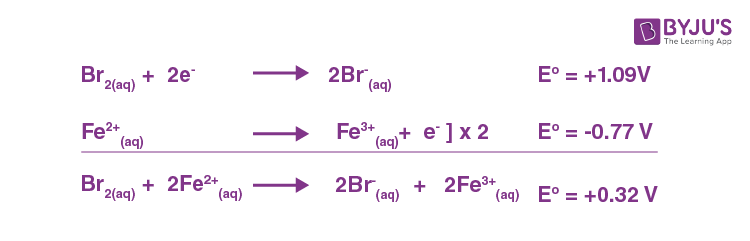
(v) Br2 (aq) and Fe2+ (aq)

Show solutionHide solution
Worked solution

(i)

Standard electrode potential calculation


(ii)

NCERT Solutions for Class 12 Chemistry Chapter 3 Electrochemistry Q 3.17(ii)

E0  is positive; hence, the reaction is feasible.


(iii)

NCERT Solutions for Class 12 Chemistry Chapter 3 Electrochemistry Q 3.17(iii)

E0  is negative; hence, the reaction is not feasible.


(iv)

NCERT Solutions for Class 12 Chemistry Chapter 3 Electrochemistry Q 3.17(iv)

E0  is negative; hence, the reaction is not feasible.


(v)

NCERT Solutions for Class 12 Chemistry Chapter 3 Electrochemistry Q 3.17(v)

E0  is positive; hence, the reaction is feasible.

Q3.18Written answer

Predict the products of electrolysis in each of the following.
(i) An aqueous solution of AgNO3 with silver electrodes
(ii) An aqueous solution of AgNO3 with platinum electrodes
(iii) A dilute solution of H2SO4 with platinum electrodes
(iv) An aqueous solution of CuCl2 with platinum electrodes

Show solutionHide solution
Worked solution

(i) At the cathode,

The following reduction reactions compete to take place at the cathode.

\(\begin{array}{l}Ag^+_{(aq)}+e^- \rightarrow Ag_{(s)}\end{array} \)
0
\(\begin{array}{l}H^+_{(aq)}+e^- \rightarrow \frac{1}{2}H_{2(g)}\end{array} \)
0

The reaction with a higher value of E0 takes place at the cathode. Therefore, the deposition of silver will take place at the cathode.

At the anode,

The Ag anode is attacked by

\(\begin{array}{l}NO^+_3\end{array} \)
+

(ii) At the cathode,

The following reduction reactions compete to take place at the cathode.

\(\begin{array}{l}Ag^+_{(aq)}+e^- \rightarrow Ag_{(s)}\end{array} \)
0
\(\begin{array}{l}H^+_{(aq)}+e^- \rightarrow \frac{1}{2}H_{2(g)}\end{array} \)
0

The reaction with a higher value of E0 takes place at the cathode. Therefore, the deposition of silver will take place at the cathode.

At the anode,

Since Pt electrodes are inert, the anode is not attacked by

\(\begin{array}{l}NO^+_3\end{array} \)
−
\(\begin{array}{l}NO^+_3\end{array} \)
−2
\(\begin{array}{l}OH^-\rightarrow OH + E^-\end{array} \)
\(\begin{array}{l}4OH^-\rightarrow 2H_2O + O_2\end{array} \)

(iii) At the cathode, the following reduction reaction occurs to produce H2 gas.

\(\begin{array}{l}H^+_{(aq)}+e^-\rightarrow \frac{1}{2}H_{2(g)}\end{array} \)

At the anode, the following processes are possible.

\(\begin{array}{l}2H_2O_{(l)}\rightarrow O_{2(g)} + 4H^+_{(aq)}+4e^-\end{array} \)
0
\(\begin{array}{l}2SO^{2-}_{4(aq)}\rightarrow S_2O^{2-}_{6(aq)} + 2e^-\end{array} \)
0

For dilute sulphuric acid, reaction (i) is preferred to produce O2 gas. But for concentrated sulphuric acid, reaction (ii) occurs.

(iv) At the cathode,

The following reduction reactions compete to take place at the cathode.

\(\begin{array}{l}Cu^{2+}_{(aq)}+2e^- \rightarrow Cu_{(s)}\end{array} \)
0
\(\begin{array}{l}H^+_{(aq)}+e^- \rightarrow \frac{1}{2}H_{2(g)}\end{array} \)
0

The reaction with a higher value takes place at the cathode. Therefore, the deposition of copper will take place at the cathode.

At the anode,

The following oxidation reactions are possible at the anode.

\(\begin{array}{l}Cl^{-}_{(aq)} \rightarrow \frac{1}{2} Cl_{2(g)}+e^-\end{array} \)
0
\(\begin{array}{l}2H_20_{(l)} \rightarrow O_{2(g)} + 4H^+_{(aq)} +e^-\end{array} \)
0

At the anode, the reaction with a lower value of E0 is preferred. But due to the overpotential of oxygen, Cl− gets oxidised at the anode to produce Cl2 gas.