My Cart
Your Cart 0

    Your cart is empty.

  • Total (Amount) ₹0.00
NCERT · Class 12 · Chemistry

Chapter 2: Electrochemistry

Practice each question, then open the answer or worked solution.

Questions

18 questions
Q3.1Written answer

Arrange the following metals in the order in which they displace each other from the solution of their salts. Al, Cu, Fe, Mg and Zn.

Show solutionHide solution
Worked solution

According to their reactivity, the given metals replace the others from their salt solutions in the said order: Mg, Al, Zn, Fe, and Cu.

Mg: Al: Zn: Fe: Cu

Q3.2Written answer

Given the standard electrode potentials.
K+/K = –2.93V

Ag+/Ag = 0.80V

Hg2+/Hg = 0.79V

Mg2+/Mg = –2.37 V

Cr3+/Cr = – 0.74V
Arrange these metals in their increasing order of reducing power.

Show solutionHide solution
Worked solution

The reducing power increases with the lowering of the reduction potential. In order of given standard electrode potential (increasing order): K+/K < Mg2+/Mg < Cr3+/Cr < Hg2+/Hg < Ag+/Ag

Thus, in the order of reducing power, we can arrange the given metals as Ag< Hg < Cr < Mg < K

Q3.3Written answer

Depict the galvanic cell in which the reaction
Zn(s) + 2Ag+(aq) →Zn2+(aq) + 2Ag(s) takes place. Further show:
(i) Which of the electrode is negatively charged?
(ii) The carriers of the current in the cell.
(iii) Individual reaction at each electrode.

Show solutionHide solution
Worked solution

The galvanic cell in which the given reaction takes place is depicted as

\(\begin{array}{l}Zn_{ ( s ) } | Zn^{ 2+ }_{( aq )}||Ag^{ + }_{( aq )}|Ag_{( s )}\end{array} \)

(i) The negatively charged electrode is the Zn electrode (anode).

(ii) The current carriers in the cell are ions. Current flows to zinc from silver in the external circuit.

(iii) Reaction at the anode is given by

\(\begin{array}{l}Zn_{ ( s ) }\rightarrow Zn^{ 2+ }_{( aq )} + 2 e^-\end{array} \)

Reaction at the anode is given by

\(\begin{array}{l}Ag^{+}_{ ( aq ) } + e^- \rightarrow Ag_{( s )}\end{array} \)
Q3.4Written answer

Calculate the standard cell potentials of the galvanic cell in which the following
reactions take place.
(i) 2Cr(s) + 3Cd2+(aq) → 2Cr3+(aq) + 3Cd
(ii) Fe2+(aq) + Ag+(aq) → Fe3+(aq) + Ag(s)
Calculate the ∆rGJ and equilibrium constant of the reactions.

Show solutionHide solution
Worked solution

(i)

\(\begin{array}{l}E^{\Theta}_{Cr^{3+}/Cr}\end{array} \)
\(\begin{array}{l}E^{\Theta}_{Cd^{2+}/Cd}\end{array} \)

The galvanic cell of the given reaction is depicted as

\(\begin{array}{l}Cr_{ ( s ) }|Cr^{ 3+ }_{ ( aq ) }||Cd^{ 2+ }_{ aq }|Cd_{ ( s ) }\end{array} \)

Now, the standard cell potential is

\(\begin{array}{l}E^{\Theta }_{cell} = E^{\Theta }_{g}-E^{\Theta }_{L}\end{array} \)

= – 0.40 – ( -0.74 )

= + 0.34 V

In the given equation, n = 6

F = 96487 C mol−1

\(\begin{array}{l}E^{\Theta }_{cell}\end{array} \)

Then,

\(\begin{array}{l}\Delta_rG^{\Theta}\end{array} \)
−1

= −196833.48 CV mol−1

= −196833.48 J mol−1

= −196.83 kJ mol−1

Again,

\(\begin{array}{l}\Delta_rG^{\Theta} = – R T ln K\end{array} \)
\(\begin{array}{l}\Delta_rG^{\Theta} = – 2.303 R T ln K\end{array} \)
\(\begin{array}{l}log {k} = \frac{\Delta_rG}{ 2.303 R T }\end{array} \)
\(\begin{array}{l}= \frac{-196.83\times10^{3}}{ 2.303 \times8.314\times 298 }\end{array} \)

= 34.496

K = antilog (34.496) = 3.13 × 1034

The galvanic cell of the given reaction is depicted as

\(\begin{array}{l}Fe^{ 2+ }_{( aq )}|Fe^{ 3+ }_{( aq )}|| Ag^+_{( aq )}|Ag_{( s )}\end{array} \)

Now, the standard cell potential is

\(\begin{array}{l}E^{\Theta }_{cell} = E^{\Theta }_{g}-E^{\Theta }_{L}\end{array} \)

Here, n = 1

Then,

\(\begin{array}{l}\Delta_t G^0 = -nFE^0_{cell}\end{array} \)

= −1 × 96487 C mol−1 × 0.03 V

= −2894.61 J mol−1

= −2.89 kJ mol−1

Again,  

\(\begin{array}{l}\Delta_t G^0 = -2.303 RT \; ln K\end{array} \)
\(\begin{array}{l}ln K = \frac{\Delta_t G}{ 2.303 RT }\end{array} \)
\(\begin{array}{l}= \frac{-2894.61 }{ 2.303 \times 8.314 \times 298 }\end{array} \)

= 0.5073

K = antilog (0.5073)

= 3.2 (approximately)

Q3.5Written answer

Write the Nernst equation and emf of the following cells at 298 K.
(i) Mg(s)|Mg2+(0.001M)||Cu2+(0.0001 M)|Cu(s)
(ii) Fe(s)|Fe2+(0.001M)||H+(1M)|H2(g)(1bar)| Pt(s)
(iii) Sn(s)|Sn2+(0.050 M)||H+(0.020 M)|H2(g) (1 bar)|Pt(s)
(iv) Pt(s)|Br–(0.010 M)|Br2(l )||H+(0.030 M)| H2(g) (1 bar)|Pt(s)

Show solutionHide solution
Worked solution

(i) For the given reaction, the Nernst equation can be given as

\(\begin{array}{l}E_{cell} = E^0_{cell} – \frac{0.591}{n}log\frac{[Mg^{2+}]}{[Cu^{2+}]}\end{array} \)
\(\begin{array}{l}= 0.34 – (-2.36) – \frac{0.0591}{2} log \frac{0.001}{0.0001}\end{array} \)
\(\begin{array}{l}2.7 -\frac{0.0591}{2}log10\end{array} \)

= 2.7 − 0.02955

= 2.67 V (approximately)

(ii) For the given reaction, the Nernst equation can be given as

\(\begin{array}{l}E_{cell} = E^0_{cell} – \frac{0.591}{n}log\frac{[Fe^{2+}]}{[H ^{+}]^2}\end{array} \)

= 0 – ( – 0.14) –

\(\begin{array}{l}\frac{0.0591}{n}log\frac{0.050}{(0.020)^{2}}\end{array} \)

= 0.52865 V

= 0.53 V (approximately)

(iii) For the given reaction, the Nernst equation can be given as

\(\begin{array}{l}E_{cell} = E^0_{cell} – \frac{0.591}{n}log\frac{[Sn^{2+}]}{[H ^{+}]^2}\end{array} \)

= 0 – ( – 0.14) –

\(\begin{array}{l}\frac{0.591}{2}log\frac{0.050}{(0.020)^2}\end{array} \)

= 0.14 − 0.0295 × log125

= 0.14 − 0.062

= 0.078 V

= 0.08 V (approximately)

(iv) For the given reaction, the Nernst equation can be given as

\(\begin{array}{l}E_{cell} = E^0_{cell} – \frac{0.591}{n}log\frac{1}{[Br^{-}]^2[H ^{+}]^2}\end{array} \)

= 0 – 1.09 –

\(\begin{array}{l}\frac{0.591}{2}log\frac{1}{(0.010)^2(0.030)^2}\end{array} \)

= -1.09 – 0.02955 x

\(\begin{array}{l}log\frac{1}{0.00000009}\end{array} \)

= -1.09 – 0.02955 x

\(\begin{array}{l}log\frac{1}{9\times 10^{-8}}\end{array} \)

= -1.09 – 0.02955 x

\(\begin{array}{l}log{ (1.11 \times 10^{7} )}\end{array} \)

= -1.09 – 0.02955 x (0.0453 + 7)

= -1.09 – 0.208

= -1.298 V

Q3.6Written answer

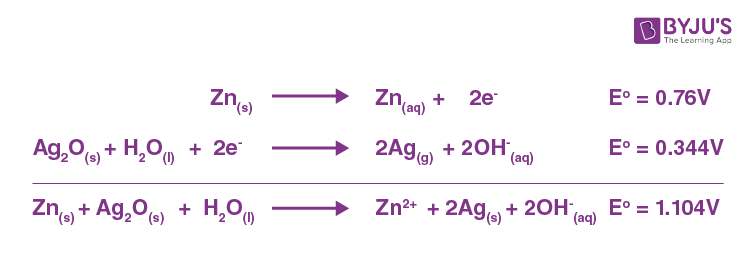
In the button cells widely used in watches and other devices, the following reaction takes place:

Reaction taking place in the button cells


Determine ∆r GJ and EJ for the reaction.

Show solutionHide solution
Worked solution
\(\begin{array}{l}E^0\end{array} \)

We know that,

\(\begin{array}{l}\Delta_r G^\Theta = -nFE^\Theta\end{array} \)

= −2 × 96487 × 1.04

= −213043.296 J

= −213.04 kJ

Q3.7Written answer

Define conductivity and molar conductivity for the solution of an electrolyte. Discuss their variation with concentration.

Show solutionHide solution
Worked solution

The conductivity of a solution is defined as the conductance of a solution of 1 cm in length and area of cross-section 1 sq. cm. Specific conductance is the inverse of resistivity, and it is represented by the symbol κ. If ρ is resistivity, then we can write

\(\begin{array}{l}k = \frac{1}{\rho}\end{array} \)

At any given concentration, the conductivity of a solution is defined as the unit volume of solution kept between two platinum electrodes with the unit area of the cross-section at a distance of unit length.

\(\begin{array}{l}G = k \frac{a}{l} = k \times 1 = k\end{array} \)

When concentration decreases, there will be a decrease in Conductivity. It is applicable for both weak and strong electrolytes. This is because the number of ions per unit volume that carry the current in a solution decreases with a decrease in concentration.

Molar conductivity –

The molar conductivity of a solution at a given concentration is the conductance of volume V of a solution containing 1 mole of the electrolyte, kept between two electrodes with the area of cross-section A and distance of unit length.

\(\begin{array}{l}\Lambda_m = k \frac{A}{l}\end{array} \)

Now, l = 1 and A = V (volume containing 1 mole of the electrolyte)

\(\begin{array}{l}\Lambda_m = k V\end{array} \)

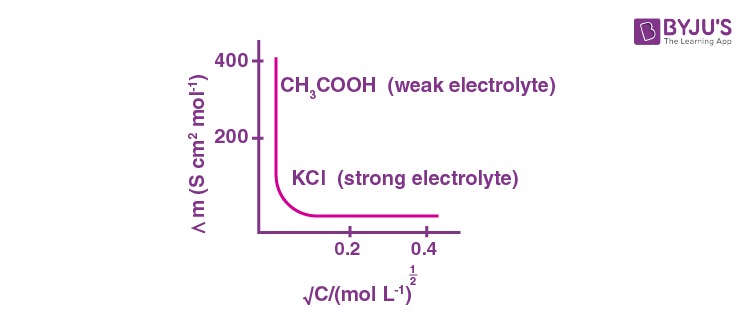
Molar conductivity increases with a decrease in concentration. This is because the total volume V of the solution containing one mole of the electrolyte increases on dilution. The variation of

\(\begin{array}{l}\Lambda_m\end{array} \)
\(\begin{array}{l}\sqrt{c}\end{array} \)

NCERT Solutions for Class 12 Chemistry Chapter 3 Electrochemistry Q 3.7 Plot

Q3.8Written answer

The conductivity of the 0.20 M solution of KCl at 298 K is 0.0248 S cm–1. Calculate its molar conductivity.

Show solutionHide solution
Worked solution

Given, κ = 0.0248 S cm−1 c

c = 0.20 M

Molar conductivity,

\(\begin{array}{l}\Lambda_m = \frac{k \times 1000}{c}\end{array} \)
\(\begin{array}{l}= \frac{0.0248 \times 1000}{0.2}\end{array} \)

= 124 Scm2mol-1

Q3.9Written answer

The resistance of a conductivity cell containing 0.001M KCl solution at 298 K is 1500 Ω. What is the cell constant if the conductivity of 0.001M KCl solution at 298 K is 0.146 × 10⁻³ S cm–1

Show solutionHide solution
Worked solution

Given,

Conductivity, k = 0.146 × 10⁻³ S cm−1

Resistance, R = 1500 Ω

Cell constant = k × R

= 0.146 × 10−3 × 1500

= 0.219 cm−1

Q3.10Written answer

The conductivity of sodium chloride at 298 K has been determined at different concentrations, and the results are given below.

Concentration/M            0.001     0.010     0.020     0.050     0.100

102 × k/S m−1                      1.237     11.85     23.15     55.53     106.74

Calculate Λm for all concentrations and draw a plot between Λm and c½. Find the value of 0 Λ m.

Show solutionHide solution
Worked solution

Given,

κ = 1.237 × 10⁻² S m−1, c = 0.001 M

Then, κ = 1.237 × 10⁻⁴ S cm−1, c1⁄2 = 0.0316 M1/2

\(\begin{array}{l}\Lambda_m =\frac{k}{c}\end{array} \)
\(\begin{array}{l}=\frac{1.237 \times 10^{ -4 } S\;cm^{-1} }{0.001 \; mol\; \; L^{ -1 }}\times \frac{1000\;cm^{-1}}{L}\end{array} \)

= 123.7 S cm2 mol−1

Given,

κ = 11.85 × 10⁻² S m−1, c = 0.010M

Then, κ = 11.85 × 10⁻⁴ S cm−1, c1⁄2 = 0.1 M1/2

\(\begin{array}{l}\Lambda_m =\frac{k}{c}\end{array} \)
\(\begin{array}{l}=\frac{11.85 \times 10^{ -4 } S\;cm^{-1} }{0.010 \; mol\; \; L^{ -1 }}\times \frac{1000\;cm^{-1}}{L}\end{array} \)

= 118.5 S cm2 mol−1

Given,

κ = 23.15 × 10⁻² S m−1, c = 0.020 M

Then, κ = 23.15 × 10⁻⁴ S cm−1, c1/2 = 0.1414 M1/2

\(\begin{array}{l}\Lambda_m =\frac{k}{c}\end{array} \)
\(\begin{array}{l}=\frac{23.15 \times 10^{ -4 } S\;cm^{-1} }{0.020 \; mol\; \; L^{ -1 }}\times \frac{1000\;cm^{-1}}{L}\end{array} \)

= 115.8 S cm2 mol−1

Given,

κ = 55.53 × 10⁻² S m−1, c = 0.050 M

Then, κ = 55.53 × 10⁻⁴ S cm−1, c1/2 = 0.2236 M1/2

\(\begin{array}{l}\Lambda_m =\frac{k}{c}\end{array} \)
\(\begin{array}{l}=\frac{106.74 \times 10^{ -4 } S\;cm^{-1} }{0.050 \; mol\; \; L^{ -1 }}\times \frac{1000\;cm^{-1}}{L}\end{array} \)

= 111.1 1 S cm2 mol−1

Given,

κ = 106.74 × 10⁻² S m−1, c = 0.100 M

Then, κ = 106.74 × 10⁻⁴ S cm−1, c1/2 = 0.3162 M1/2

\(\begin{array}{l}\Lambda_m =\frac{k}{c}\end{array} \)
\(\begin{array}{l}=\frac{106.74 \times 10^{ -4 } S\;cm^{-1} }{0.100 \; mol\; \; L^{ -1 }}\times \frac{1000\;cm^{-1}}{L}\end{array} \)

= 106.74 S cm2 mol−1

Now, we have the following data:
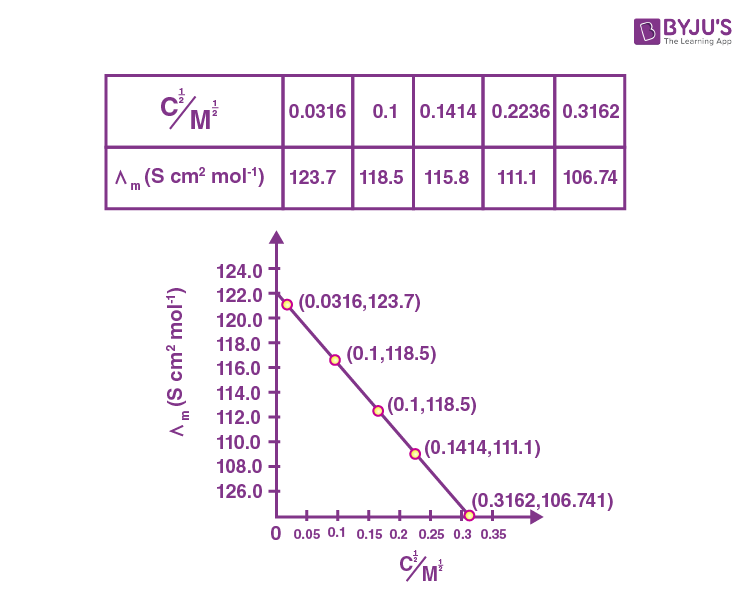
NCERT Solutions for Class 12 Chemistry Chapter 3 Electrochemistry Q 3.10 Data & Graph

Since the line interrupts

\(\begin{array}{l}\Lambda_m\end{array} \)
2−1
\(\begin{array}{l}\Lambda^0_m\end{array} \)
2−1