My Cart
Your Cart 0

    Your cart is empty.

  • Total (Amount) ₹0.00
NCERT · Class 12 · Biology

Chapter 5: Molecular Basis of Inheritance

Practice each question, then open the answer or worked solution.

Questions

14 questions
Q1Written answer

Group the following as nitrogenous bases and nucleosides:

Adenine, Cytidine, Thymine, Guanosine, Uracil and Cytosine.

Show solutionHide solution
Worked solution

Following is the grouping:

Nitrogenous Base Nucleosides
Adenine Cytidine
Thymine Guanosine
Uracil
Cytosine
Q2Written answer

If a double-stranded DNA has 20 per cent of cytosine, calculate the per cent of adenine in the DNA.

Show solutionHide solution
Worked solution

As per Chargaff’s rule, DNA molecules are required to have an equal ratio of purine (adenine and guanine) and pyridine (cytosine and thymine). This is to say that the number of adenine molecules is equivalent to the cytosine molecule.

Percentage of adenosine = percentage of thymine

Percentage of guanine = percentage of cytosine

Hence, according to the law, if the double-stranded DNA has 20% of cytosine, it should have 20% of guanine. Therefore, the percentage of G + percentage of C = 40%

The other 60% indicates both A + T percentage molecules. As adenine and thymine are always found in equal numbers, the adenine content is 30%.
Q3Written answer

If the sequence of one strand of DNA is written as follows:

5′ -ATGCATGCATGCATGCATGCATGCATGC-3′

Write down the sequence of the complementary strand in a 5’→3′ direction.

Show solutionHide solution
Worked solution

With regard to base sequence, DNA strands are complementary to each other. Therefore, if the sequence of one strand of DNA is written as:

5′ -ATGCATGCATGCATGCATGCATGCATGC-3′

The sequence of the complementary strand in 3′ -> 5′ is as follows:

3′ – TACGTACGTACGTACGTACGTACGTACG – 5′

Subsequently, the sequence of the complementary strand in 5’→3′ direction is written as:

5′ – GCATGCATGCATGCATGCATGCATGCAT – 3′

Q4Written answer

If the sequence of the coding strand in a transcription unit is written as follows:

5′ -ATGCATGCATGCATGCATGCATGCATGC-3′

Write down the sequence of mRNA.

Show solutionHide solution
Worked solution

In a transcription unit, if the coding strand is as follows:

5′ -ATGCATGCATGCATGCATGCATGCATGC-3′

Then the sequence that codes for nothing are the same as mRNA, except that in mRNA, uracil replaces thymine. Hence, the mRNA sequence is as written below:

5′ -AUGCAUGCAUGCAUGCAUGCAUGCAUGC-3′

Q5Written answer

Which property of DNA double helix led Watson and Crick to hypothesise a semi-conservative mode of DNA replication? Explain.

Show solutionHide solution
Worked solution

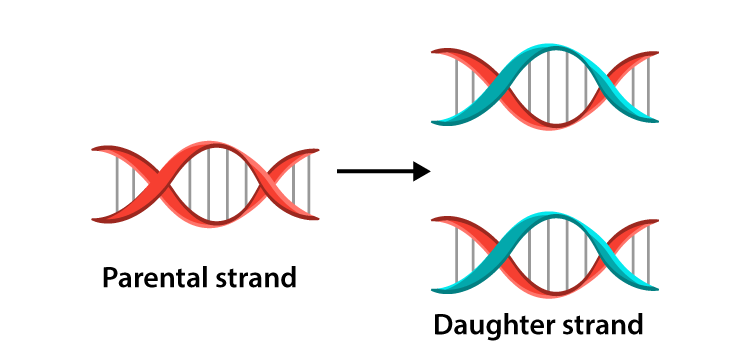
Watson and Crick noted that the two DNA strands are anti-parallel, complementary to each other with regards to their base sequences which facilitates each strand to serve as a template to synthesise a new strand. This organisation of the DNA molecule furthered the hypothesis that the replication of DNA is semi-conservative. In other words, the double-stranded DNA molecule splits, and in turn, each of the separated strands serves as a template to synthesise a new complementary strand. Subsequently, each DNA molecule will have one parental strand and a newly synthesised daughter strand. As only one parental strand is conserved in each of the daughter molecules, the mode of replication is termed as semi-conservative.

NCERT solutions class 12 biology Chapter 6 - 1

The sequence of bases in the template strand because of complementary base pairing governs the sequence of bases in the daughter strand. Subsequently, this property of DNA led Watson and Crick to hypothesise the semi-conservative mode of replication.

Q6Written answer

Depending upon the chemical nature of the template (DNA or RNA) and the nature of nucleic acids synthesised from it (DNA or RNA), list the types of nucleic acid polymerases.

Show solutionHide solution
Worked solution

The list includes two different types of nucleic acid polymerases:

  • DNA-dependent DNA polymerases
  • DNA-dependent RNA polymerases
  • RNA-dependent DNA polymerases
  • RNA-dependent RNA polymerases

To synthesise a new strand, the DNA-dependent DNA polymerases use a DNA template. But, DNA-dependent RNA polymerases utilise a DNA template strand to synthesise RNA.

Q7Written answer

How did Hershey and Chase differentiate between DNA and protein in their experiment while proving that DNA is the genetic material?

Show solutionHide solution
Worked solution

To prove DNA is the genetic material, Hershey and Chase studied and worked on bacteriophage and E.Coli. To label the protein coat and DNA of the bacteriophage, they used different radioactive isotopes. In a medium containing radioactive phosphorous (32P), they cultivated some bacteriophages to detect DNA and a few more on a medium comprising radioactive sulphur (35S) to detect protein. The labelled radioactive phages were then made to infect the bacteria – E.coli. Once infected, the protein coat of the bacteriophage was segregated from the bacterial cell by mixing and then subject to the centrifugation process.

It was observed that, in the supernatant, as the protein coat was lighter, the infected bacteria got settled at the bottom of the centrifuge tube. In case I – the supernatant was observed to be radioactive, indicating that the protein did not enter the bacterial cell when infected. But in case II – the bacterial cells were radioactive as they possess radioactive DNA. Thus, it was proved that DNA is a genetic material as it was transferred from viruses to bacteria.

Q8Written answer

Differentiate between the following:

(a) Repetitive DNA and satellite DNA

(b) mRNA and tRNA

(c) Template strand and coding strand

Show solutionHide solution
Worked solution

(a) Repetitive DNA and Satellite DNA

Repetitive DNA Satellite DNA
These are DNA sequences containing small segments repeated several times These are repetitive DNA sequences containing highly repetitive DNA
Vary in length from several base pairs to hundreds and thousands Shorter in length and are close to a hundred base pairs long
Can be segregated from bulk DNA by density gradient centrifugation, because of which they appear as light bands Can be segregated from bulk DNA through density gradient centrifugation, because of which they appear as dark bands and small peaks.

(b) mRNA and tRNA

mRNA tRNA
The messenger RNA serves as a template for the transcription process The transfer RNA serves as an adaptor molecule carrying a particular amino acid to the mRNA to synthesise polypeptide
mRNA is a linear molecule Resembles a clover-shaped leaf
Gets attached to the ribosome only Gets attached at one end to the ribosome and the other end to an amino acid

(c) Template Strand and Coding Strand

Template Strand Coding Strand
Serves as a template for the mRNA synthesis during transcription Serves as a complementary strand of the template strand
Consists of a sequence that is complementary to the mRNA Consists of a sequence that is identical to the mRNA, except that thymine in DNA is replaced by uracil in mRNA
Template strand runs from 3′ to 5′ The coding strand runs from 5′ to 3′
Q9Written answer

List two essential roles of the ribosome during translation.

Show solutionHide solution
Worked solution

Two essential roles of the ribosome during translation are as given below:

  • Ribosomes are sites where the synthesis of proteins occurs from individual amino acids. It consists of two subunits – the larger subunit serves as an amino acid binding site, whereas the smaller subunit attaches to the mRNA forming a protein-synthesising complex
  • Since the large subunit of the ribosome has two different sites to attach to tRNA, it facilitates amino acids to come closer for peptide bond formation. Also, the ribosome behaves as a catalyst for the formation of the peptide bond. Example – 23s r-RNA acts as a ribozyme in bacteria
Q10Written answer

In the medium where E. coli was growing, lactose was added, which induced the lac operon. Then, why does the lac operon shut down sometime after the addition of lactose in the medium?

Show solutionHide solution
Worked solution

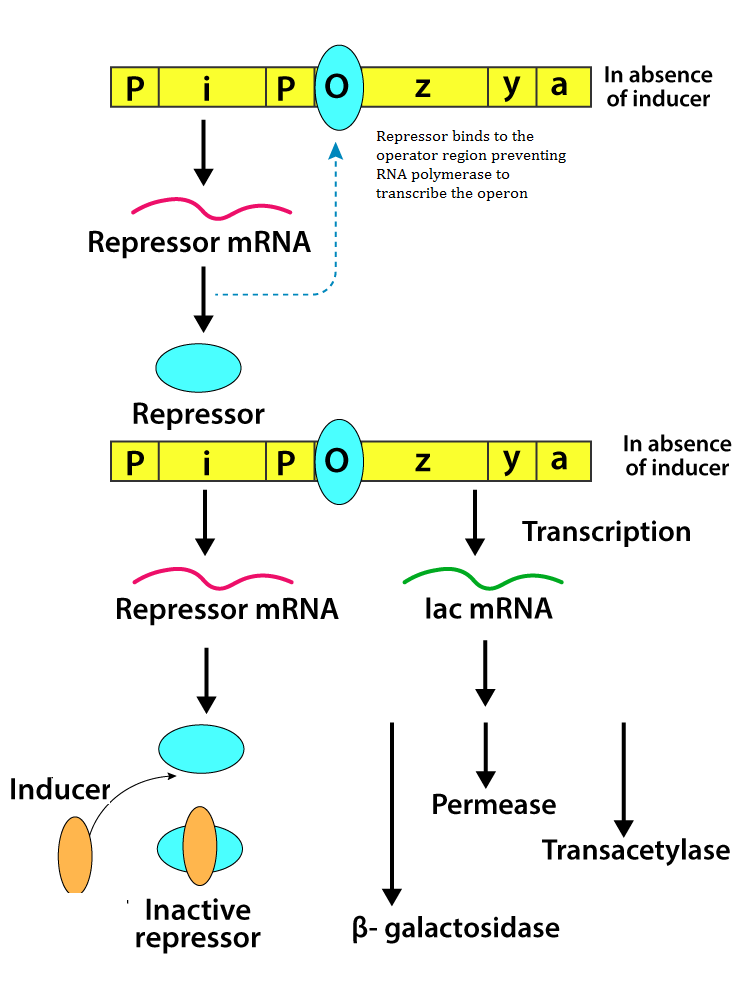
A segment of DNA which comprises three adjacent structural genes – a promoter gene, an operator gene, and a regulator gene is known as a lac operon. It is functional in a coordinated manner in order to metabolise lactose into galactose and glucose. Lactose serves as an inducer in the lac operon, which binds to the repressor, inactivating it. Once the lactose is bound to the repressor, RNA polymerase binds to the area of the promoter. Therefore, the structural genes express their product, and corresponding enzymes are yielded. Lactose is metabolised due to the action of enzymes into galactose and glucose. Later on, the level of inducer decreases as enzymes completely metabolise them, which results in the synthesis of the repressor from the regulator gene. Thus, the repressor is bound to the operator gene, restricting RNA polymerase from transcribing the operon; subsequently, transcription is ceased. This kind of regulation is termed negative regulation.

NCERT solutions class 12 biology Chapter 6 - 2