(a) Transcription
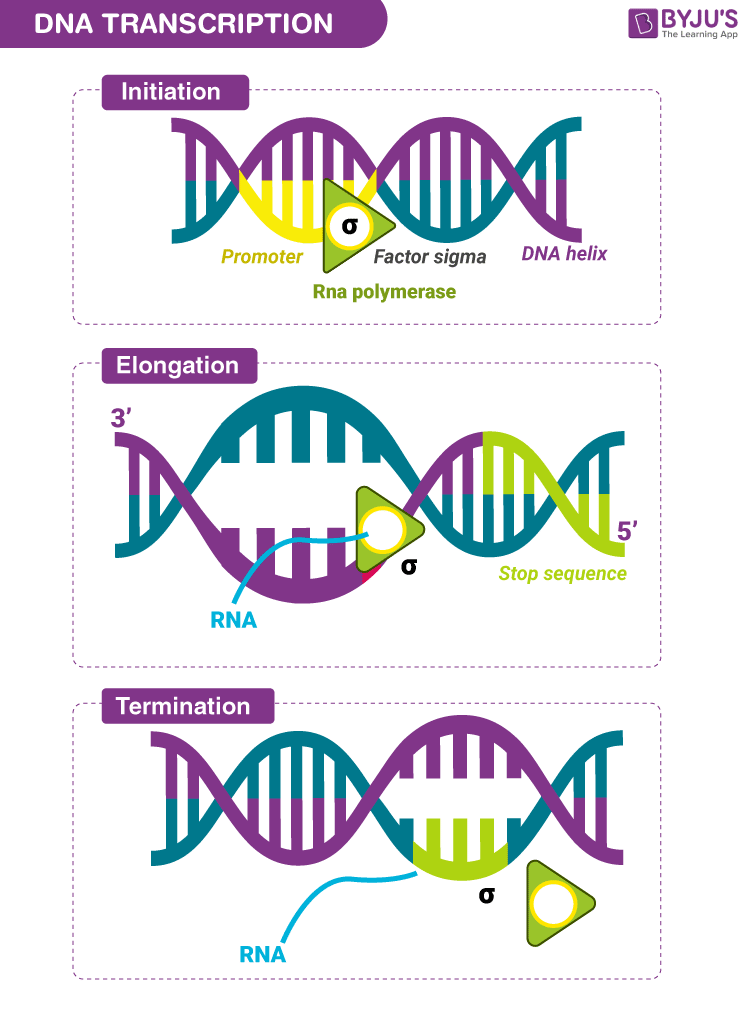
It is the process of synthesising RNA from a DNA template. A section of DNA gets duplicated into mRNA in the process. The transcription process originates from the promoter region of the template DNA and ends at the terminator region. The section of DNA between these two regions is termed a transcription unit. The transcription process necessitates a DNA template, RNA polymerase enzyme, four types of ribonucleotides and a few cofactors, namely Mg2+.
Three significant events occurring during the transcription process are:
- Initiation
- Elongation
- Termination
The process of transcription is initiated when the DNA-dependent RNA polymerase and several initiation factors bind at the promoter region of the template strand at the double-stranded DNA. The RNA polymerase passes along the DNA, causing the DNA duplex to unwind into two distinct strands. One of the strands is known as the sense strand, which serves as a template for mRNA synthesis. The RNA polymerase enzyme uses nucleoside triphosphates (dNTPs) as raw material to polymerize them to form mRNA as per the complementary bases positioned in the template DNA. This phenomenon of the opening of the helix and elongation of the polynucleotide chain lasts until the enzyme arrives at the terminator region. Once the RNA polymerase arrives at the terminator section, the freshly produced mRNA transcripted in addition to the enzyme is liberated. Additionally, another factor known as the terminator factor is essential for the transcription process to end.
(b) Polymorphism
It is a form of genetic variation wherein different nucleotide sequences can be present at different sites in a molecule of DNA. There is a high frequency of this heritable mutation to be observed in a population which emerges as a result of mutation either in the germ cells or somatic cells. The germ cell mutation can be passed from parents to offspring, which leads to the accumulation of different mutations in a population, causing variation and polymorphism in the population. This has a crucial role to play in the evolution and speciation process.
(c) Translation
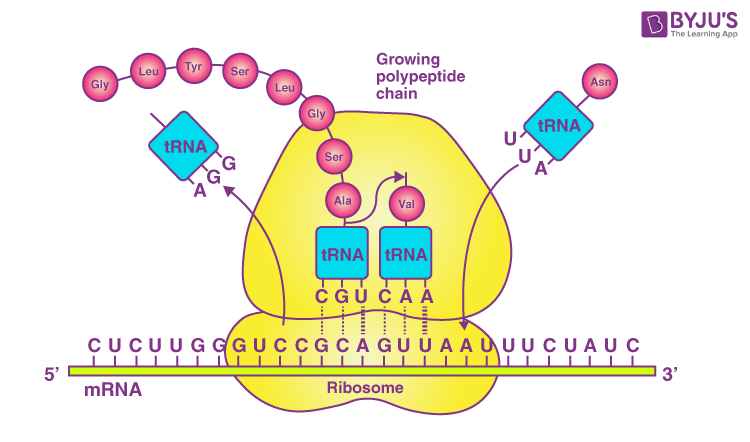
It is the process wherein amino acids are polymerized for the formation of a polypeptide chain, a ribosome, by reading an mRNA molecule. In mRNA, the triplet sequence of base pairs defines the order and sequence of amino acids in a polypeptide chain.
This phenomenon includes three steps:
- Initiation
- Elongation
- Termination
The tRNA gets charged during the initiation of the translation when the amino acids bind to it with the help of ATP. The initiation code – AUG that is located on the mRNA is identified only by the charged tRNA. For the process of translation, the ribosome acts as an actual site, containing two distinct sites in a large subunit to attach to the following amino acids. The smaller subunit of the ribosome is bound to the mRNA at AUG (initiation code), subsequently by the large subunit. The process of translation is then said to be initiated.
In the elongation process, the ribosome passes one codon downstream with the mRNA in order to leave some space to bind another charged tRNA. Amino acid brings tRNA, which gets linked with the former amino acid via a peptide bond. The process continues leading to the formation of a polypeptide chain. When the ribosome arrives, one or more STOP codons (UAA, UGA, and UAG). The phenomena of translation end, polypeptide chain releases and the ribosomes get detached from mRNA.
(d) Bioinformatics
It is the application of statistical and computational methodologies to the molecular biology stream. It explains practical issues that arise from the analysis and management of biological data. The stream of bioinformatics developed after accomplishing the human genome project as a huge amount of data was produced during the process, which has to be stored and managed for easy access and analysis for later use. Thus, bioinformatics includes creating biological databases which store huge amounts of data on biology. It comes up with a few tools for efficient and easy access to data which can be used. Also, bioinformatics brought in new algorithms and statistical techniques to figure out the dynamics between data, to predict the structure of protein and their functionalities and to group protein sequences into their associated families.